
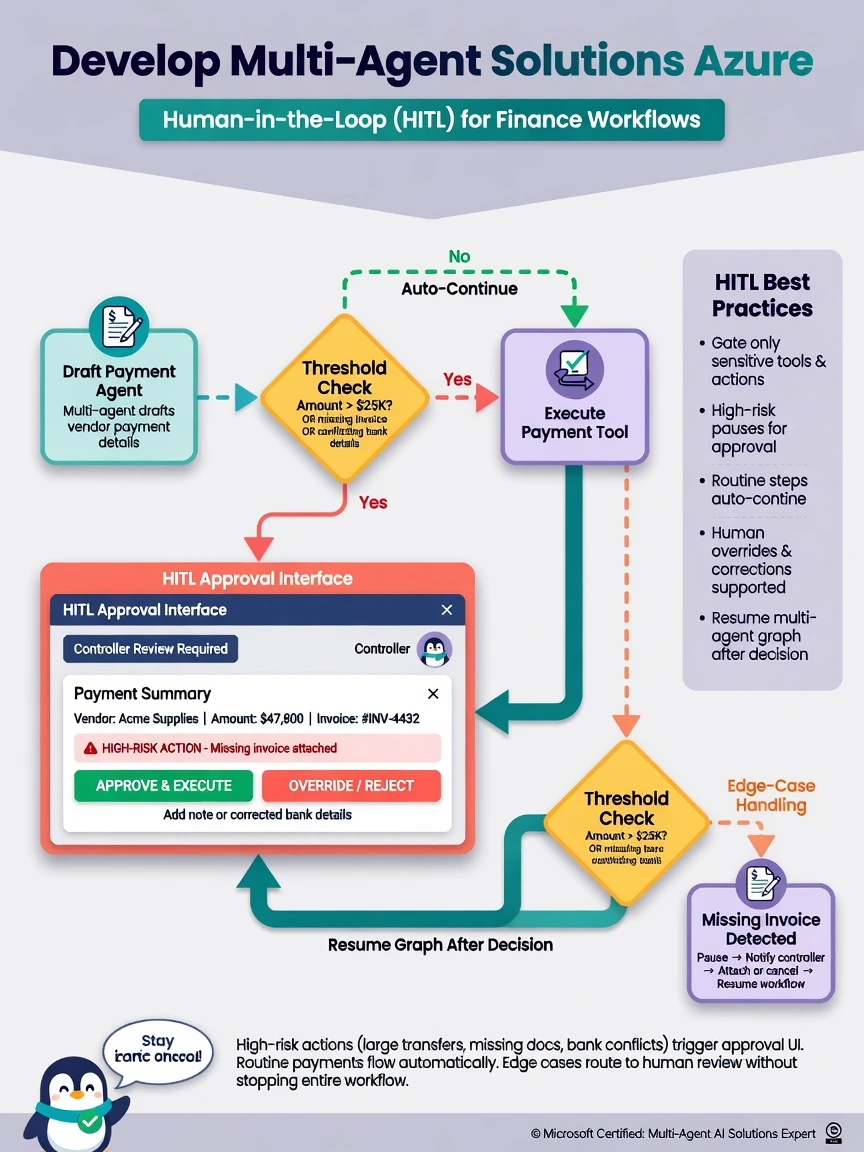
A multi-agent finance workflow can draft vendor payments but must not execute transfers above a threshold without controller approval. Edge cases include missing invoices and conflicting vendor bank details. How should you implement human-in-the-loop?
Select an answer to reveal the explanation.
Short Explanation
Correct answer: A. HITL implementation covers approval workflows, overrides, and edge cases—not all-or-nothing automation. Auto-approve (B) ignores risk. Over-manualizing (C) destroys value. Silent drops (D) fail operations. Gate only sensitive tools/actions and resume the graph after decisions.
Full Explanation
Developing multi-agent solutions includes human-in-the-loop processes: approvals, overrides, and edge-case handling. Encode thresholds in orchestration so the payment execution tool is unreachable without an approved token/state. Present controllers a concise packet (amount, vendor, evidence) rather than raw chain-of-thought. Support reject/edit paths that feed back into agents. Option B violates control requirements. Option C overuses humans. Option D creates silent financial risk. Persist HITL state durably so long approval delays do not lose workflow context.