
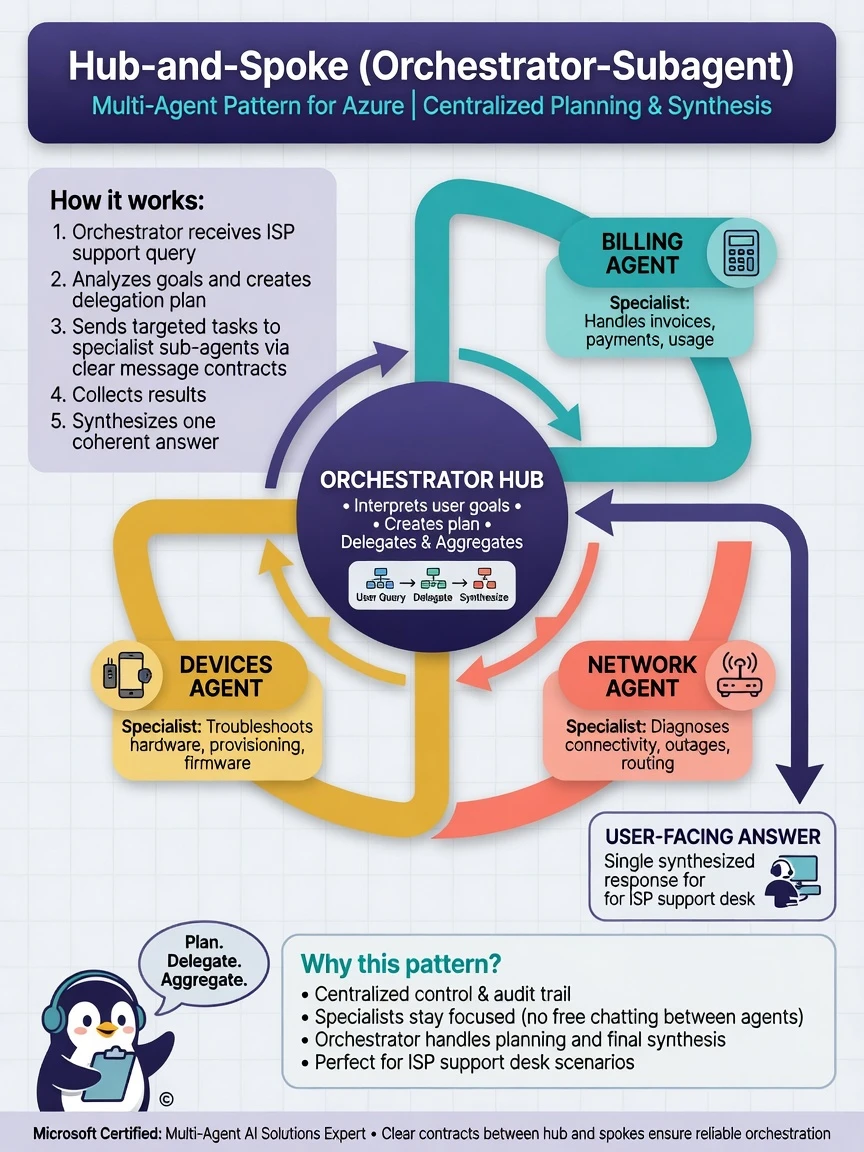
You need a multi-agent pattern where a central orchestrator interprets user goals, delegates to specialist agents (billing, network, devices), and synthesizes a single response for an ISP support desk. Specialists should not freely chat with each other. Which orchestration pattern should you implement?
Select an answer to reveal the explanation.
Short Explanation
Correct answer: D. Hub-and-spoke / orchestrator-subagent is the pattern for centralized planning and synthesis with specialist workers. Free mesh (A) complicates control and audit. Single-agent (B) underuses specialization. Random spawning (C) is not a pattern. Implement clear message contracts between hub and spokes.
Full Explanation
Multi-agent orchestration patterns in AI-500 include hub-and-spoke, sequential, parallel, peer-to-peer, and orchestrator-subagent. ISP support with distinct skill domains fits hub-and-spoke: the hub owns dialogue state and policy, spokes run bounded tasks, and the hub merges outputs. This simplifies guardrails and logging compared with fully connected peers. Peer-to-peer is valid for other collaborations but not when the requirement forbids free specialist chatter. Sequential/parallel hybrids can still sit under the hub for multi-step tickets. Use Agent Framework or LangGraph to encode the graph, timeouts, and aggregation logic explicitly.