
An underwriting multi-agent workflow must run credit, property, and compliance checks that do not depend on each other’s outputs, then merge results. Latency SLOs are tight. Which orchestration approach is most appropriate?
Select an answer to reveal the explanation.
Short Explanation
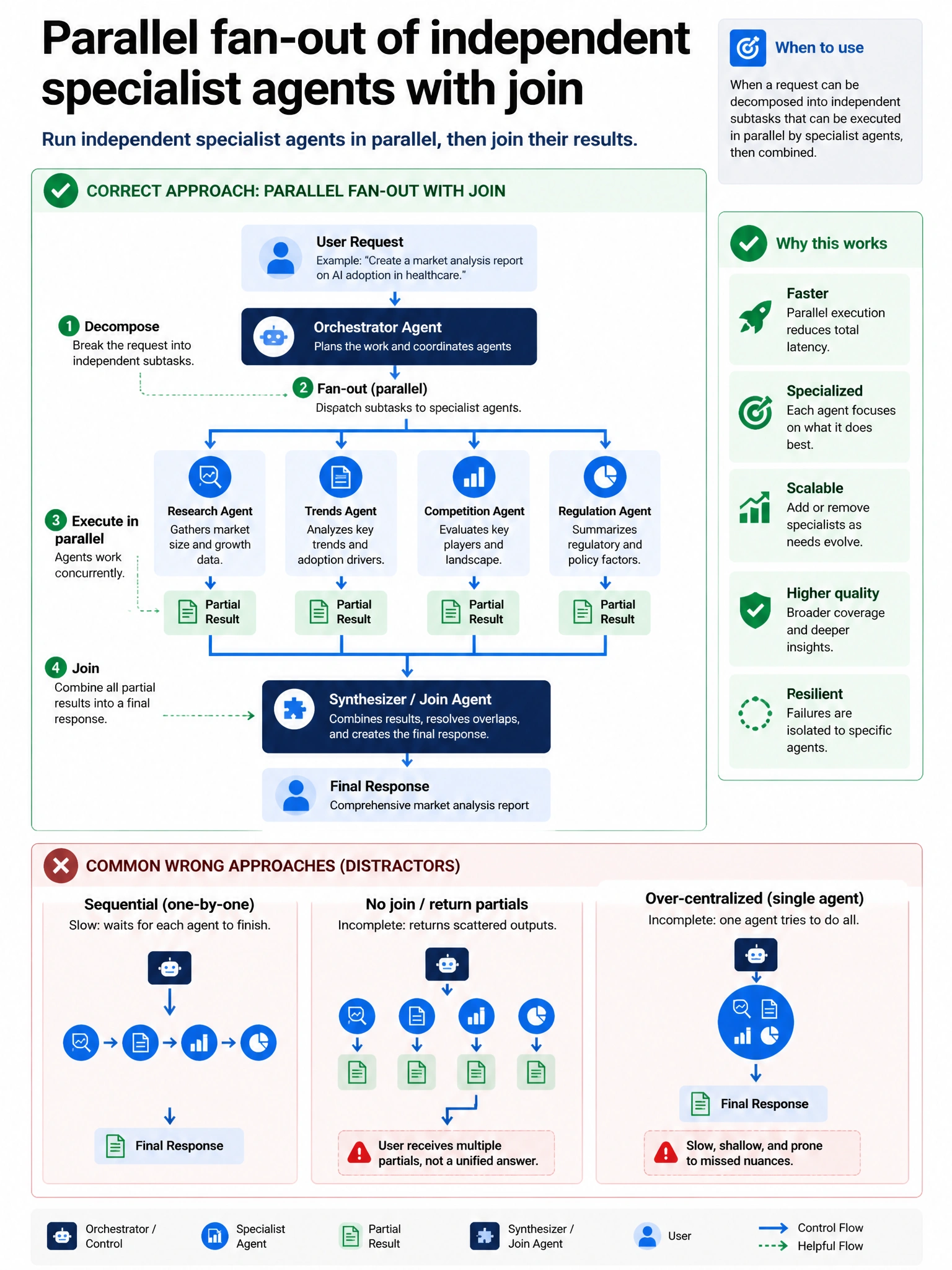
A is correct. Independent specialists with a merge step scream parallel / concurrent fan-out—then join. That cuts wall-clock time versus pure sequential when there is no data dependency. B sequential wastes the SLO. C random single specialist is incomplete underwriting. D manual triple chat is not orchestration. Scaling and control of concurrent execution is an explicit develop skill; pair it with join semantics and failure isolation.
Full Explanation
Correct Answer — A
Parallel multi-agent orchestration runs independent specialists concurrently and joins outputs before downstream decisioning, improving task duration when dependencies allow.
Why B is wrong: Unnecessary sequencing increases latency without correctness benefit.
Why C is wrong: Omitting required checks fails underwriting completeness.
Why D is wrong: Manual multi-chat is not a controlled multi-agent solution.
Exam tip: No inter-check dependencies → fan-out/fan-in parallelism.