
You need a multi-agent claims system where a coordinator assigns work to fraud, coverage, and settlement specialists, aggregates results, and returns one decision package. Specialists should not freely call each other. Which orchestration pattern should you implement?
Select an answer to reveal the explanation.
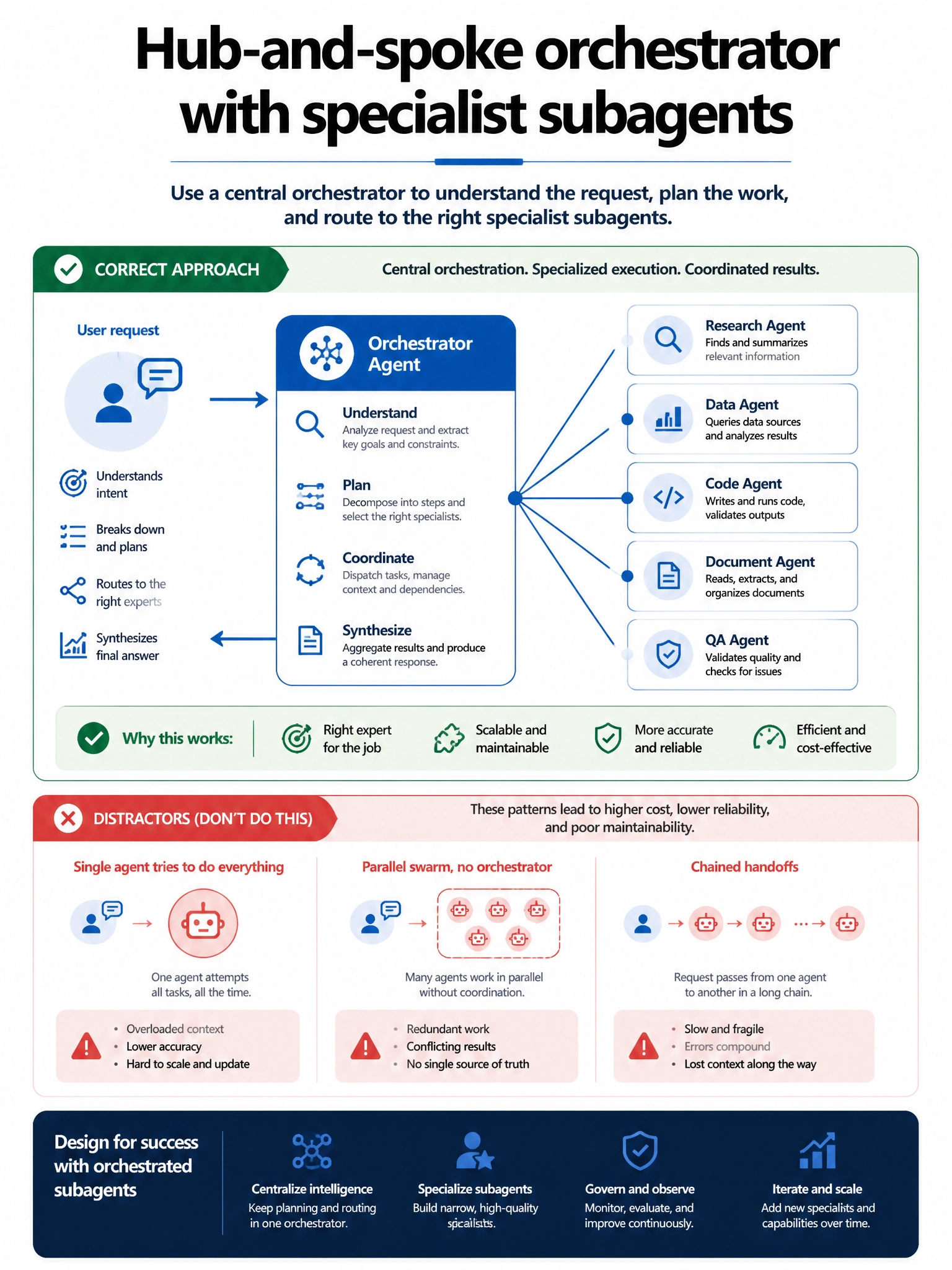
Short Explanation
D is the classic fit. Hub-and-spoke / orchestrator-subagent gives you a coordinator that routes, scopes, and aggregates while specialists stay in their lanes—exactly the claims package story. A full mesh invites uncontrolled chatter and harder audit. B sequential-only leaves independent work serial for no reason. C spawning without aggregation loses the decision package. AI-500 expects you to name patterns: hub-and-spoke, sequential, parallel, peer-to-peer, orchestrator-subagent.
Full Explanation
Correct Answer — D
Multi-agent orchestration patterns include hub-and-spoke, sequential, parallel, peer-to-peer, and orchestrator-subagent. Claims-style coordination with scoped specialists and a single aggregated package maps cleanly to hub-and-spoke / orchestrator-subagent.
Why A is wrong: Unconstrained peer mesh complicates control, audit, and scope.
Why B is wrong: Forced sequencing underuses parallelism when checks are independent.
Why C is wrong: Spawning without aggregation fails the “one decision package” requirement.
Exam tip: Match pattern to control needs: hub when aggregation and routing dominate.