
A pricing agent occasionally forwards malformed tool payloads (missing currency, negative quantities) into the quote composer agent, causing bad customer quotes. What control should you add in the tool ecosystem?
Select an answer to reveal the explanation.
Short Explanation
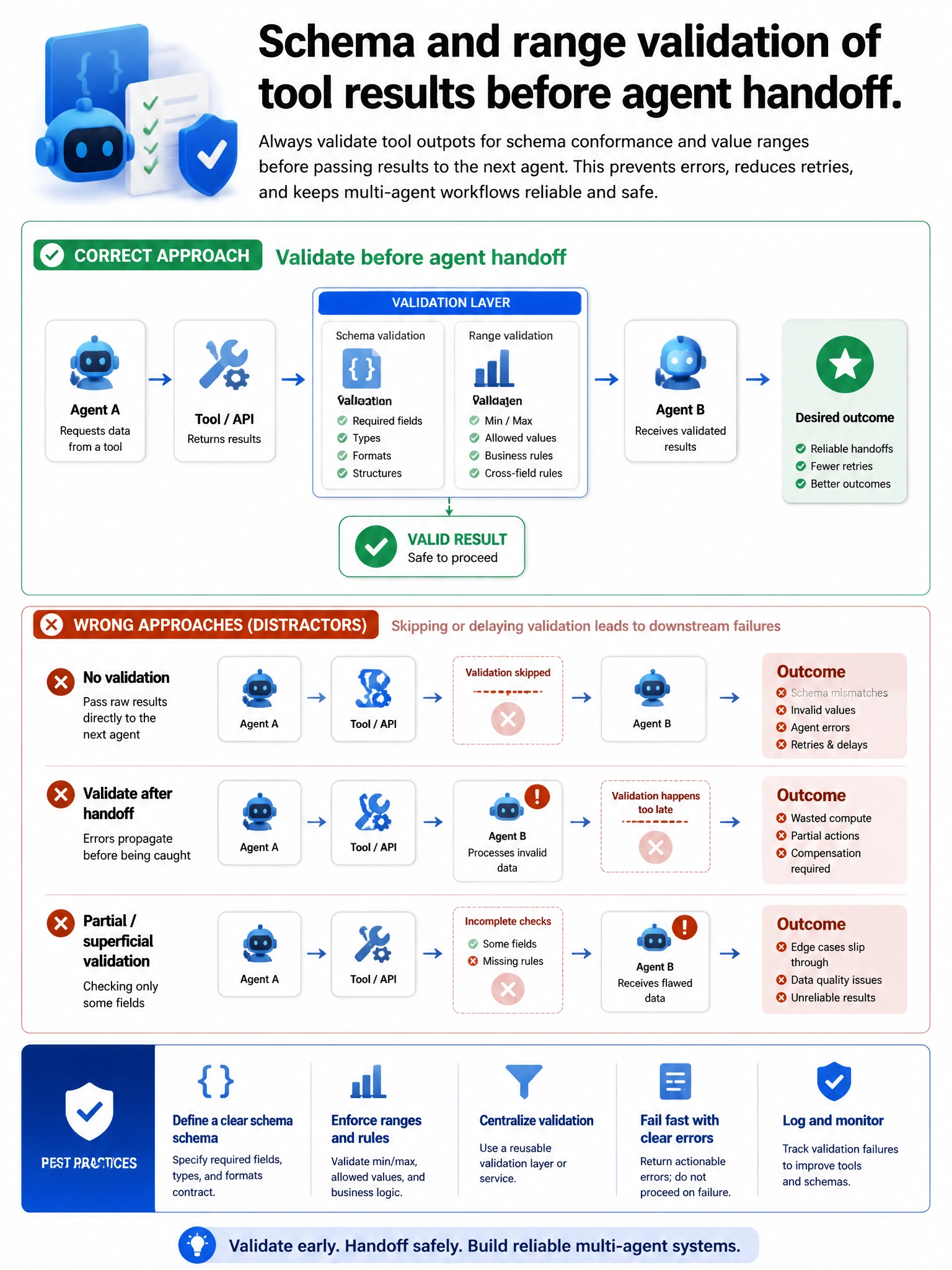
C is correct. Tool result validation and quality checks sit right next to error handling in the blueprint. Schema and range checks catch missing currency and negative quantities before they poison shared state or the quote composer. A max tokens does not fix schema. B MCP does not magically guarantee business-valid payloads. D dumping raw tools to customers is not a control. Validation is a first-class multi-agent development skill, not an afterthought.
Full Explanation
Correct Answer — C
Implementing tool result validation and quality checks prevents malformed or nonsensical tool outputs from propagating across agents. Schema validation, business range checks, and reject/repair paths protect shared state and downstream composers.
Why A is wrong: Token limits do not enforce payload structure or business rules.
Why B is wrong: Protocols deliver structure/transport; they do not guarantee domain correctness.
Why D is wrong: Customer-facing raw dumps are unsafe and unprofessional.
Exam tip: Validate tool outputs at the boundary before multi-agent state commits.