
During a parallel multi-agent research run, one MCP tool returns intermittent 429 and timeout errors. Without handling, the whole workflow fails. What should you implement?
Select an answer to reveal the explanation.
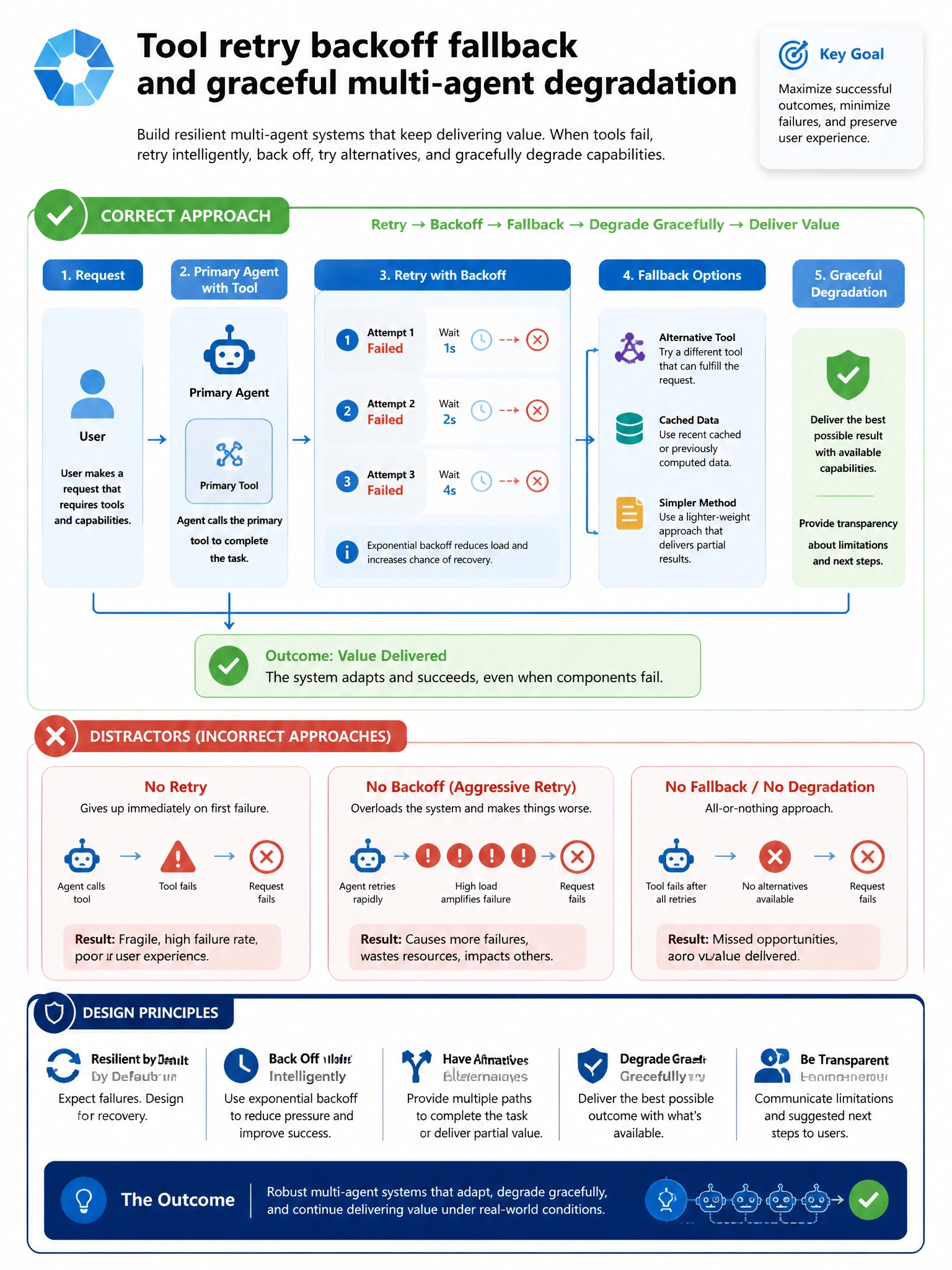
Short Explanation
B is the professional pattern. Tool error-handling and fallback mechanisms are explicit AI-500 skills: backoff retries for 429/timeouts, alternate tools or cache when safe, and degrade without nuking independent parallel branches. A fails the whole graph on first blip—bad for parallel research. C infinite retries create outages and bans. D lying with empty success corrupts agent reasoning. Teach the model and the runtime both: transient vs permanent, then fallback paths.
Full Explanation
Correct Answer — B
Tool error-handling and fallback mechanisms include retries with backoff, alternate tools, cached results, and graceful degradation so multi-agent workflows tolerate transient MCP or API faults without total failure.
Why A is wrong: Immediate full-graph failure is brittle for intermittent errors.
Why C is wrong: Tight infinite retries worsen throttling and availability.
Why D is wrong: Silent empty successes mislead agents and hide outages.
Exam tip: Pair tool resilience with parallel-orchestration isolation.