
A support multi-agent solution uses a triage agent, a billing specialist, and a technical specialist. After a user corrects an earlier account number, the technical specialist continues troubleshooting the wrong account because it only saw the first message. What should you implement so agents behave correctly with evolving conversation context?
Select an answer to reveal the explanation.
Short Explanation
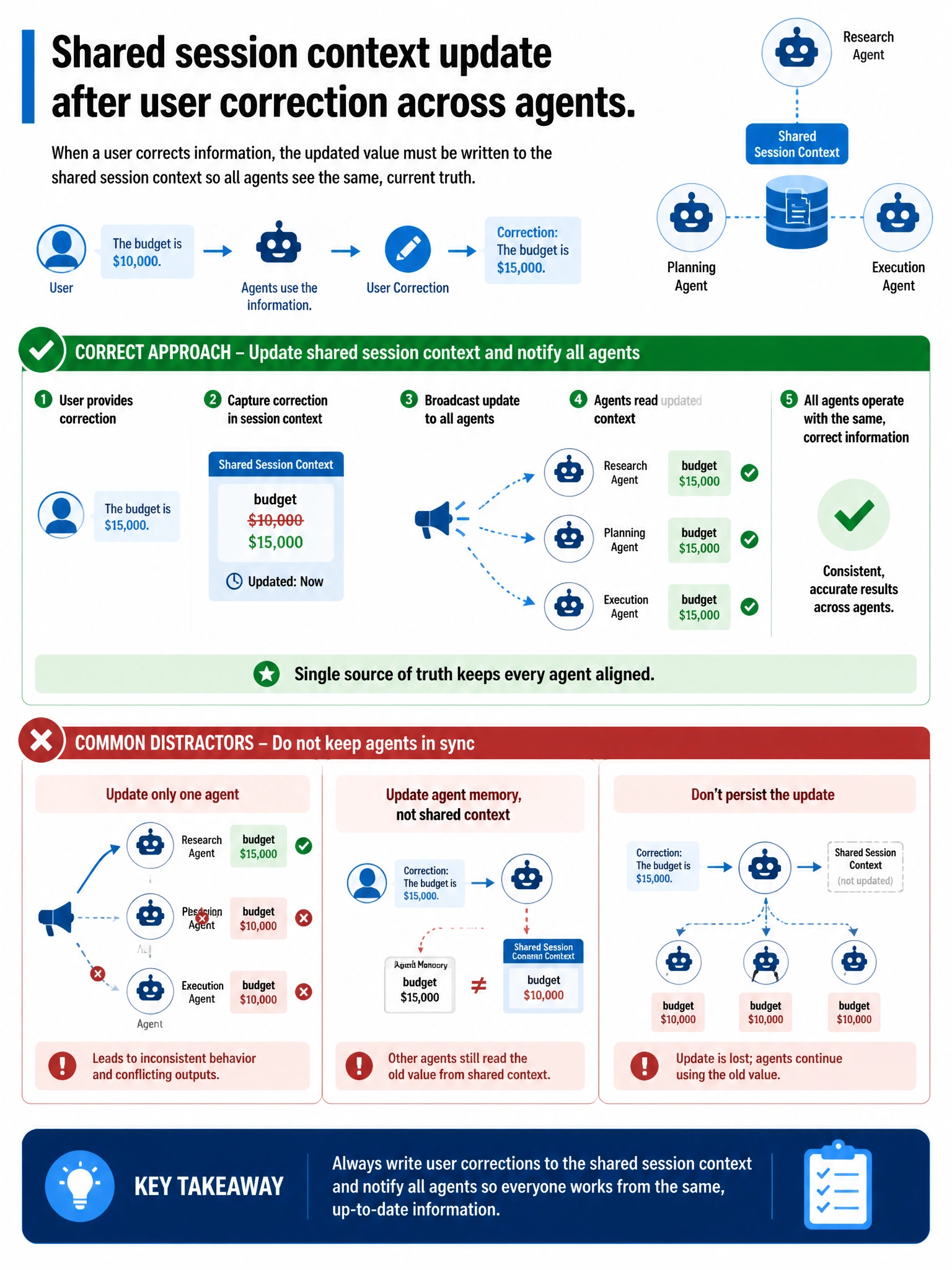
Answer B is the one you want. Multi-agent systems fail hard when specialists keep acting on stale facts. If a user corrects the account number, that correction must update shared session context and be injected into the next specialist before any tool call. That is context-aware multi-agent behavior: accumulation of the right facts, retrieval of what matters now, and injection at decision points. A locks you to the first message forever—classic wrong-account bug. C raises temperature and encourages more hallucination. D thrashing history makes the experience awful and still does not guarantee correct identity propagation. On AI-500, when you see “agent used the old value after a correction,” think update shared context and inject current identity into downstream agents.
Full Explanation
Correct Answer — B
Context-aware multi-agent behaviors require disciplined context management across agents: accumulate relevant turns, update on corrections, retrieve current entities, and inject them before tool use. Shared session state carrying the authoritative account identity prevents specialists from acting on superseded values.
Why A is wrong: Freezing the first message in long-term memory maximizes stale-entity risk.
Why C is wrong: Higher temperature increases variability and fabrication; it does not fix identity propagation.
Why D is wrong: Wiping history every hop harms UX and does not implement structured context sharing.
Exam tip: Corrections must invalidate prior entity bindings in shared multi-agent context.