
You are implementing specialist agents in Microsoft Foundry for a claims-processing multi-agent system. The extraction agent sometimes invents policy numbers when source text is incomplete. You need advanced prompt engineering that improves consistency without fine-tuning. Which approach best fits production multi-agent practice?
Select an answer to reveal the explanation.
Short Explanation
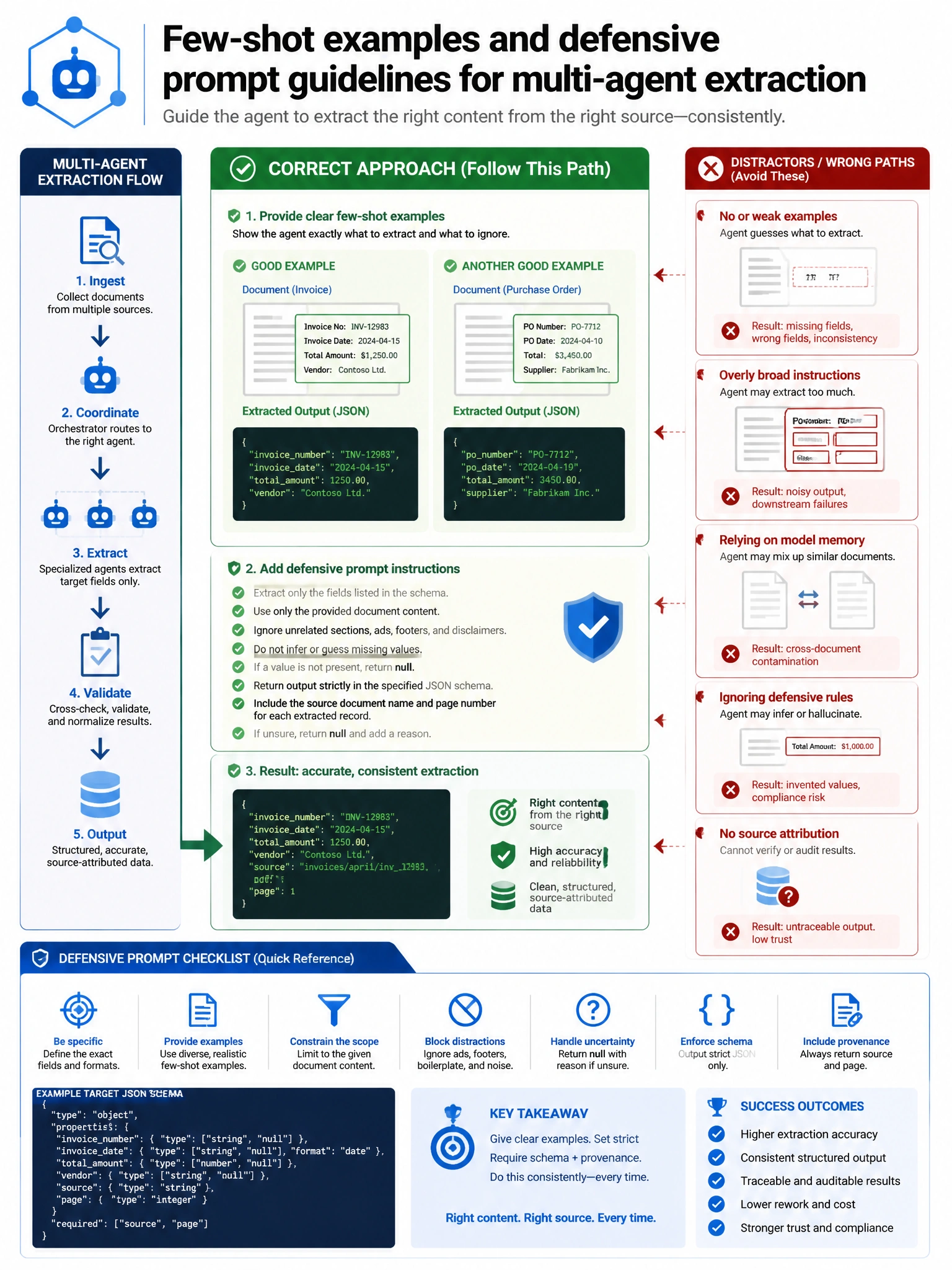
Correct answer is A. When an extraction agent starts inventing policy numbers, you do not start with full fine-tunes or empty prompts. In multi-agent Foundry work, advanced prompt engineering means few-shot examples that show the hard cases—incomplete OCR, missing fields—and explicitly demonstrate refuse-or-flag behavior. Pair that with dynamic context injection so each run sees the actual claim fragment, plus defensive guidelines that ban fabricating identifiers. That combo teaches pattern and constraint without retraining. B fails because longer generic prompts and turning off tools usually worsen grounding. C is overkill as a first move and removes the examples that stabilize behavior. D pushes validation to the browser and abandons agent responsibility. Exam takeaway: examples plus defenses plus context beat “just make the prompt longer.”
Full Explanation
Correct Answer — A
Advanced prompt engineering for multi-agent solutions includes few-shot examples, dynamic context injection, defensive guidelines, and prompt lifecycle management. For an extraction agent that fabricates policy numbers on incomplete input, curated few-shot pairs that show incomplete sources and correct refuse/flag outcomes, plus runtime claim context and explicit anti-fabrication rules, improve reliability without an immediate fine-tune.
Why B is wrong: Lengthening a generic prompt and disabling tools reduces grounding and does not teach incomplete-input behavior.
Why C is wrong: Per–claim-type fine-tuning before prompt work is costly and premature; removing examples removes a primary control.
Why D is wrong: Client-side validation cannot replace agent-side extraction discipline or multi-agent orchestration requirements.
Exam tip: Map “invented identifiers” symptoms to few-shot + defensive guidelines + dynamic context first.