
Your legal review multi-agent workflow shows consistent citation formatting errors that few-shot prompting only partially fixes. Leadership asks for a fine-tuning plan for the citation agent’s model. What strategy best matches multi-agent fine-tuning guidance?
Select an answer to reveal the explanation.
Short Explanation
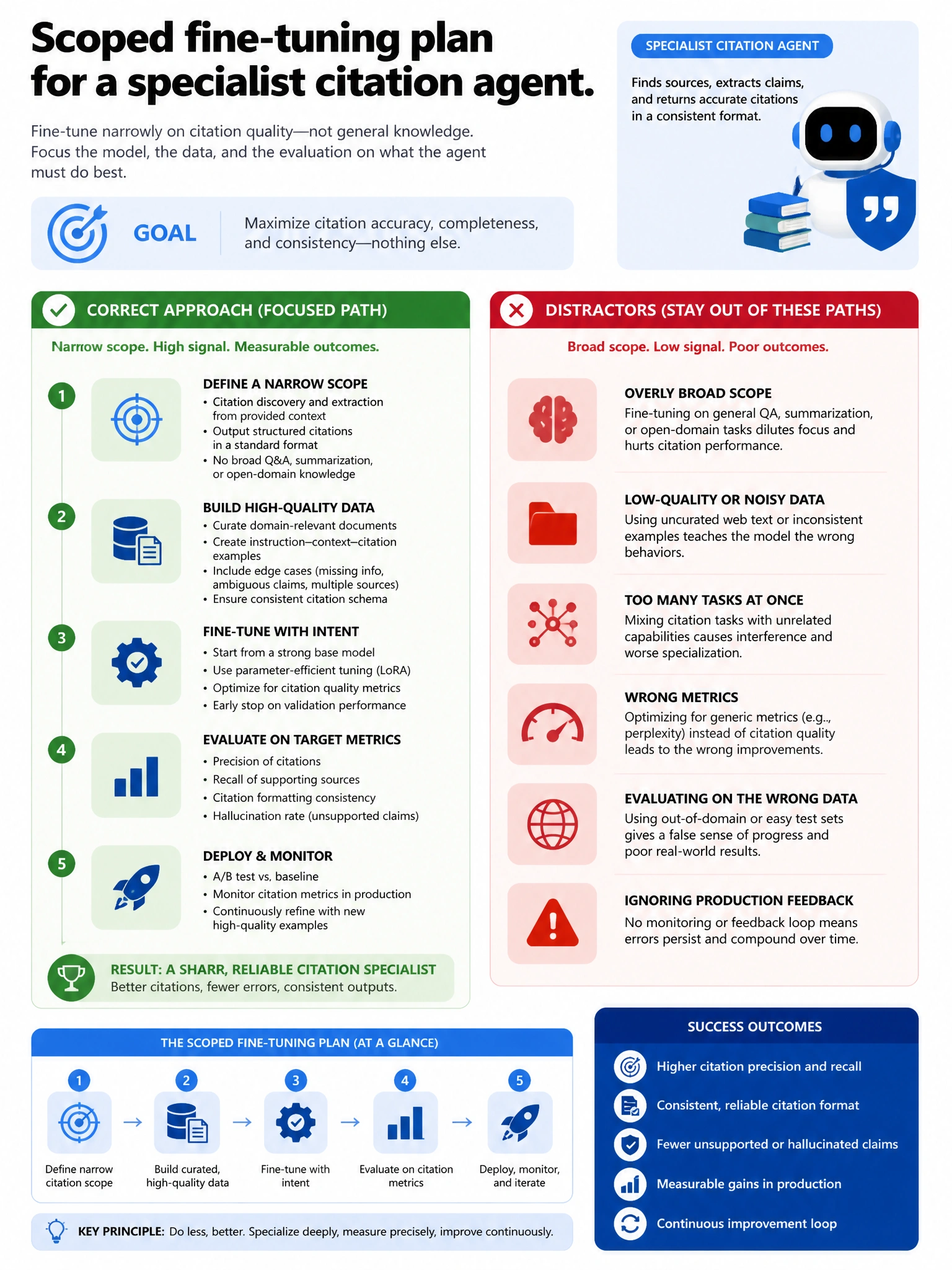
C is correct. Fine-tuning in multi-agent systems is scoped and deliberate: right data, right agent, right refresh cadence. Citation style issues that survive few-shot work are a good candidate for a focused fine-tune of the citation agent’s model, not a nightly free-for-all on raw production chats. You curate train and eval sets that match the style guide, measure error drift, and retune when the guide or drift warrants it. A dumps PII-laden production traffic into weights and overfits everything. B with random strings teaches nothing useful. D assumes formatting “inherits” from the orchestrator—specialists need their own capability. Remember: fine-tune strategy equals data quality plus frequency plus agent scope.
Full Explanation
Correct Answer — C
Fine-tuning strategies for agents and models include data selection, evaluation sets, and frequency planning. Scope fine-tunes to the agent whose task fails (citation formatting), use curated domain data, and refresh based on style-guide changes and measured drift—not continuous uncurated production dumps.
Why A is wrong: Uncurated production chat dumps risk PII leakage, noise, and uncontrolled behavior changes across agents.
Why B is wrong: Random synthetic strings do not teach citation conventions.
Why D is wrong: Orchestrator fine-tuning does not automatically fix specialist formatting behavior.
Exam tip: Prefer prompt/RAG fixes first; when fine-tuning, scope model + data + cadence per agent role.