
Operators notice a long-running multi-agent investigation “forgets” earlier entities: names morph, amounts change, and later agents contradict earlier tool results after repeated summarization. Which diagnosis and response is most appropriate?
Select an answer to reveal the explanation.
Short Explanation
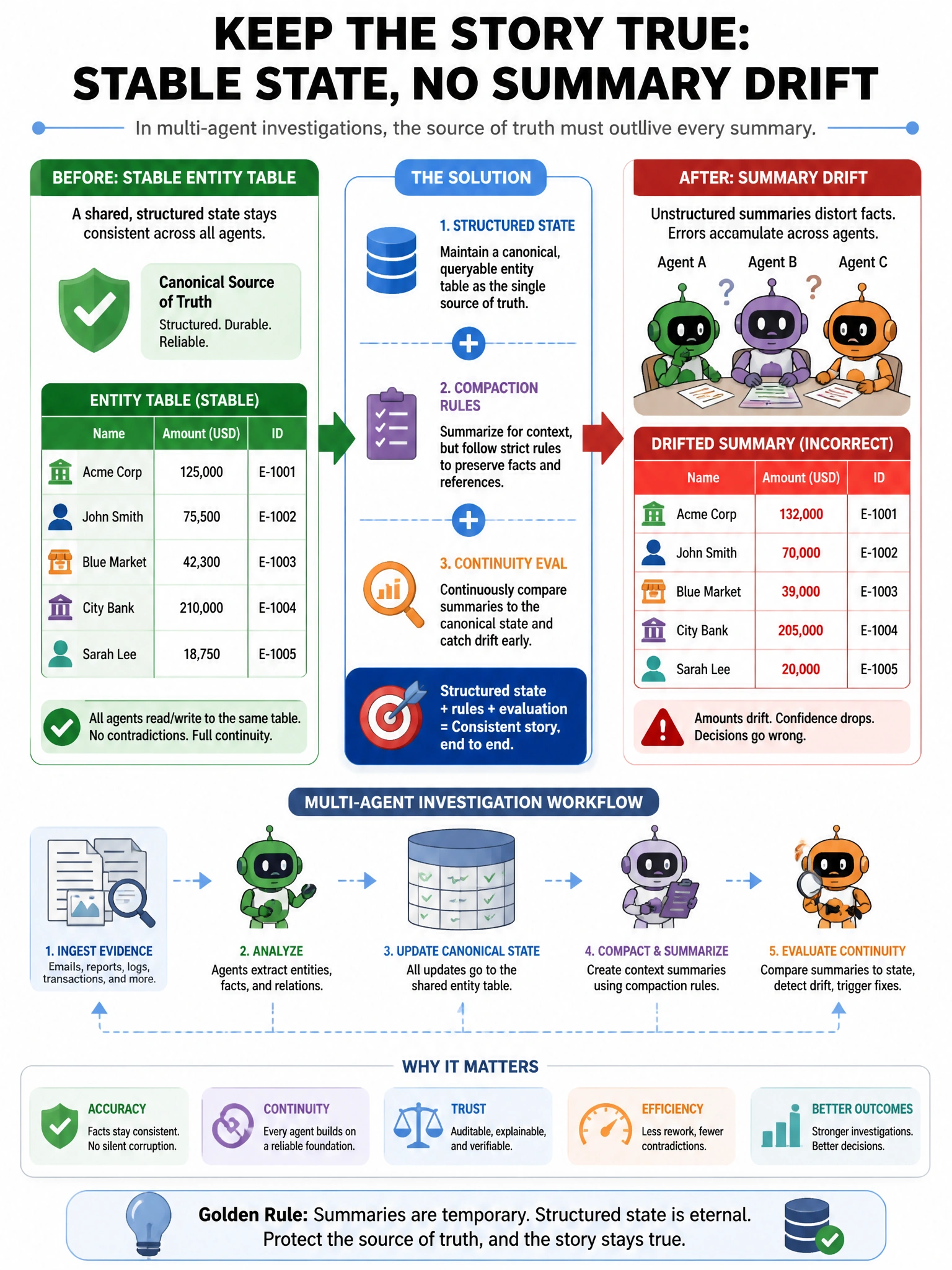
A correctly diagnoses summary drift and entity continuity issues—classic context-window failure modes called out for multi-agent optimization. Fix by better compaction, structured entity memory, and evals that catch inconsistencies. B makes hallucinations worse. C removes the structured truth that prevents drift. D misattributes the bug. When investigations span many agent turns, treat entities as first-class state, not only narrative summaries.
Full Explanation
A is correct because optimizers must diagnose context window issues including sliding-window amnesia, summary drift, vector-only recall limits, and entity continuity problems. Structured entity stores plus drift-aware evaluations mitigate lossy summarization. B is incorrect: higher temperature increases variability, not factual continuity. C is incorrect: prose-only memory worsens drift. D is incorrect: regional latency does not explain mutating entities across summaries. Monitor diffs of key entities between workflow stages and fail builds when continuity checks regress.