
After deploying a multi-agent customer-email system in Microsoft Foundry, quality fluctuates weekly. You need continuous improvement beyond occasional manual spot checks. Which evaluation approach best fits?
Select an answer to reveal the explanation.
Short Explanation
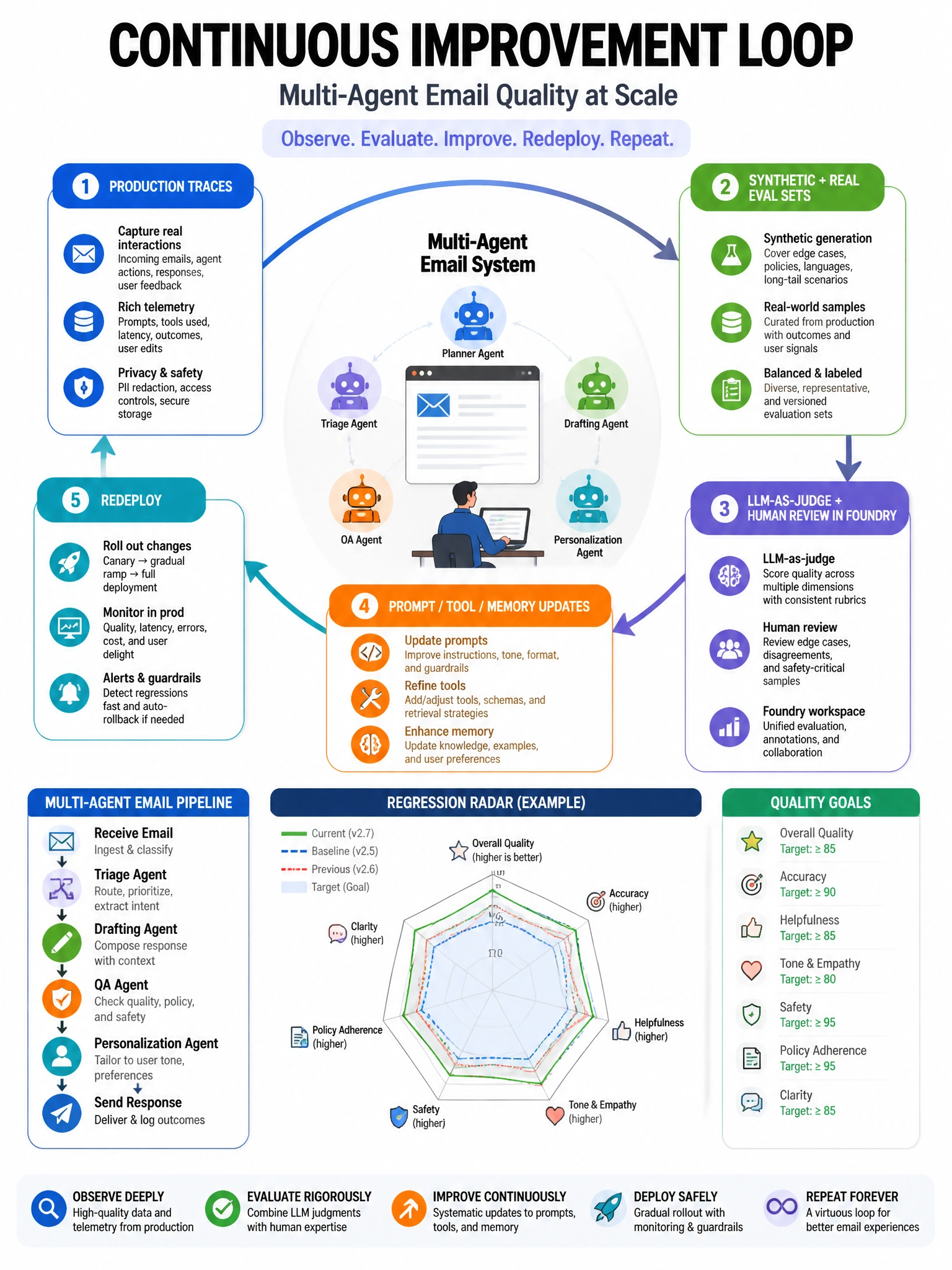
D is the continuous improvement stack: LLM-as-a-judge for scalable scoring, human review where it matters in Foundry, synthetic data for coverage, and user feedback loops. That matches evaluate/optimize skills for multi-agent solutions—including evaluations for memory, knowledge, tools, and prompts. A, B, and C are how quality dies quietly. Automate evals in CI/CD for agent changes, and keep humans on high-risk samples.
Full Explanation
D is correct because optimizing multi-agent solutions includes continuous improvement with LLM-as-a-judge frameworks, synthetic data generation, semantic optimization loops, and user feedback, plus human review processes in Foundry and evaluations for memory, knowledge, tools, and prompts. A is incorrect: production without measurement delays detection of drift. B is incorrect: random acceptance is not evaluation. C is incorrect: complaint-driven-only quality is lagging and incomplete. Track groundedness, task success, tool error rates, and workflow completion alongside judge scores.