
Finance flags rising spend on a multi-agent Azure solution. Engineering must monitor reliability and cost: token burn, loop storms, tool-call fan-out, and workflow failures—with actionable alerts. Which strategy best addresses this?
Select an answer to reveal the explanation.
Short Explanation
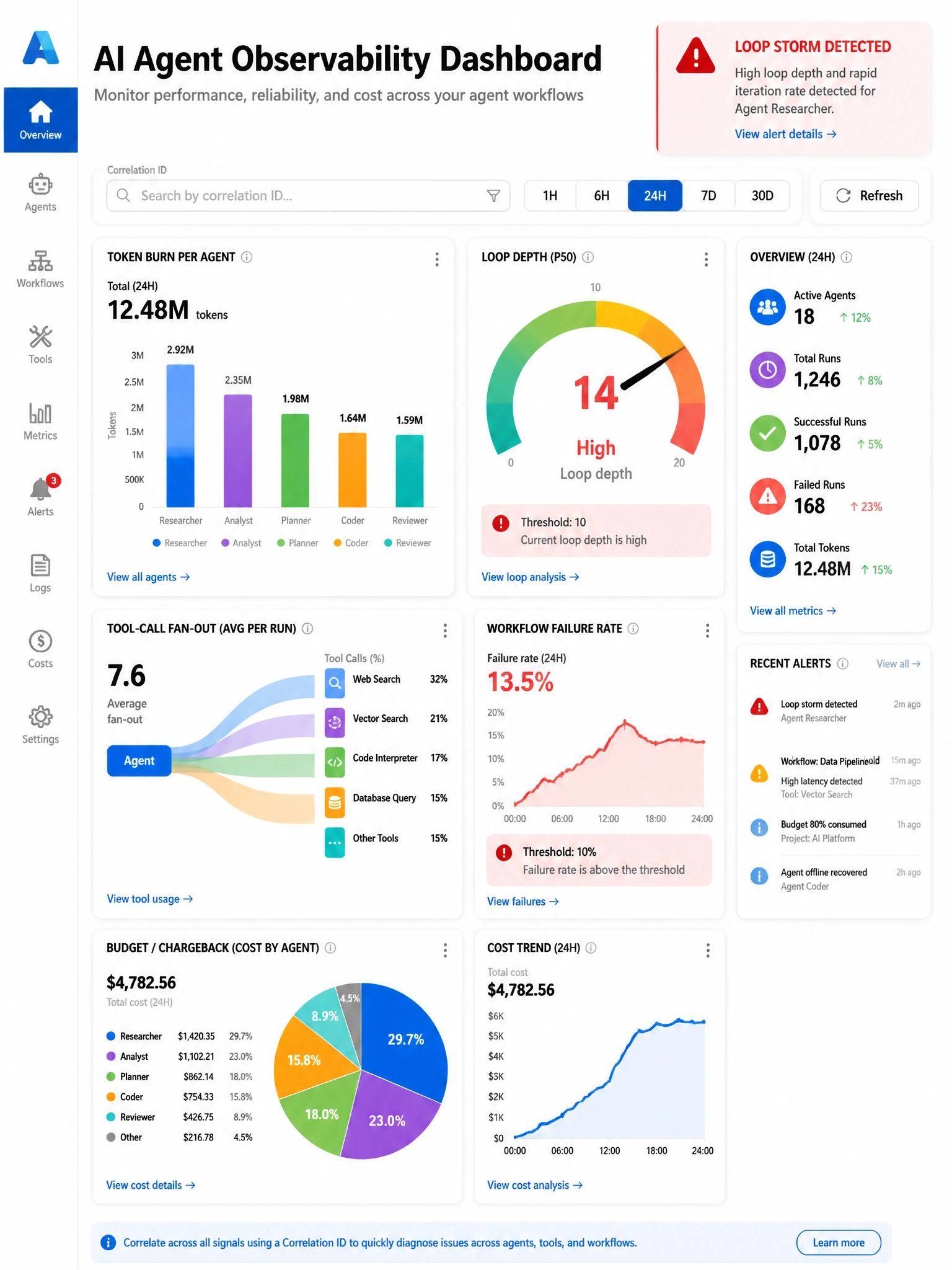
B is the monitoring package for multi-agent production: tracing in Foundry (tokens, prompts, correlation IDs, execution), reliability signals (health, workflow failures, drift), and cost controls (quotas, allocations, chargebacks) plus loop/tool limits to stop token storms. A blinds you until the bill lands. C invites runaway cost. D misses the unit of spend—tokens and tool calls. Instrument first, then set budgets and alerts per agent and workflow.
Full Explanation
B is correct because evaluate/monitor skills require strategies for reliability monitoring, availability/performance/SLA adherence, token usage optimization (limits, loop controls, tool calls), cost management (usage, quotas, allocations, chargebacks), and tracing in Foundry including tokens, prompts, correlation IDs, alerting, and execution tracking. A is incorrect: bill-only visibility is too coarse and late. C is incorrect: uncontrolled loops drive cost and failure. D is incorrect: infrastructure uptime alone does not explain LLM spend or agent quality. Create alerts on token spikes, repeated tool failures, and workflow error budgets.