
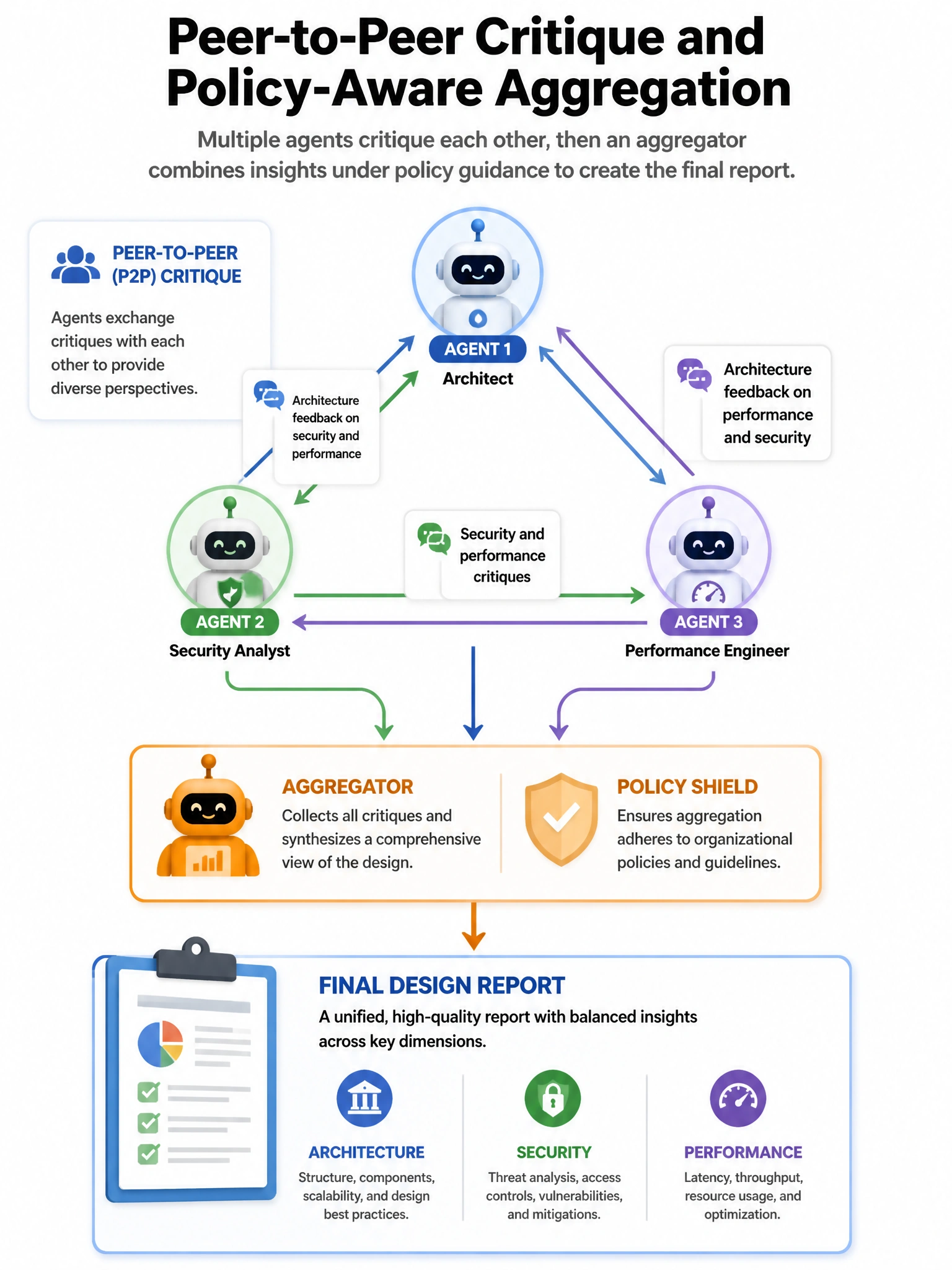
In a multi-agent design review system, architecture, security, and performance agents must critique each other’s findings without a permanent central boss for every message. The workflow still needs eventual aggregation for a final report. Which orchestration choice fits this collaboration style while remaining implementable?
Select an answer to reveal the explanation.
Short Explanation
C blends peer-to-peer critique with a controlled aggregation step—valid when specialists should challenge each other, then converge. Pure rigid sequence (A) blocks peer review dynamics. Public social buses (B) are insecure. Memory deletion (D) prevents collaboration. AI-500 lists peer-to-peer among orchestration patterns; use it intentionally with guardrails and a finish aggregation path.
Full Explanation
C is correct because multi-agent orchestration patterns include peer-to-peer as well as hub-and-spoke and sequential designs. Peer rounds enable cross-critique; a final aggregation step ensures a coherent deliverable and policy enforcement. A is incorrect: pure sequence may underuse peer review. B is incorrect: public networks are not enterprise control planes. D is incorrect: destroying memory prevents multi-agent reasoning. Define message schemas, auth, and termination conditions for peer rounds.