
Adventure Works is integrating a research agent that must call internal knowledge tools and also collaborate with a partner-built planning agent hosted outside Adventure Works’ subscription. Architects must choose communication approaches. Which protocol selection is most appropriate?
Select an answer to reveal the explanation.
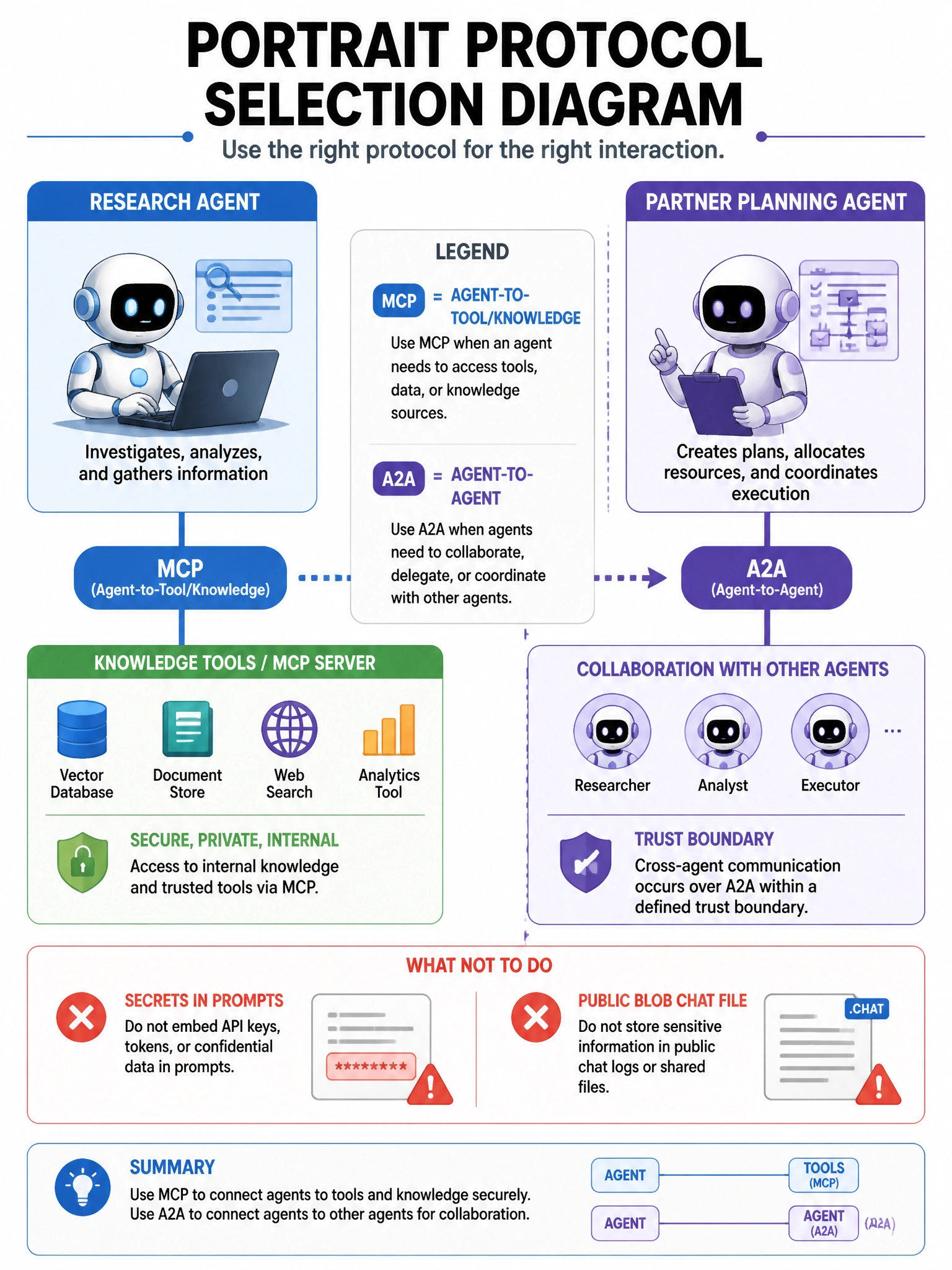
Short Explanation
A is correct. In modern Microsoft multi-agent designs, MCP is the go-to standard for connecting agents to tools and knowledge sources in a structured way. When you need to integrate another agent—especially an external or separately owned agent—A2A-style agent-to-agent integration is the right lane. That combo matches the exam’s emphasis on specifying protocols for agent-to-agent and agent-to-component communication. B is a non-starter for security. C is not a control plane. D is insecure and non-transactional. Pick protocols by interaction type: tools/knowledge → MCP (or equivalent tool interfaces); peer agents → A2A/orchestration messaging—not shared secrets in prompts.
Full Explanation
A is correct because architects must specify appropriate protocols for communication between multiple agents and between agents and other components. MCP standardizes tool and knowledge integration (including MCP servers/clients often built with Azure Functions, Logic Apps, or API Management). A2A supports secure integration of existing or external agents into a multi-agent solution. B is incorrect: embedding database credentials in prompts violates secrets management and least privilege. C is incorrect: email is not a reliable, securable agent protocol for production orchestration. D is incorrect: public shared files provide neither authentication boundaries nor structured tool contracts. Map each edge in the architecture to an explicit protocol and auth method.