
An enterprise customer-support multi-agent solution must remember the current ticket thread, share selected facts across specialist agents during a session, and retain resolved-case embeddings for future similar incidents without mixing tenants. Which memory architecture best addresses these needs?
Select an answer to reveal the explanation.
Short Explanation
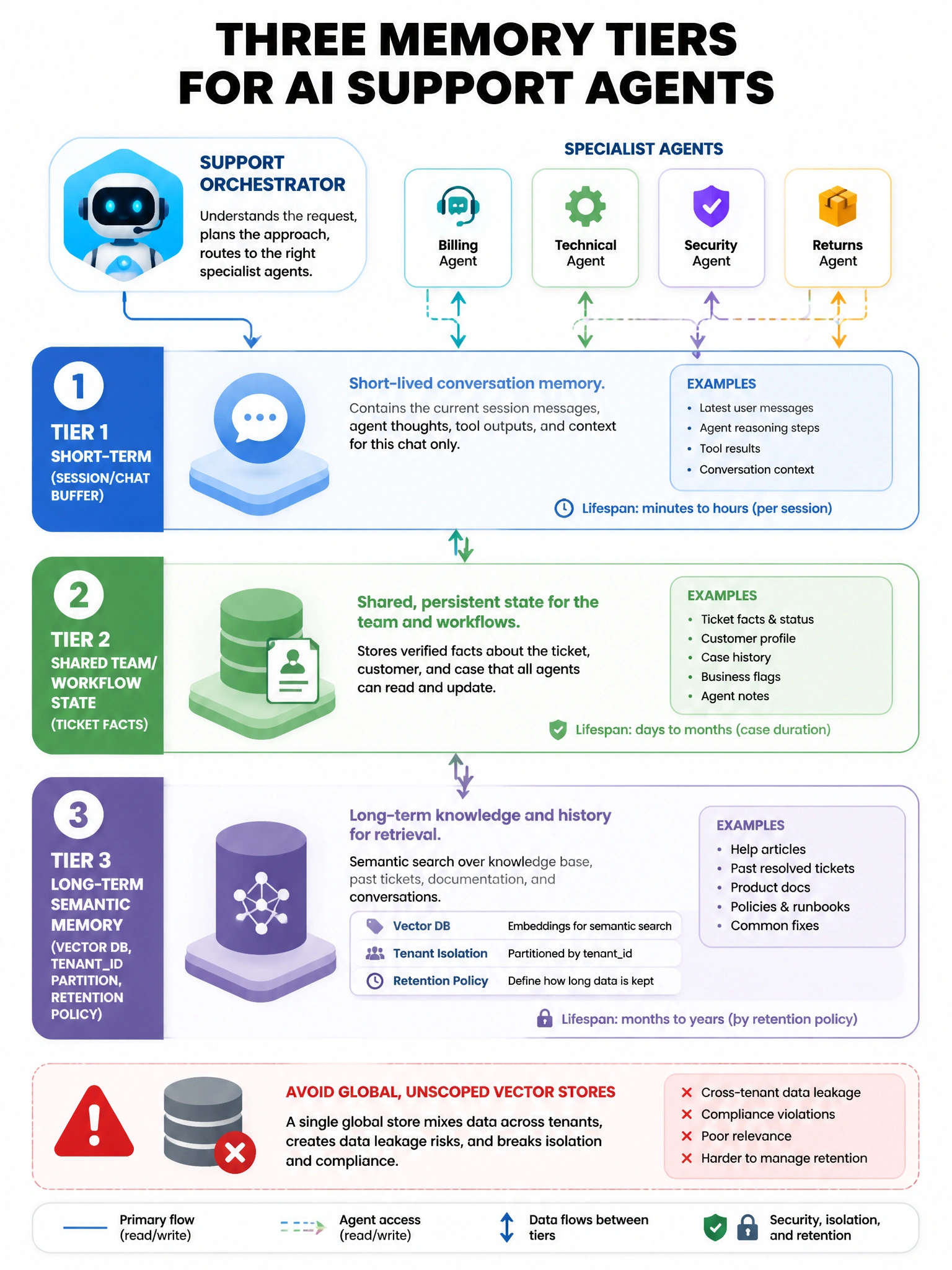
D is the production answer. AI-500 expects multi-tier memory: short-term session context for the live ticket, shared team/workflow state so specialists see the same case facts, and long-term semantic memory (embeddings/case notes) with tenant isolation and retention policies. That matches session continuity, cross-agent context sharing, and multi-tenant compliance. A guarantees amnesia and broken multi-step support. B is a data-residency and privacy disaster—cross-tenant leakage. C pretends the context window is a database; it is not durable, not tenant-safe at scale, and will hit token limits. Design memory like you design storage tiers: hot session state, warm shared workflow state, cold/long-term semantic memory with lifecycle.
Full Explanation
D is correct because multi-agent architecture should specify short-term and long-term memory, including context sharing, plus multi-tier state persistence for session state, shared team state, and long-term semantic memory with lifecycle and tenant-isolation policies. A is wrong: single-utterance memory cannot support multi-turn tickets or specialist handoffs. B is wrong: a non-isolated global vector store violates tenant isolation and compliance. C is wrong: the model context window is not a substitute for durable, queryable, policy-governed memory. Implement clear write paths (what each agent may persist), redaction rules, and retention TTLs aligned to regulatory needs.