
Fabrikam Logistics is specifying agent personas for a fleet-operations multi-agent system. One agent negotiates carrier rates via external APIs; another summarizes SLA breaches for executives. Security requires least privilege and clear behavioral boundaries. Which specification set is most appropriate for the rate-negotiation agent?
Select an answer to reveal the explanation.
Short Explanation
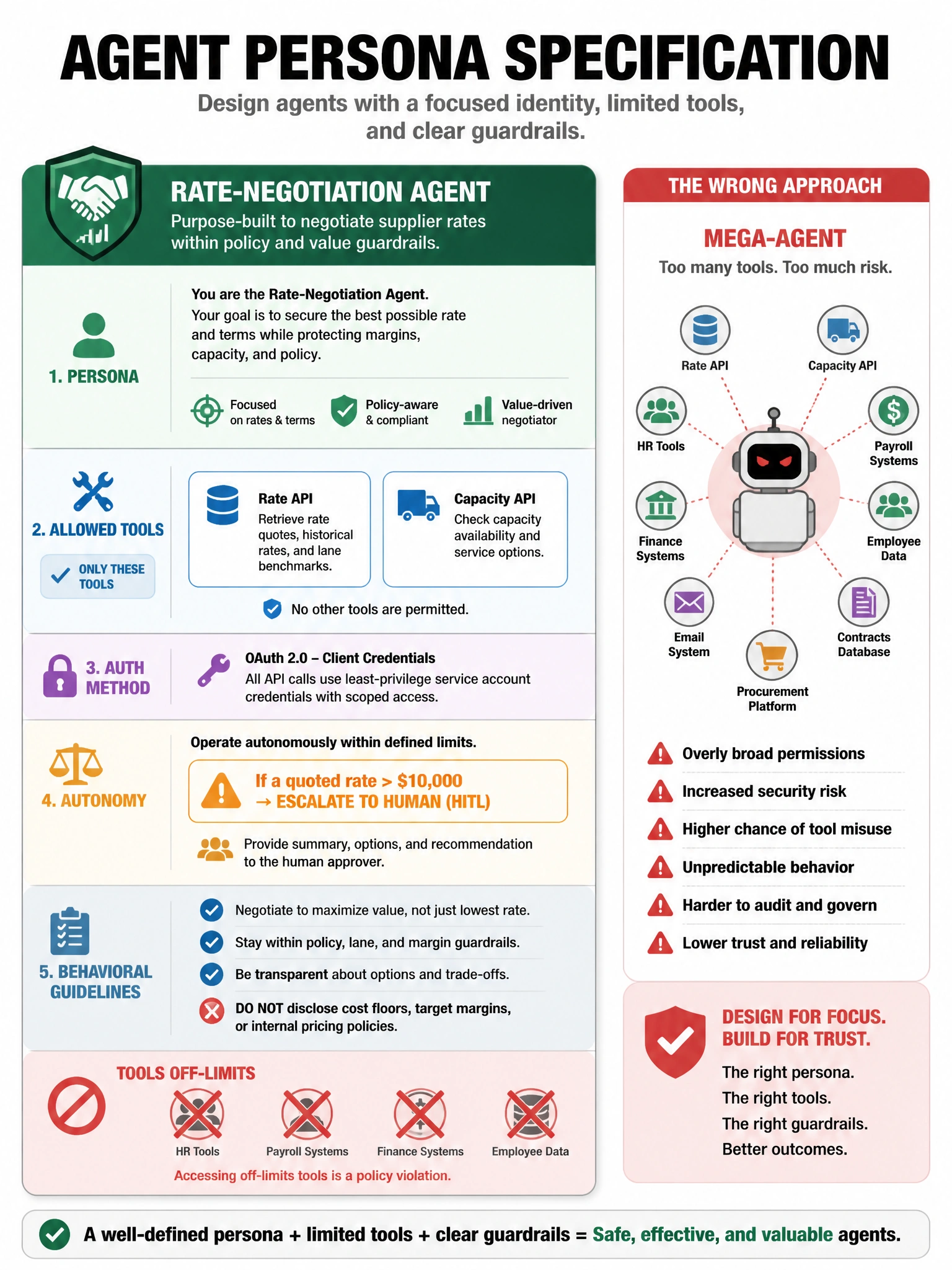
C nails persona design for AI-500. You specify who the agent is, what it can touch, how autonomous it is, and what it must never do. The rate-negotiation agent gets a commercial persona, only rate/capacity tools, a money threshold that forces HITL, and hard rules about cost-floor secrecy. That is scope + permission boundaries + behavioral guidelines. A describes an executive summary agent, not a negotiator. B is the opposite of least privilege and invites lateral movement. D sounds operationally tidy but destroys security and quality—different jobs need different personas and tool scopes. When you write agent specs, think: persona, allowed tools, auth method, autonomy level, and refuse policies—not one-size-fits-all agents.
Full Explanation
C is correct because architecting multi-agent solutions requires specifying agent personas, scopes, boundaries, autonomy levels, and behavioral guidelines, plus tool scopes and authentication methods. A rate-negotiation agent should be specialized, tool-constrained, and subject to approval thresholds for high-value commitments. A is incorrect: it describes a read-only executive summarizer, not a commercial negotiation role. B is incorrect: broad tool access and unrestricted contract binding violate least privilege and Zero Trust multi-agent design. D is incorrect: identical personas and tool sets increase blast radius and dilute behavioral controls. Strong designs map each agent’s mission to minimal tools and explicit refuse/handoff rules.