
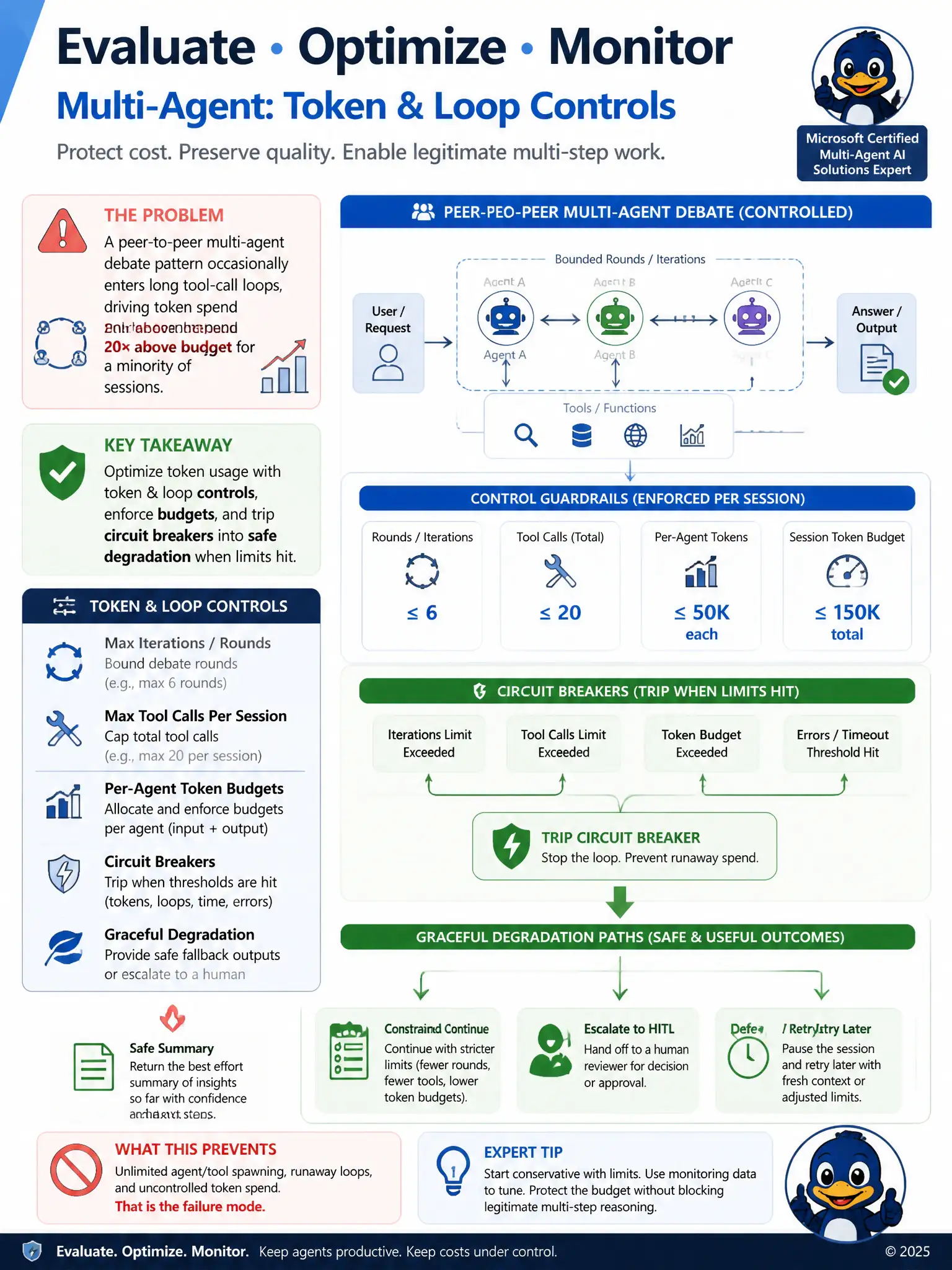
A peer-to-peer multi-agent debate pattern occasionally enters long tool-call loops, driving token spend 20× above budget for a minority of sessions. You need controls that protect cost without killing legitimate multi-step work. What should you implement?
Select an answer to reveal the explanation.
Short Explanation
You've got to protect spend by capping iterations, tool calls, and per-agent tokens, then tripping circuit breakers into a safe summary or human review. Unlimited spawning, hidden cost metrics, and extreme temperature don't enforce budgets.
Full Explanation
The correct control is token and loop governance: max iterations, max tool calls per session, per-agent token budgets, circuit breakers, and graceful degradation when limits hit. Design strategies for token usage and cost include limits, loop controls, tool-call ceilings, quotas, and chargeback visibility. For peer-to-peer patterns, hard-cap dialogue rounds and shared token pools; on breach, stop spawning, return best-so-far, and alert. Unlimited recursive agent spawning with no caps is wrong because uncontrolled spawning is a primary driver of runaway cost and chaotic traces. Hiding cost metrics from operators is wrong because cost monitoring, including usage, quotas, allocations, and chargebacks, is an explicit exam skill. Setting temperature to 2.0 globally to finish faster is wrong because temperature does not implement financial or iteration governance and often increases verbose retries. Pair controls with dashboards of tokens per workflow and alerts on budget outliers.