
Two business units already run production agents—one on Microsoft Agent Framework in Foundry and one on an external LangGraph service. You must compose them into a single customer journey without rewriting both codebases or sharing long-lived static secrets in prompts. What is the best integration approach?
Select an answer to reveal the explanation.
Short Explanation
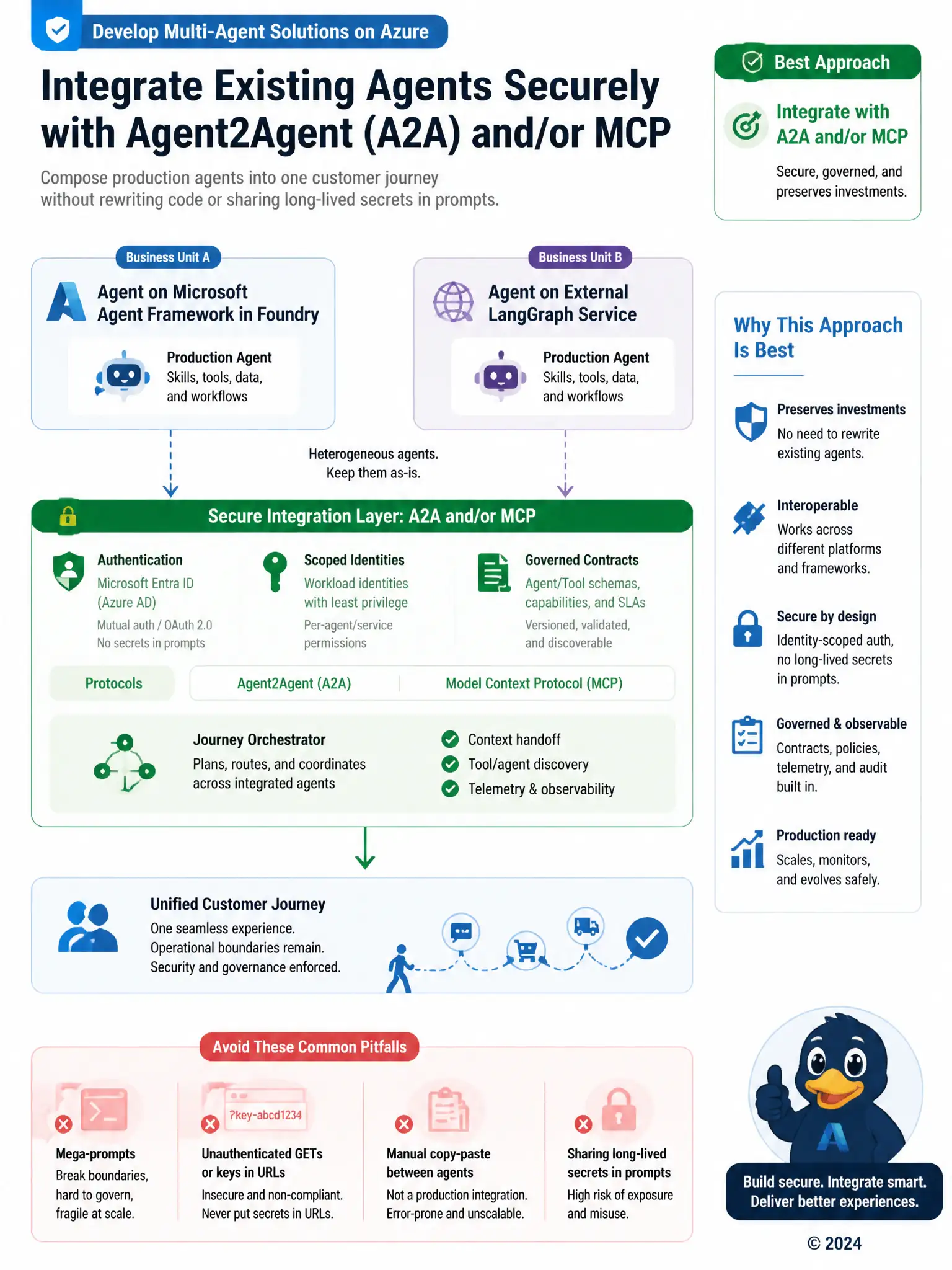
Use Agent2Agent (A2A) and/or MCP to connect the existing Foundry and LangGraph agents through authenticated, governed contracts. You keep both codebases, avoid prompt-embedded secrets, and let each agent keep its own runtime.
Full Explanation
Secure composition of heterogeneous agents is an explicit develop skill: use Agent2Agent (A2A) and/or MCP so Foundry and external LangGraph agents interoperate through authenticated, versioned interfaces. The correct approach is integrating existing agents securely using Agent2Agent (A2A) and/or MCP with proper authentication, scoped identities, and governed tool/agent contracts. Each agent keeps its own runtime while the orchestrator discovers capabilities and invokes them under least-privilege identities. The mega-prompt approach that copies both agent system prompts into one prompt and deletes the existing services is incorrect because collapsing into one prompt loses independent scaling, ownership, evaluation, and security boundaries. The unauthenticated public HTTP GET approach with query-string API keys is incorrect because unauthenticated or query-string key patterns leak credentials and fail Zero Trust expectations for multi-agent production systems. The manual cut-and-paste approach between the two agent UIs is incorrect because human swivel-chair integration is not automatable orchestration and breaks SLA and audit requirements. Design middleware for logging, authorization, and exception handling across the A2A/MCP boundary.