
Platform ops needs a reliability strategy for a production multi-agent system: detect when individual agents are unhealthy, when workflows fail mid-orchestration, when traces cannot be correlated, and when automated remediation should page on-call or restart a failed step. Which monitoring strategy scope is most complete?
Select an answer to reveal the explanation.
Short Explanation
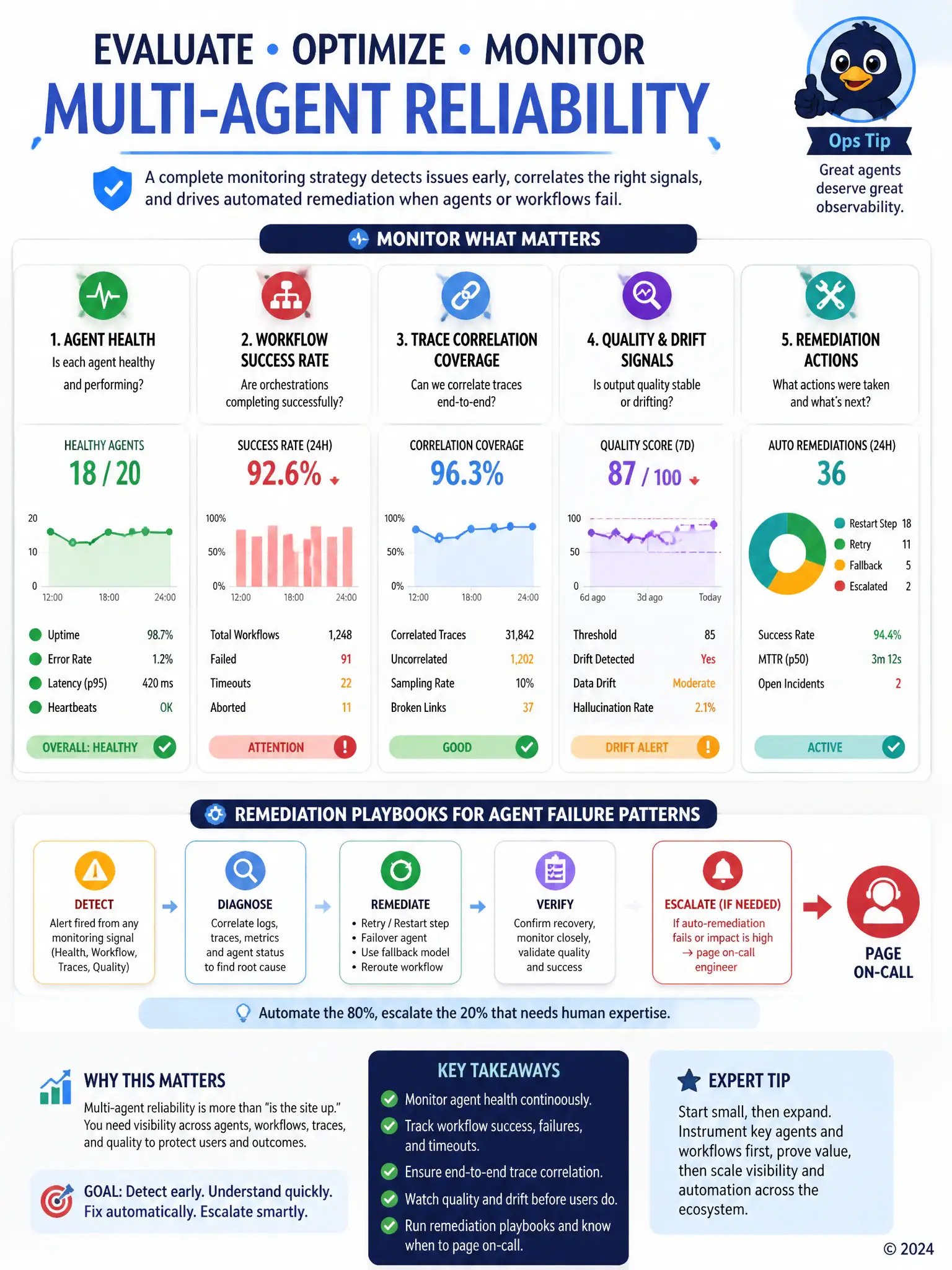
Multi-agent reliability isn’t just checking whether a site or repo is alive. You need agent health, workflow failure detection, trace correlation, quality/drift signals, and remediation playbooks. Bounce rates, push acceptance, and laptop batteries won’t cover production agent failures.
Full Explanation
The complete strategy is monitoring reliability via agent health, workflow failures, trace correlation, drift/quality signals, and remediation playbooks for agent failure patterns. That combination supports both detection and response for production agent systems, including when automated remediation should page on-call or restart a failed step. Monitoring only the marketing website bounce rate is incorrect because frontend bounce rate does not diagnose agent or orchestration failures. Monitoring only whether the Git repository still accepts pushes is incorrect because source control availability is not runtime multi-agent health. Monitoring only laptop battery percentages of remote developers is incorrect because developer device metrics are unrelated to production agent reliability. Exam focus: reliability monitoring must span agents, workflows, traces, quality, and remediation.