
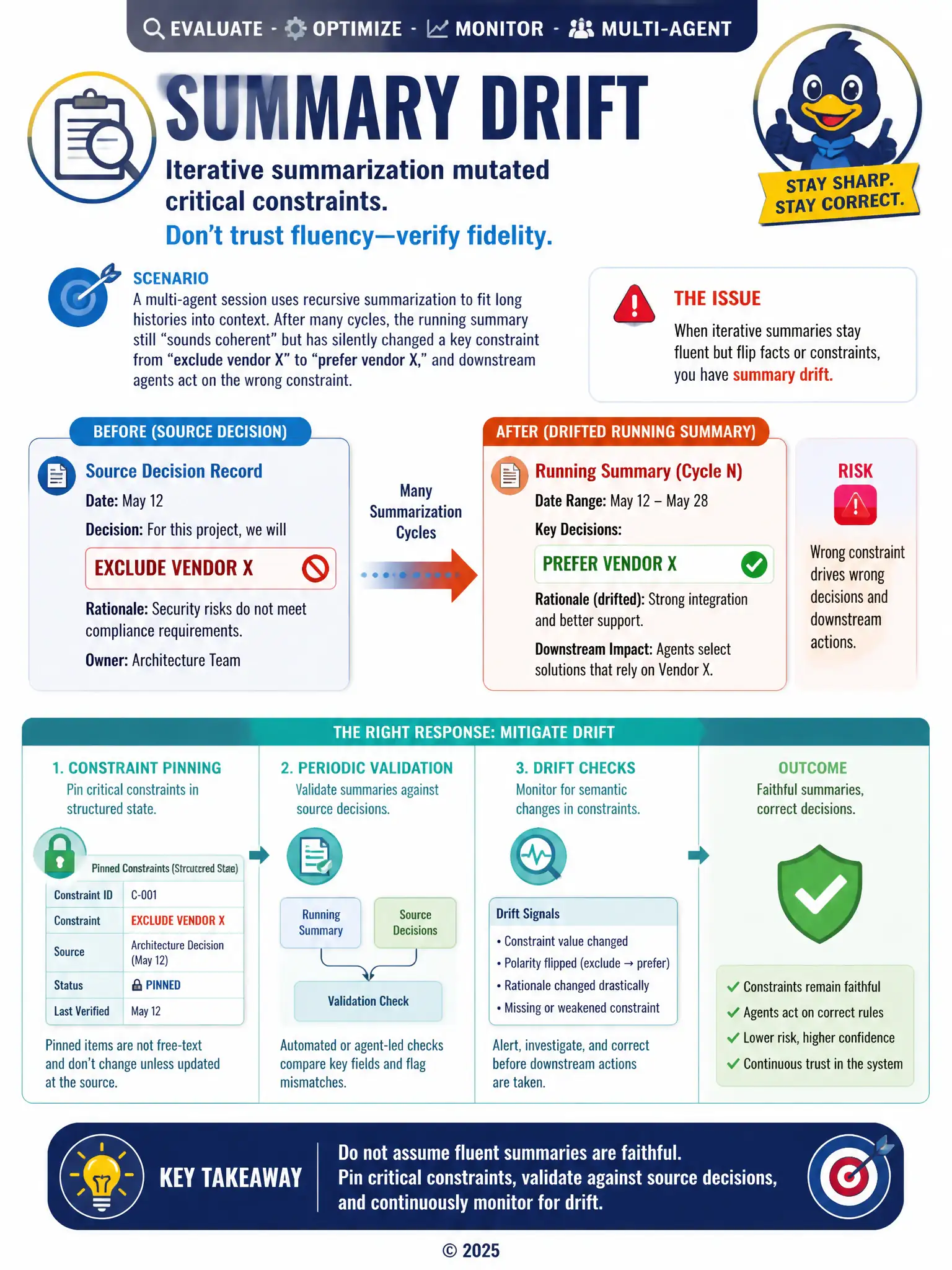
A multi-agent session uses recursive summarization to fit long histories into context. After many cycles, the running summary still “sounds coherent” but has silently changed a key constraint from “exclude vendor X” to “prefer vendor X,” and downstream agents act on the wrong constraint. Which context issue is this, and what is the right response?
Select an answer to reveal the explanation.
Short Explanation
When iterative summaries stay fluent but flip facts or constraints, you have summary drift. Pin critical constraints into structured state, validate summaries against source decisions, and monitor for drift—do not assume fluent summaries are faithful. The healthy-normal-operation claim, TCP MTU fragmentation, and Azure subscription naming policy are red herrings.
Full Explanation
The correct diagnosis is summary drift: iterative summarization mutated critical constraints while remaining readable. Context-window issue diagnosis includes summary drift—iterative compression that gradually corrupts entities or constraints while remaining readable. Mitigations include pinning immutable constraints outside free-text summaries, storing structured state, validating summaries against authoritative earlier decisions, and running drift checks. The claim that this is healthy normal operation needing no monitoring is incorrect because fluent summaries can still be wrong; drift requires active controls. The claim that pure network MTU fragmentation at the TCP layer rewrote English constraints is incorrect because TCP fragmentation does not semantically rewrite vendor constraints in agent memory. The claim that an Azure subscription naming policy automatically renames vendors in text is incorrect because subscription naming policies do not mutate conversation summaries. Exam focus: distinguish summary drift from sliding-window amnesia and entity continuity failures.