
Before implementation, an architect must document how a triage agent, a medical-coding agent, and a billing agent should behave in a hospital revenue-cycle multi-agent system. What specification elements are most critical to define for each agent?
Select an answer to reveal the explanation.
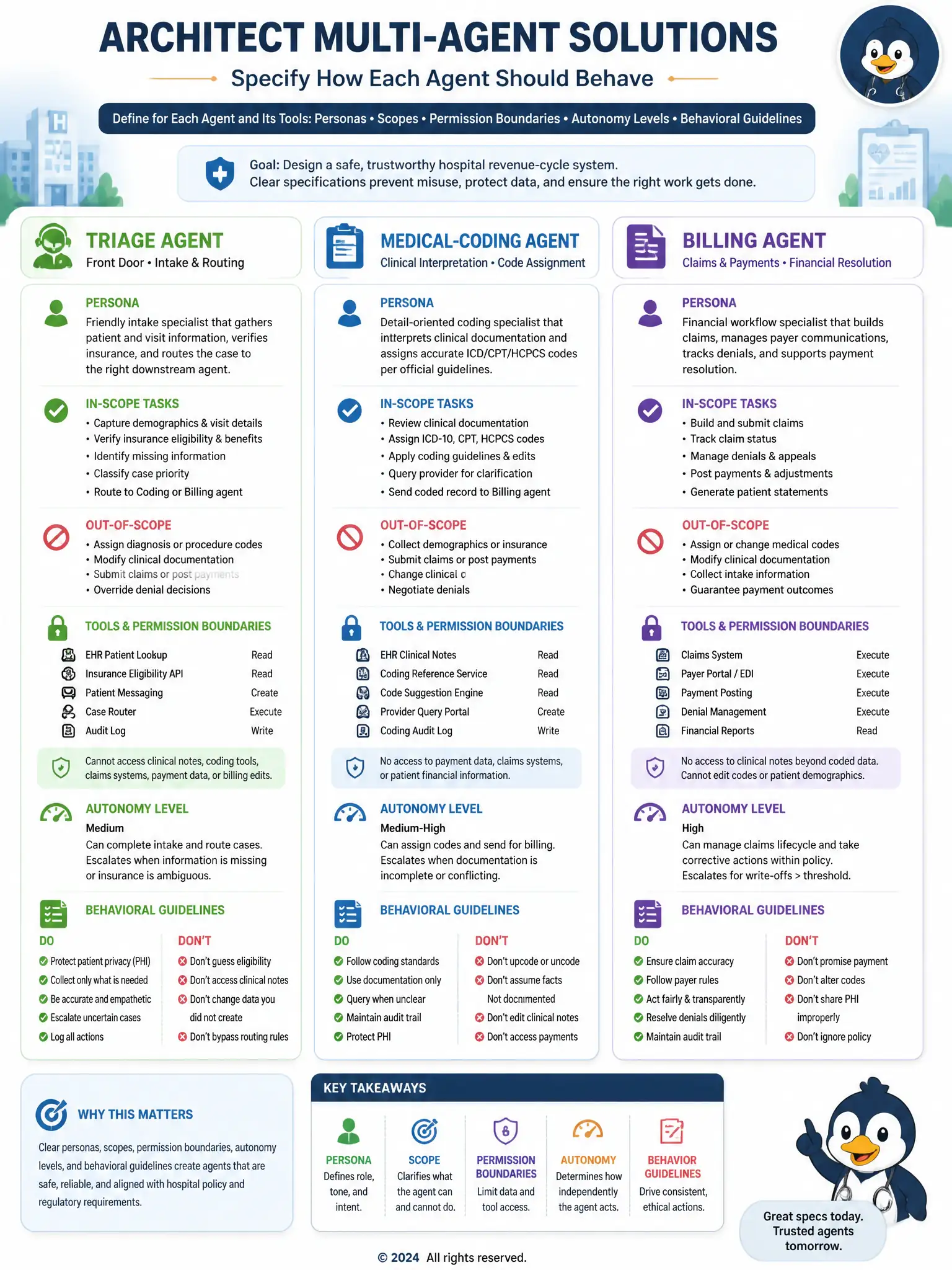
Short Explanation
You need to pin down each agent’s persona, scope, tool permissions, autonomy, and behavior rules—especially in a hospital revenue cycle. Avatar colors are just cosmetics. A shared unrestricted tool list or ignoring policy invites unsafe, out-of-scope actions.
Full Explanation
The specification elements most critical to define are personas, scopes, permission boundaries, autonomy levels, and behavioral guidelines for each agent and its tools. In a hospital revenue-cycle multi-agent system, triage, medical-coding, and billing agents must have distinct operational roles, least-privilege tool access, and clear behavioral constraints to prevent role confusion and unsafe tool use. The option describing only the brand color palette for each agent's future UI avatar is incorrect because visual branding does not define operational behavior, scope, or safety boundaries. The option describing a single shared unrestricted tool list with no per-agent boundaries is incorrect because it collapses least privilege and increases cross-role damage potential. The option instructing all agents to ignore hospital policy to maximize throughput is incorrect because ignoring policy violates clinical, financial, and responsible AI requirements.