
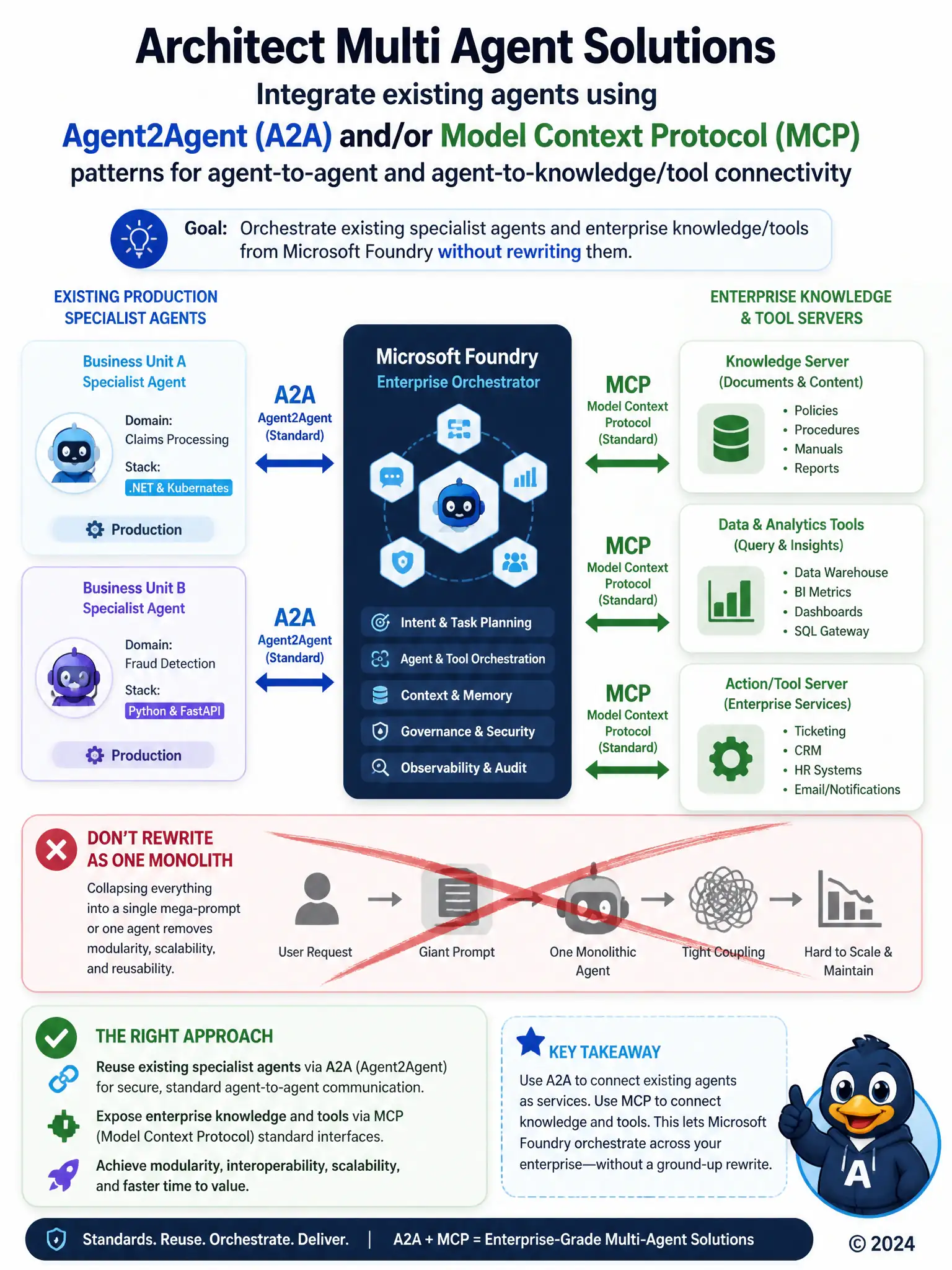
Two business units already run production specialist agents on different stacks. A new enterprise orchestrator in Microsoft Foundry must invoke those existing agents as tools/services without rewriting them from scratch, and must also expose enterprise knowledge sources through a standard tool interface. Which protocol approach should the architect specify?
Select an answer to reveal the explanation.
Short Explanation
You should specify integrating existing agents with Agent2Agent (A2A) and/or Model Context Protocol (MCP) patterns. That lets Foundry orchestrate the specialists and expose knowledge/tools through standard interfaces without a ground-up rewrite. Requiring one giant prompt, ad hoc TCP, or social DMs doesn't give you enterprise-grade modularity, security, or operability.
Full Explanation
The correct approach is integrating existing agents using Agent2Agent (A2A) and/or Model Context Protocol (MCP) patterns for agent-to-agent and agent-to-knowledge/tool connectivity. Architecture and integration skills include specifying protocols for multi-agent communication and integrating existing agents with A2A and/or MCP, plus knowledge integration through MCP-available sources. That enables secure, structured interoperability without full rewrites. The approach requiring both business units to abandon their agents and reimplement everything as a single prompt is incorrect because it discards working specialists and modularity. The approach using unauthenticated raw TCP sockets with ad hoc text framing invented per team is incorrect because such sockets lack standard security, schema, and operability for production multi-agent systems. The approach passing all inter-agent messages exclusively through public social media DMs is incorrect because public social channels are inappropriate for enterprise agent control paths and data.