
A multi-agent media pipeline includes (1) language detection on short strings, (2) multi-hop legal reasoning over contracts, and (3) creative storyboard prose. The architect must assign model families without overspending. Which matching strategy is most appropriate?
Select an answer to reveal the explanation.
Short Explanation
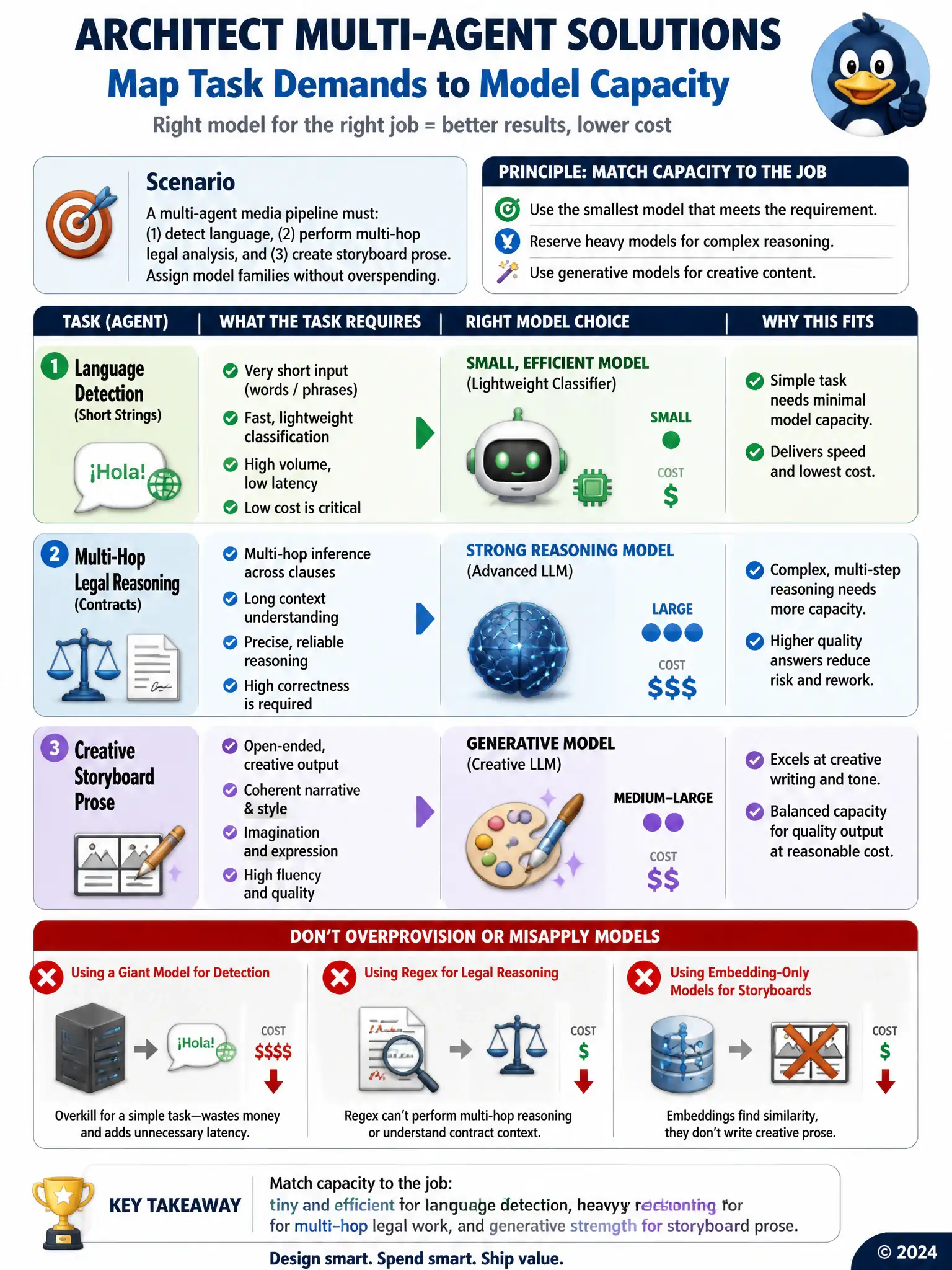
Match capacity to the job: use tiny/efficient models for language detection, heavy reasoning for multi-hop legal work, and generative strength for storyboards. One giant model for detection wastes money. Regex alone won't do multi-hop legal reasoning, and embedding-only models don't write storyboards.
Full Explanation
The appropriate strategy is mapping task demands to model capacity: small efficient models for language detection, strong reasoning models for multi-hop legal analysis, and generative models suited to creative prose. Architect skills include matching task demands to model family capacities. Heterogeneous multi-agent pipelines should route simple classification/detection to efficient models and reserve frontier reasoning or generative capacity for tasks that need them.
The largest-reasoning-model-for-every-step approach is incorrect because using the largest reasoning model for trivial detection inflates cost and latency without quality benefit.
The classical-regular-expressions-only approach is incorrect because regular expressions cannot perform multi-hop legal reasoning over unstructured contracts.
The tiny-embedding-only-model-for-storyboards approach is incorrect because embedding-only models do not generate creative storyboard prose.