
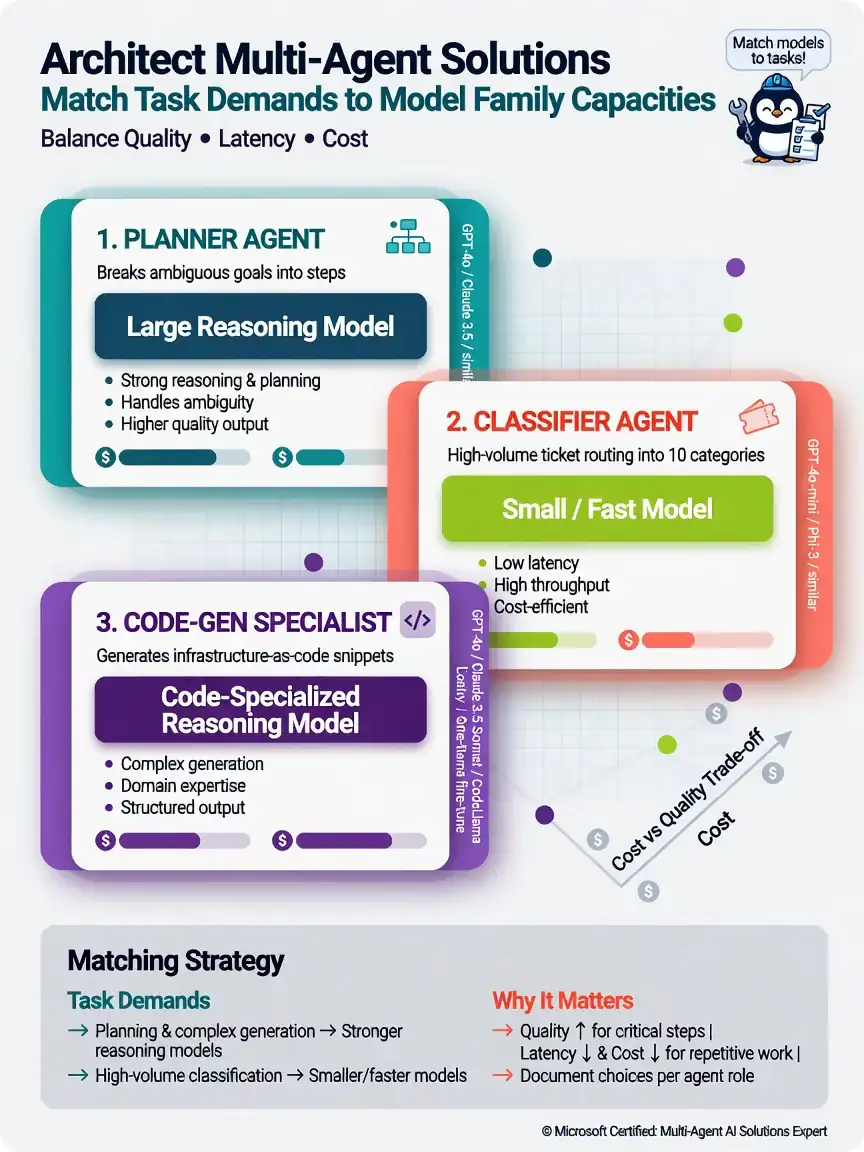
Your multi-agent architecture includes (1) a planner that breaks ambiguous goals into steps, (2) a high-volume classifier that routes tickets into ten categories, and (3) a code-generation specialist for infrastructure-as-code snippets. How should you match tasks to model capacities?
Select an answer to reveal the explanation.
Short Explanation
You match task demands to model family capacities. You use stronger reasoning models for planning and complex code generation, and smaller, faster models for high-volume ticket routing. That balances quality, latency, and cost.
Full Explanation
Matching task demands to model family capacities is an explicit architect skill. Heterogeneous multi-agent systems intentionally use different deployments: frontier-class models for ambiguous planning and hard generation, lightweight models for deterministic-ish classification or extraction, and specialized models where available. Consider context window needs, tool-calling reliability, latency service-level objectives, and unit economics. The approach that forces every agent to use the single largest reasoning model ignores cost and latency. The approach that uses only embedding models misuses embedding models, since embeddings alone cannot plan or generate code. The approach that assigns the weakest free model to planning inverts priority, because planning errors cascade and collapse orchestration quality. Include fallback models and evaluation criteria so model swaps remain safe, and document model choices per agent role.