
During design review, operations requires the ability to reconstruct why a multi-agent loan decision path produced a given outcome, correlate spans across orchestrator and tools, and replay problematic runs for debugging. Which observability components should you specify?
Select an answer to reveal the explanation.
Short Explanation
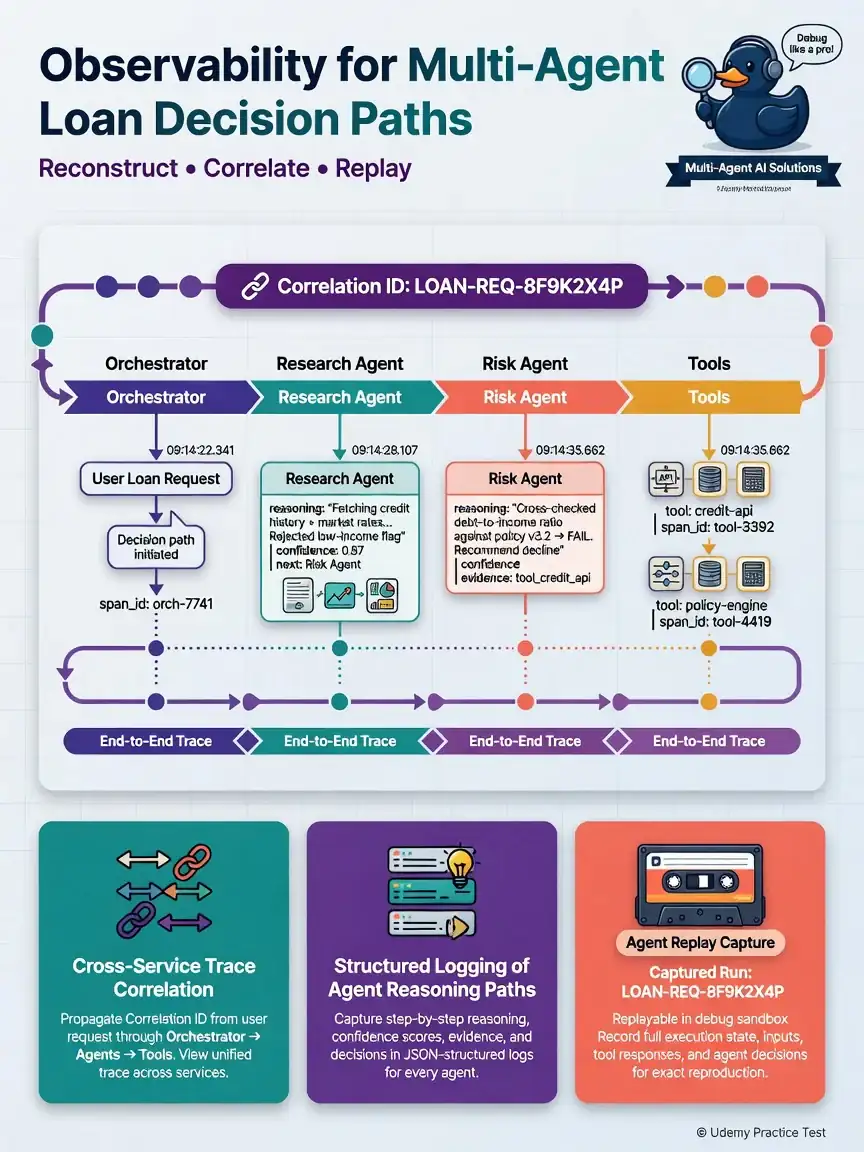
You need cross-service trace correlation, structured logging of agent reasoning paths, and agent replay capture so you can follow a loan decision across the orchestrator and tools, explain why it happened, and rerun it. Host CPU alerts, unstructured prints, and weekly screenshots won't reconstruct multi-agent behavior.
Full Explanation
Architects specify observability components including cross-service trace correlation, structured logging of agent reasoning paths, and agent replay capture for reproducible debugging. Multi-agent failures often span planner, specialists, MCP tools, and models; without correlation you cannot isolate root cause. Specify correlation IDs end-to-end from user request through tools and subagents. Structured events should capture tool names, arguments (redacted), model versions, token counts, and decision branches—balanced against privacy. Replay/capture supports offline debugging and evaluation. The option describing only CPU utilization alerts on container hosts lacks semantic insight into agent behavior. The option describing unstructured print statements without correlation IDs or retention policy cannot correlate spans or support replay. The option describing a weekly manual screenshot of the portal metrics blade is too infrequent and visual-only to reconstruct decisions. Pair observability with monitoring for coordination health, drift, and automated remediation as separate but related components.