
You are selecting technology components for a multi-agent system that will process regulated financial data. Leadership mandates Zero Trust: no implicit trust between agents, minimized lateral movement, and mappable compliance controls. Which component specification is most aligned?
Select an answer to reveal the explanation.
Short Explanation
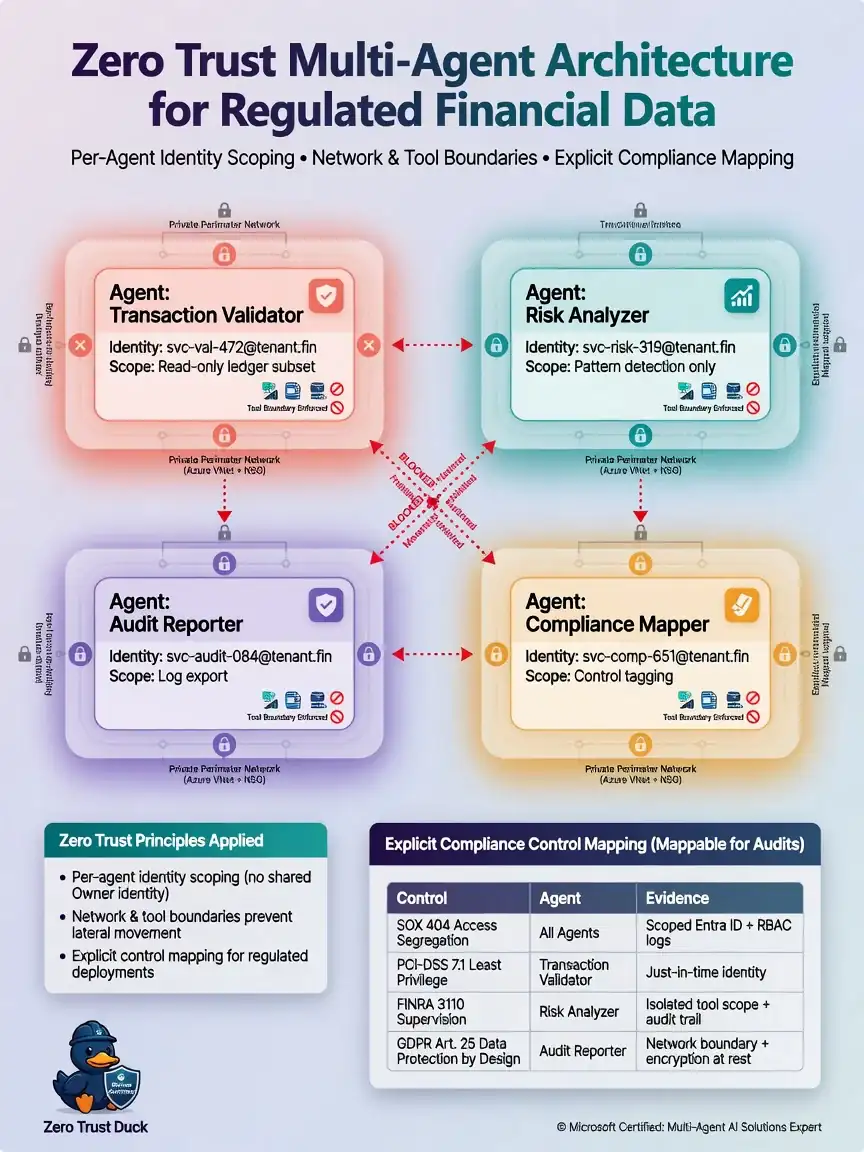
You need per-agent identity scoping, network and tool boundaries that stop lateral movement, and explicit compliance control mapping for regulated deployments. Shared Owner identities, flat mutual trust, and auth bypasses don't just simplify things—they break Zero Trust and widen the blast radius.
Full Explanation
Under 'Specify technology components,' AI-500 includes Zero Trust multi-agent solutions with per-agent identity scoping, lateral movement prevention, and compliance control mapping for regulated deployments. That means distinct identities, least-privilege tool and data access, segmented networking, authenticated agent-to-agent channels, and a matrix linking controls to regulatory requirements such as access logs, encryption, and retention. The specification with per-agent identity scoping, network and tool boundaries, and explicit compliance control mapping is correct because it designs identity, network, and tool planes so compromise of one agent does not unlock the estate. A shared service principal with Owner rights maximizes blast radius. Mutual trust on a flat private network assumes a soft inside network. Hard-coded auth bypass flags trade security for micro-latency and fail audits. Document threat models for prompt injection leading to tool abuse and show how component choices mitigate them.