
You design memory for a multi-tenant multi-agent assistant: short-term session scratchpads, shared team state for a case, and long-term semantic memory of resolved patterns. Compliance requires tenant isolation and retention limits. Which implementation choice is most appropriate?
Select an answer to reveal the explanation.
Short Explanation
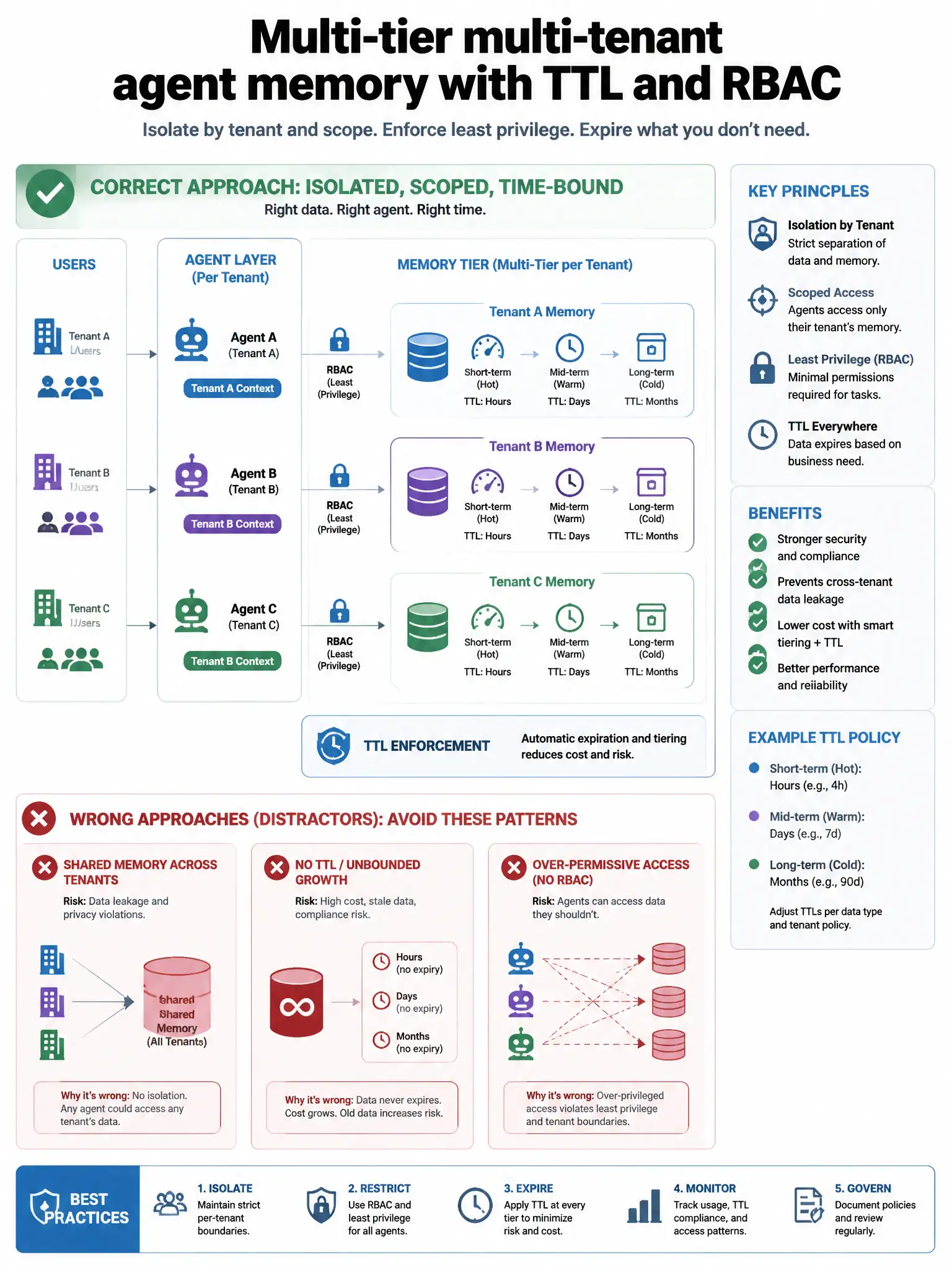
You partition memory by tenant and session, then enforce TTL, purge, and access scopes. Keep shared team state case-scoped, and bind long-term semantic memories to each tenant with RBAC on retrieval tools. That's how you keep multi-tenant isolation and retention limits real.
Full Explanation
Partition memory by tenant and session with TTL, purge, and access-scope lifecycle policies; keep shared team state case-scoped; store long-term semantic memories with tenant-bound embeddings and RBAC on retrieval tools.
Single- and multi-agent memory strategies must address security, compliance, lifecycle, storage, and session management. Multi-tier designs separate session scratchpads, shared team/case state, and long-term semantic memory with tenant isolation, TTL/purge policies, and controlled retrieval. Tenant partitions, TTLs, purge jobs, and scoped retrieval tools keep isolation real. Shared team state should be case-scoped, not company-wide soup.
The global unfiltered store violates tenant isolation and compliance. Browser cookies are inadequate for durable multi-agent memory tiers and cannot hold orchestration state reliably. Unrestricted writes break least privilege and data integrity, inviting pollution and lateral data access.
Exam tip: memory architecture questions hinge on tenant isolation plus lifecycle, not model size.