
A long-running investigation multi-agent session accumulates tool traces and intermediate reasoning until later agents hit context-window limits and drop earlier evidence. You must keep cross-agent continuity without unbounded growth. Which design should you implement?
Select an answer to reveal the explanation.
Short Explanation
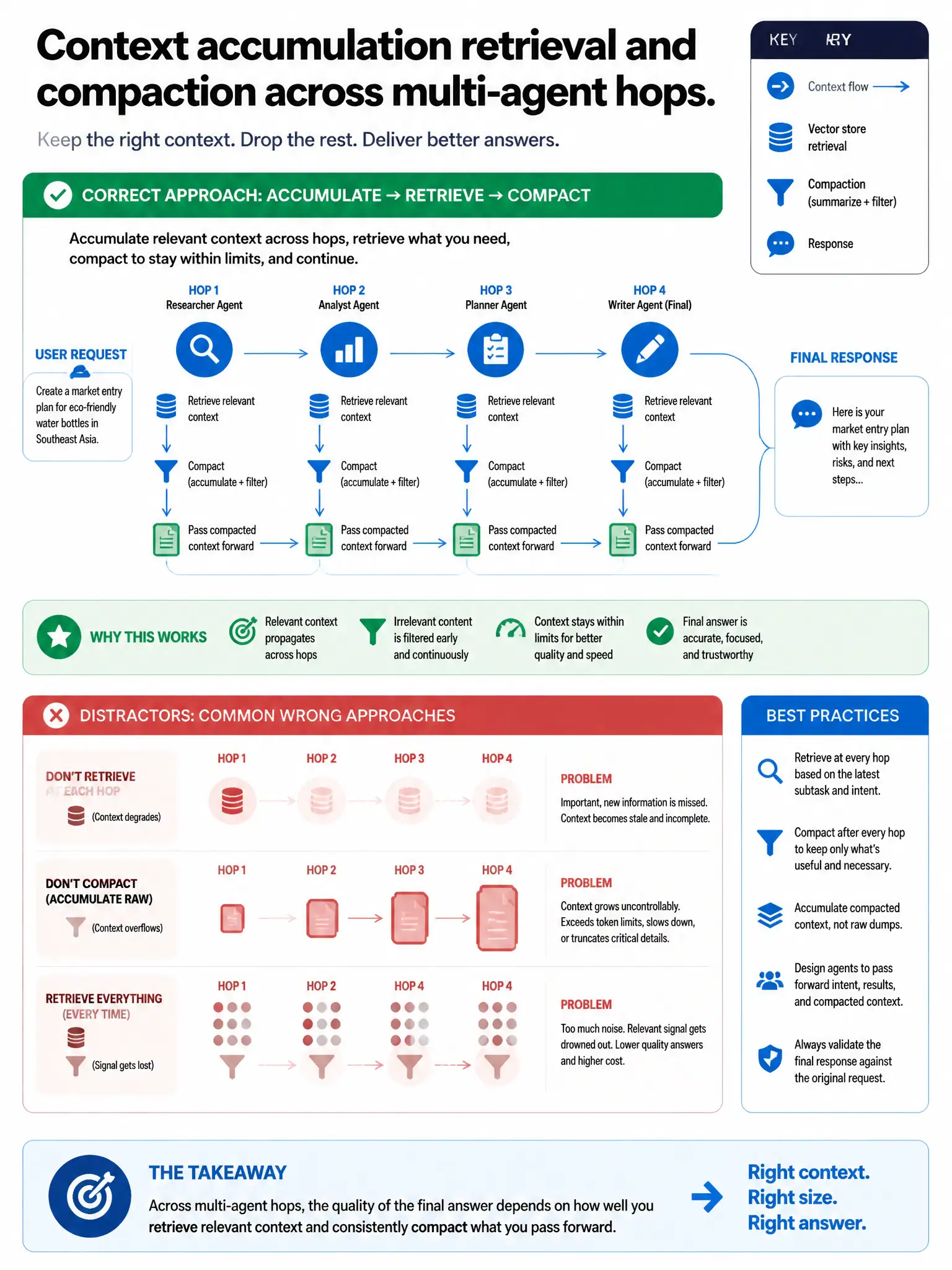
D nails it. Multi-agent context management is not “keep everything forever” and not “keep nothing.” You accumulate what matters, retrieve selectively for the next step, and compact or summarize older tool traces so the window stays usable. Entity continuity—case IDs, people, findings—must survive compaction or you get sliding-window amnesia. A deletes the audit trail and evidence. B explodes tokens by pasting full history into every hop. C buying a bigger window without policy only delays the same failure. For AI-500 develop skills: accumulation, retrieval, injection, and compaction are the four verbs of context management.
Full Explanation
Correct Answer — “Implement context management with accumulation policies, selective...”
Context management across agents includes accumulation, retrieval, injection, and compaction. Production multi-agent sessions must bound growth while preserving salient evidence and entity continuity through selective retrieval and summarization of intermediate traces.
Why “Disable all tool traces and store nothing so the context window...” is wrong: Dropping all traces removes evidence and hinders investigation quality and auditability.
Why “Duplicate the full raw history into every agent’s prompt on each...” is wrong: Full-history duplication maximizes cost and context pressure.
Why “Switch to a larger context model only, with no compaction,...” is wrong: Larger windows alone do not implement lifecycle or continuity policies.
Exam tip: Compaction without entity continuity causes summary drift and lost identifiers.
Prefer to study offline? Printable PDF study book + test engine ($7.50, unofficial). These questions stay free here.