
Your legal review multi-agent workflow shows consistent citation formatting errors that few-shot prompting only partially fixes. Leadership asks for a fine-tuning plan for the citation agent’s model. What strategy best matches multi-agent fine-tuning guidance?
Select an answer to reveal the explanation.
Short Explanation
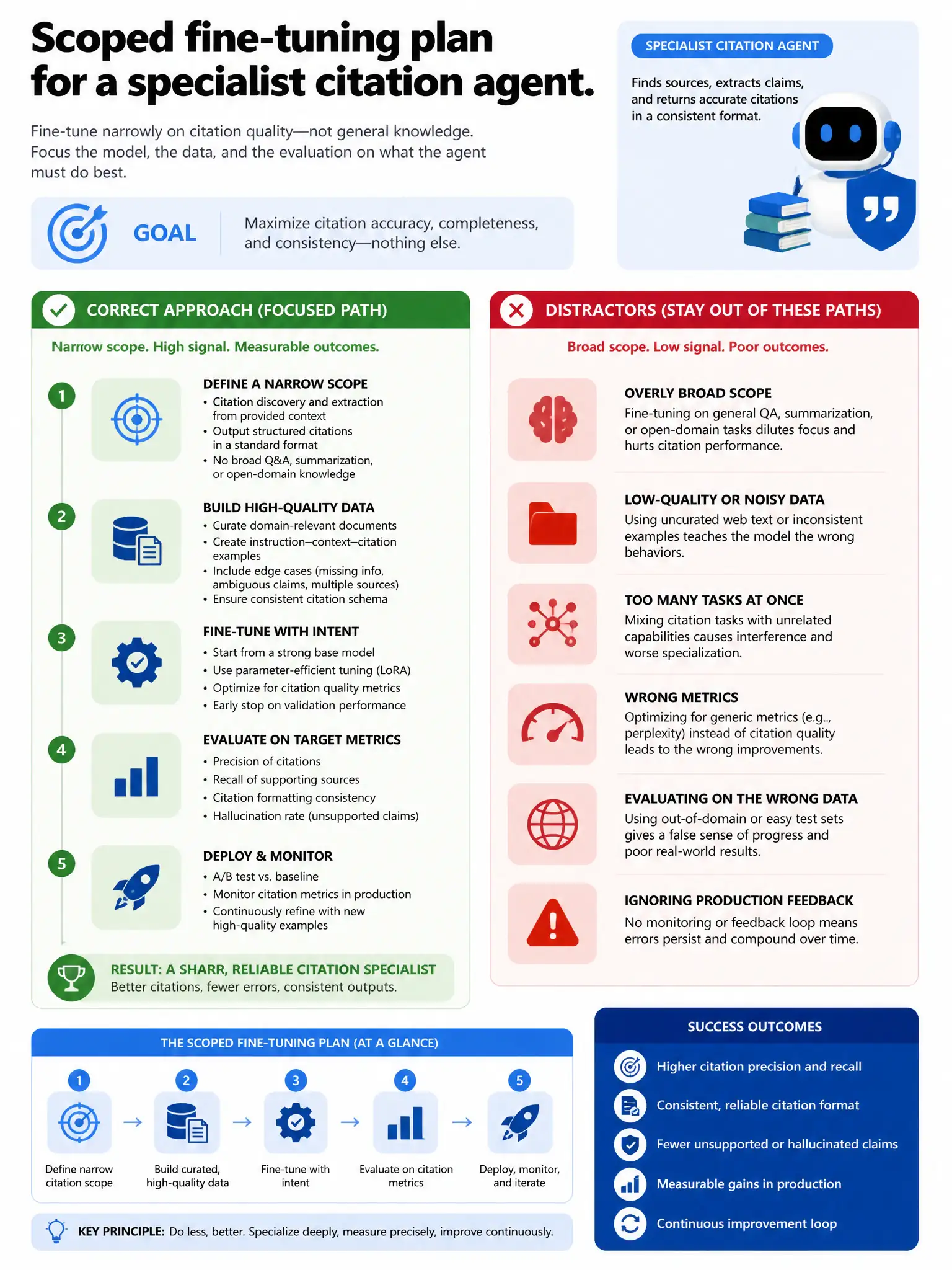
You want a scoped, deliberate fine-tune: curate citation-style train and eval sets, refresh based on style-guide changes and measured error drift, and tune only the citation agent’s model. Don’t dump raw production chats into every agent or assume the orchestrator fixes specialist formatting.
Full Explanation
Correct answer — the curated citation-agent fine-tune
Fine-tuning strategies for agents and models include data selection, evaluation sets, and frequency planning. Scope fine-tunes to the agent whose task fails, which is the citation agent handling citation formatting, use curated domain-specific data for citation style, and refresh based on style-guide change rate and measured error drift—not continuous uncurated production dumps.
Why the nightly production-dump approach is wrong: Uncurated production chat dumps risk PII leakage, noise, and uncontrolled behavior changes across agents, and redeploying all agents with the same weights overreaches the actual failure.
Why the synthetic-random-strings approach is wrong: Random synthetic strings do not teach citation conventions, and skipping data curation removes the domain signal needed for reliable formatting.
Why the orchestrator-only approach is wrong: Orchestrator fine-tuning does not automatically fix specialist formatting behavior; specialist agents need their own capability and scoped model updates.
Exam tip: Prefer prompt/RAG fixes first; when fine-tuning, scope model + data + cadence per agent role.