
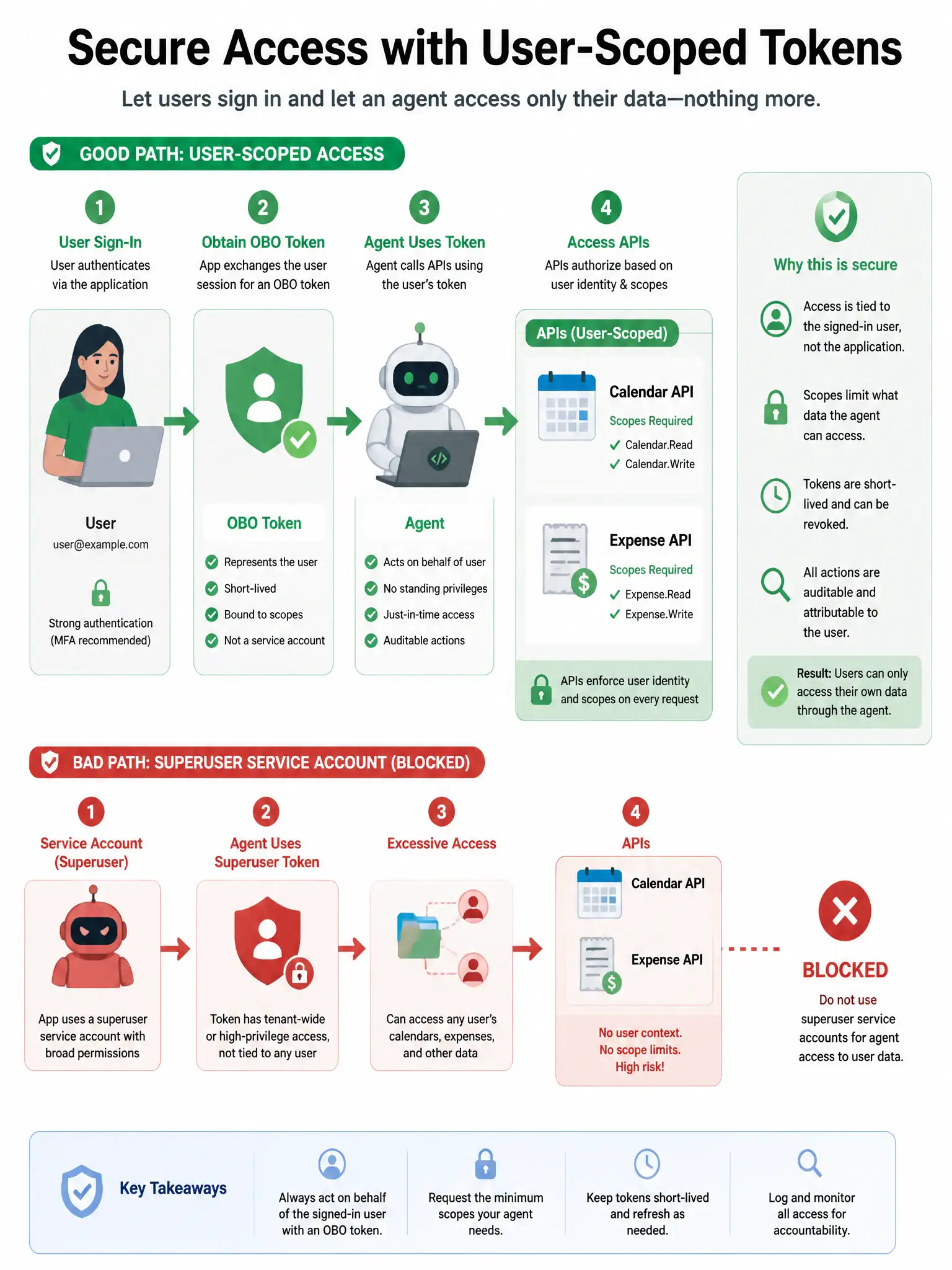
A multi-agent expense system must call a user’s personal calendar and expense APIs using that user’s permissions—not a superuser service account—so agents cannot read other employees’ data. Which authentication approach is most appropriate?
Select an answer to reveal the explanation.
Short Explanation
When you need agents to touch user-scoped data, use OAuth 2.0 on-behalf-of/delegated flows so calls carry the signed-in user’s scopes instead of a god-mode service account. Keep app identity for non-user resources. Shared admin passwords, baked-in personal access tokens, and auth-off private networks violate least privilege and Zero Trust.
Full Explanation
Authentication flows for multi-agent solutions include user impersonation, on-behalf-of, API keys, and OAuth 2.0. The requirement to respect each user’s permissions maps to OAuth 2.0 on-behalf-of/delegated access, so agents act with the signed-in user’s scopes while per-agent application identity is used for non-user resources. Sharing one global admin username and password among all agents in a config map creates shared superuser access. Embedding long-lived personal access tokens for every employee inside each agent image at build time creates secret sprawl. Disabling authentication on internal APIs because the agents run in a private VNet relies on perimeter-only trust. All violate least privilege. Implement token lifetime limits, audience validation, and audit of agent-initiated API calls keyed by user and agent identity.