
Your multi-agent travel system calls a third-party inventory API that intermittently returns 503s and occasionally returns schema-valid JSON with nonsensical prices. Which tool integration design best improves resilience and quality?
Select an answer to reveal the explanation.
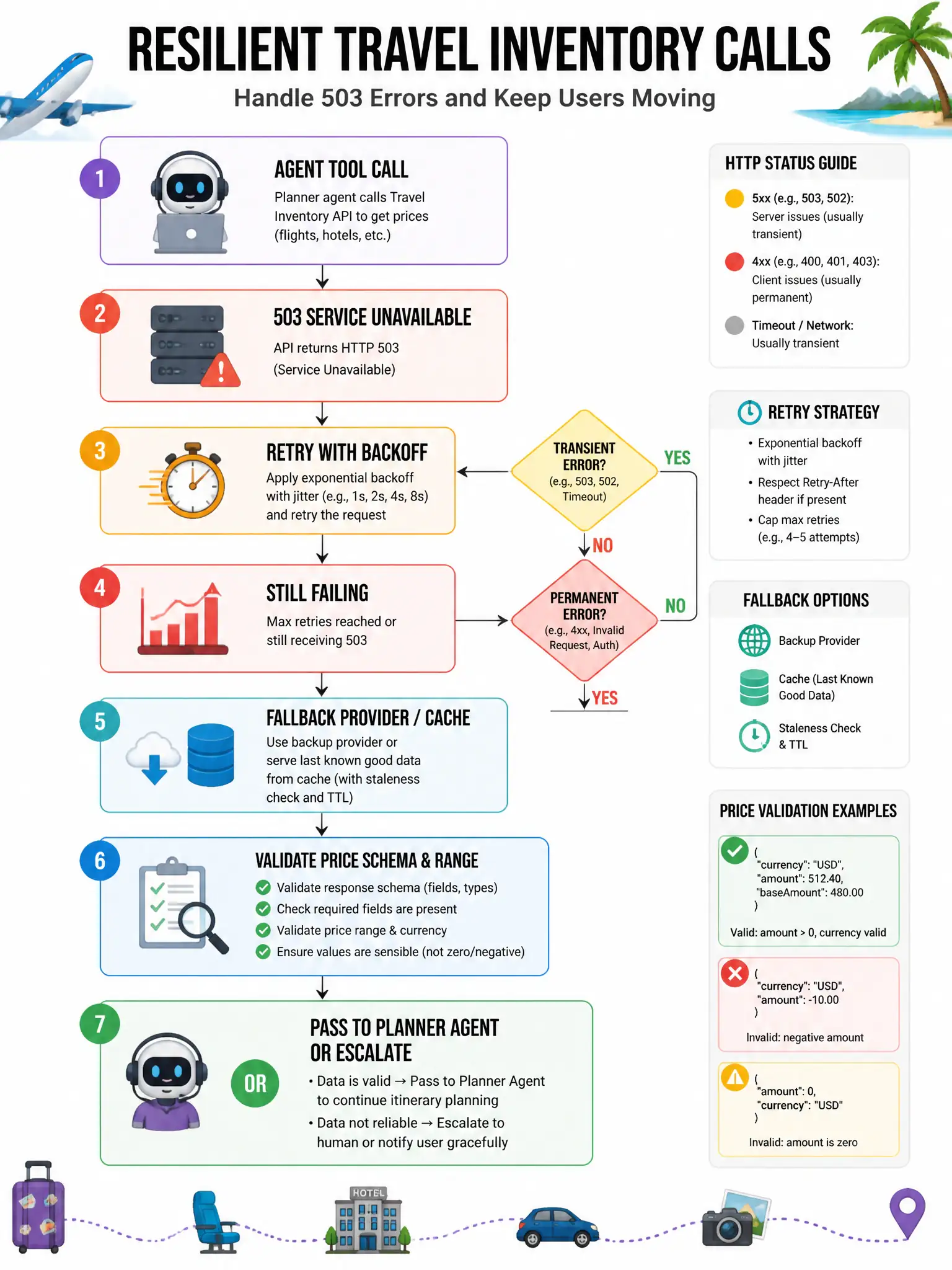
Short Explanation
You implement retries/backoff for transient 503s, fallbacks like cached quotes or alternate providers, structured errors to the orchestrator, and validation/quality checks before agents consume results. That keeps the workflow useful during outages and catches schema-valid nonsense prices before planning agents act. Ignoring errors, crashing on first failure, or trusting any 200 status just creates brittle or confidently wrong behavior.
Full Explanation
The correct design implements retries/backoff for transient failures, fallbacks such as cached quotes or alternate providers, structured errors to the orchestrator, and validation/quality checks before agents consume results. Developers must design tool error-handling and fallback mechanisms and implement tool result validation and quality checks. Resilience patterns (retry, alternate provider, cache) plus semantic validation prevent outages and garbage-in cascades across agents. Ignoring tool errors and answering from training data is wrong because bypassing tools for parametric memory undermines accuracy for live inventory. Crashing the workflow on first failure is wrong because hard failure without recovery harms reliability objectives. Disabling validation and trusting any 200 status is wrong because a 200 status does not guarantee business-valid payloads; validate ranges, currency, required fields, and emit telemetry on validation failures.