
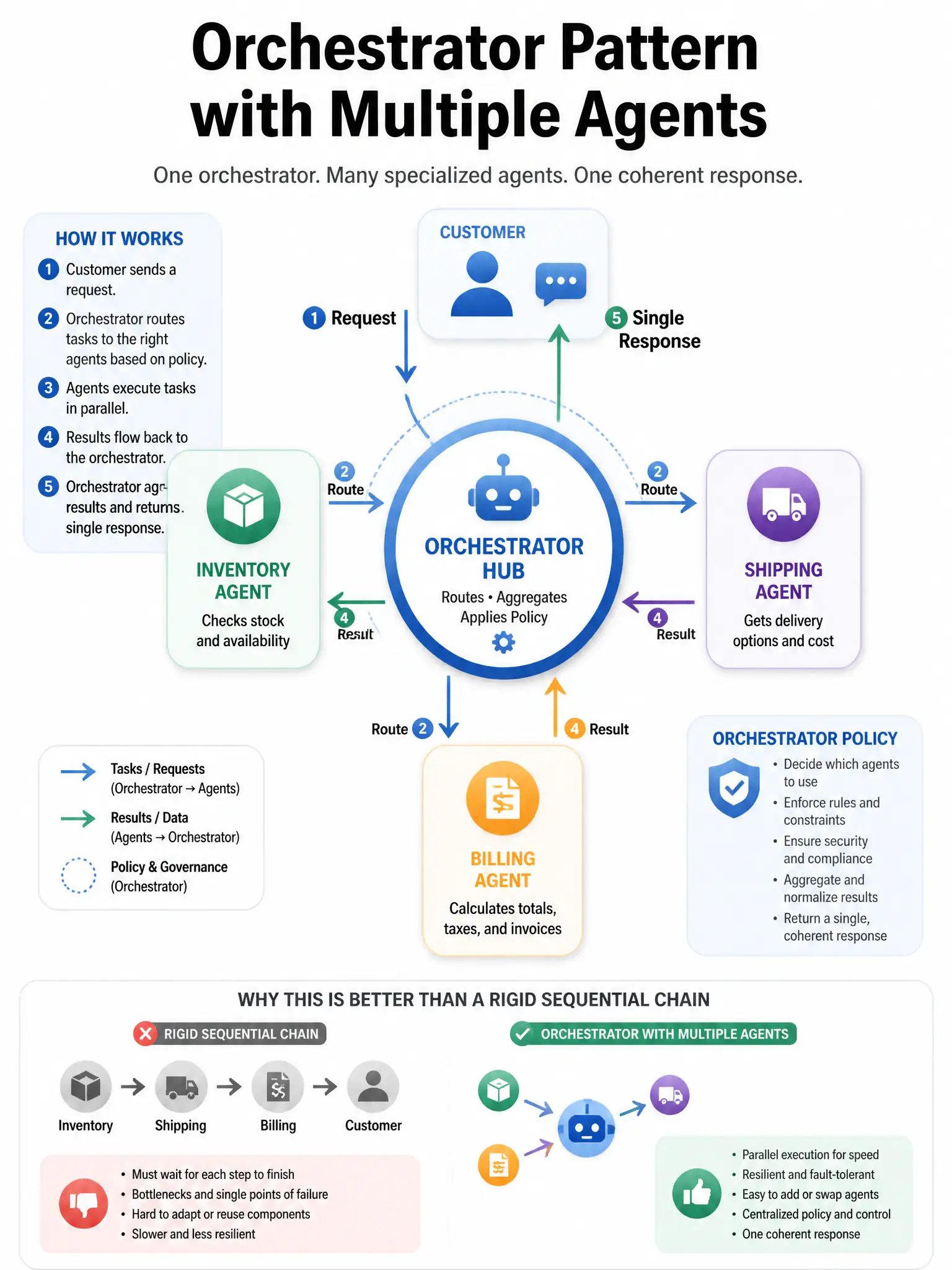
Tailwind Traders is implementing multi-agent orchestration for order troubleshooting. A central coordinator must assign work to inventory, shipping, and billing specialist agents and merge results for the customer. Which orchestration pattern should you implement?
Select an answer to reveal the explanation.
Short Explanation
You need hub-and-spoke, or orchestrator-subagent, because the central hub routes work to inventory, shipping, and billing spokes, aggregates outputs, and controls the customer-facing response. It keeps specialists scoped while giving you the coordination Tailwind Traders needs.
Full Explanation
Hub-and-spoke (orchestrator-subagent) is correct because multi-agent orchestration patterns include hub-and-spoke and orchestrator-subagent designs where a coordinator delegates to specialists and merges results. That matches order troubleshooting with inventory, shipping, and billing skills. Fully disconnected peer agents with no coordinator and no shared workflow state are incorrect: pure disconnection prevents consistent customer resolution. The fixed sequential chain that always runs billing before inventory is incorrect: it is a different pattern and may be inefficient for issue-dependent routing. One model role-playing all specialists without tool isolation is incorrect: it is not true multi-agent tool isolation. Choose hub-and-spoke when centralized policy, routing, and aggregation are required.