
A product team is assigning models to agents in a multi-agent software delivery assistant. Tasks include: (1) high-stakes architecture critique requiring deep reasoning, (2) bulk classification of thousands of low-risk backlog items, and (3) fast intent routing in the orchestrator. Which model-matching strategy is most appropriate?
Select an answer to reveal the explanation.
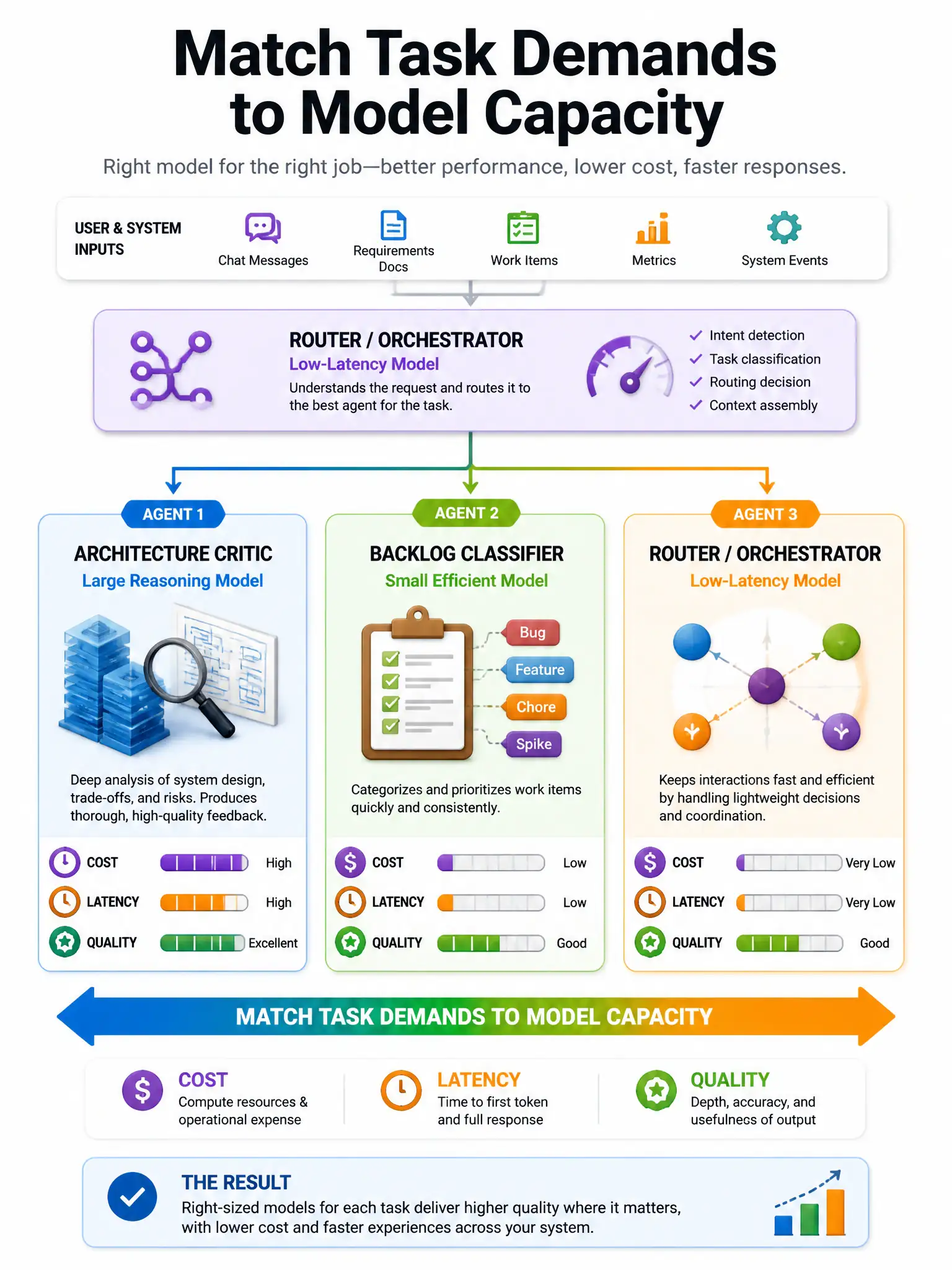
Short Explanation
You should match each agent to the model that fits its job: use a stronger reasoning model for high-stakes architecture critique, a smaller cheaper model for bulk low-risk classification, and a low-latency model for orchestrator routing. That mix improves cost, latency, and reliability instead of wasting budget or underpowering critical work.
Full Explanation
The correct strategy is to match task demands to model family capacities across the multi-agent system. Different agents have different reasoning depth, latency, and cost envelopes, so use a stronger reasoning model for architecture critique, a smaller or cheaper model for bulk low-risk classification, and a low-latency model for orchestrator routing. Using the largest, most expensive frontier model for every agent and every step is wrong because uniform frontier models waste tokens on simple routing or classification and can harm latency SLOs. Using only on-device tiny models for all three tasks is wrong because tiny on-device models may fail high-stakes architecture critique quality requirements. Randomly alternating models per request is wrong because random model switching undermines evaluation baselines, caching, and incident analysis. Document per-agent model SKUs, fallbacks, and quality gates in the logical architecture.