
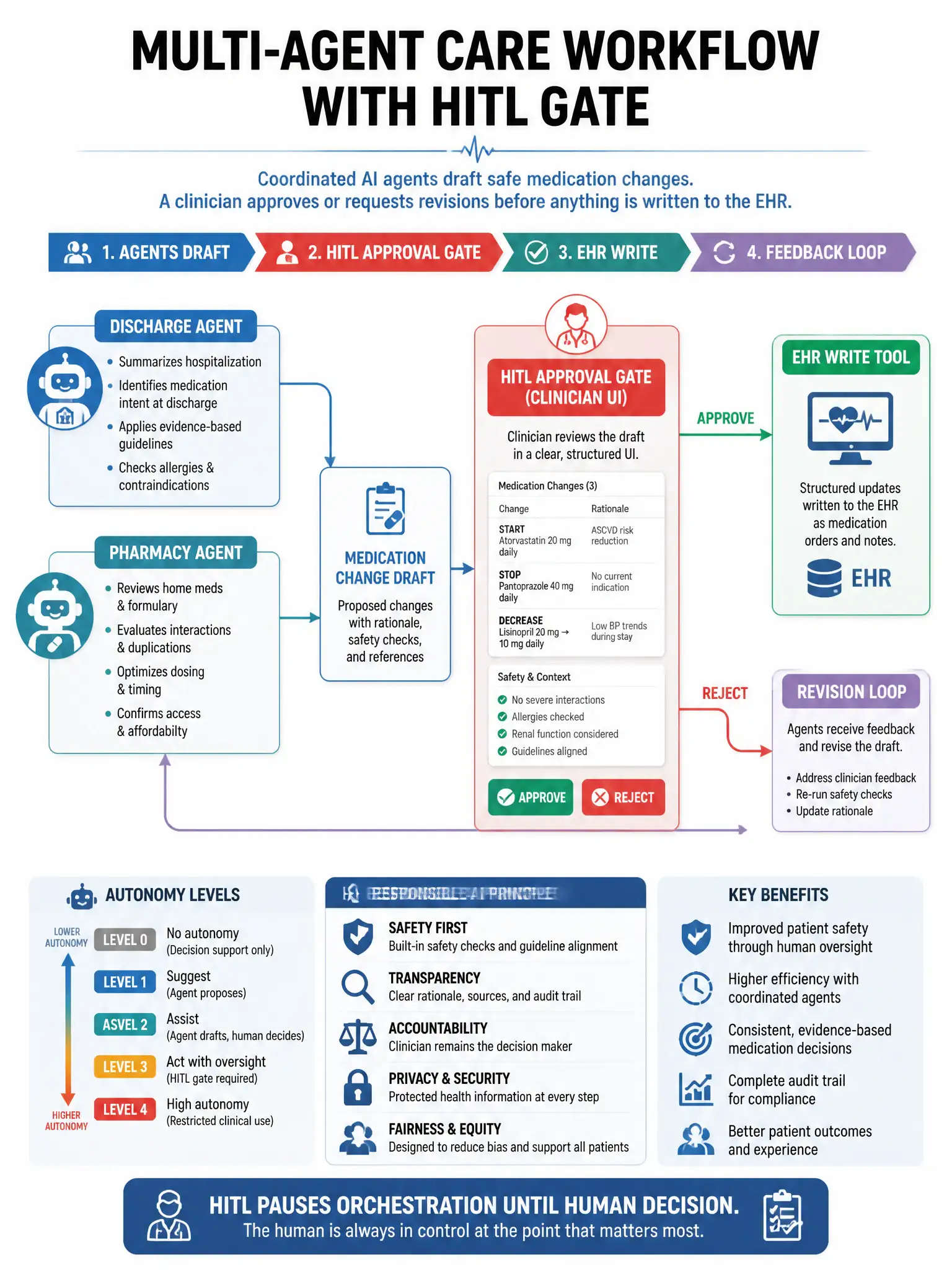
A healthcare network designs a multi-agent care-coordination solution. Agents can draft discharge summaries, propose medication changes, and schedule follow-ups. Clinical leadership requires that any medication change recommendation be reviewed by a licensed clinician before it is written to the electronic health record (EHR). Which architectural control best satisfies this requirement?
Select an answer to reveal the explanation.
Short Explanation
The approval workflow is the right control because medication changes need a clinician gate before EHR writes. You pause the orchestration, let the clinician approve or override, then resume. That’s human-in-the-loop, not prompt vibes.
Full Explanation
The correct control is the human-in-the-loop approval workflow that pauses the orchestration after medication recommendations are generated and resumes only after clinician override or approval. Multi-agent logical architecture must specify autonomy levels and human-AI experience controls. For medication changes, generate recommendations, pause the control loop, require clinician approval or override, then allow EHR write tools to execute. Allowing full EHR write access with prompt-only guidance is wrong because prompt-only guidance is not an enforceable permission boundary; tool authentication and scopes must prevent unapproved writes. Increasing temperature so recommendations are more conservative is wrong because temperature adjusts generation diversity, not compliance or clinical sign-off. Merging the discharge and pharmacy agents is wrong because consolidating agents does not create an approval gate and can concentrate privilege. Bind high-risk tools to post-approval execution paths and record the human decision in workflow state for audit. Exam caveat: HITL means approval workflows, overrides, and edge-case handling wired into the architecture, not vibes in the system prompt.