
Contoso Insurance is designing a multi-agent system in Microsoft Foundry to process complex commercial claims. Business goals include document intake, fraud risk scoring, policy coverage matching, reserve estimation, and adjuster handoff. The solution architect must decompose these goals into agents and workflows. Which design approach best matches production multi-agent architecture practices?
Select an answer to reveal the explanation.
Short Explanation
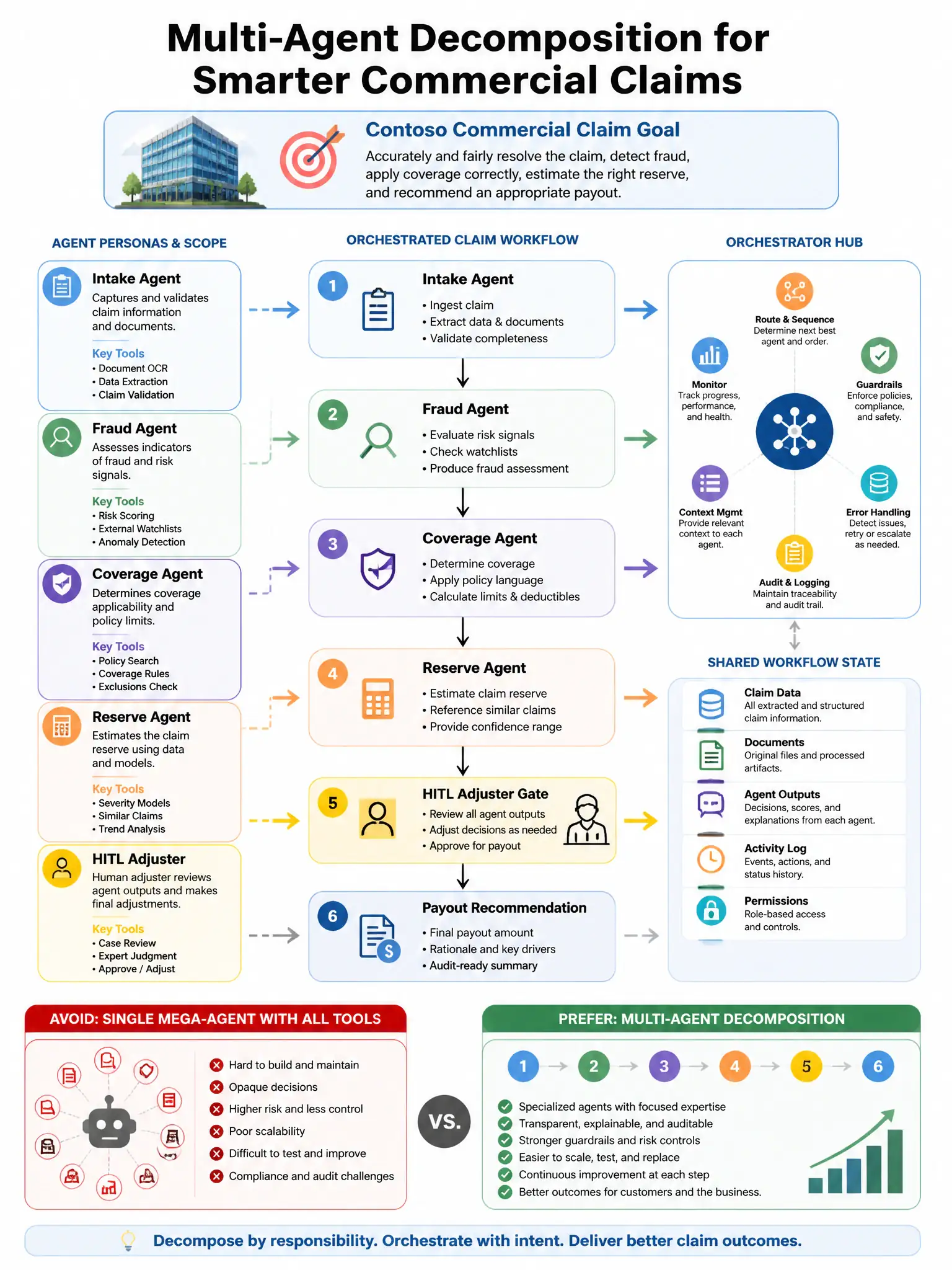
You want specialist agents for intake, fraud scoring, coverage matching, and reserve estimation, then wire them through an orchestrated workflow with explicit handoffs and a human gate before payout recommendations. That keeps each agent scoped, auditable, and safe for regulated claim money. The other approaches either overload one agent, skip coordination, or try to replace tools and workflow with a prompt.
Full Explanation
The correct design creates specialized agents for intake, fraud scoring, coverage matching, and reserve estimation, then composes them in an orchestrated workflow with explicit handoffs and a human-in-the-loop gate before payout recommendations. Expert multi-agent architecture decomposes objectives into workflows, agents, subagents, tools, and human-in-the-loop control points. Specialist agents with clear scopes and an orchestrated handoff path match the claims lifecycle and support auditability, least privilege, and failure isolation in Microsoft Foundry-style solutions. The single generalist agent with every tool attached is incorrect because unbounded tools violate scope and permission boundaries and make behavioral guidelines and tool authentication harder to enforce. The four independent chatbots that email results to a shared mailbox are incorrect because independent chatbots without orchestration, shared state, or defined protocols do not constitute a coordinated multi-agent solution. The one long system prompt with tool calling disabled is incorrect because prompt-only designs cannot implement tool scopes, durable workflow state, or reliable human approval gates required for regulated payout recommendations. Exam focus: decompose goals into agents, tools, and control loops, not monolith prompts. Operational check: design personas, scopes, and control loops first, then wire protocols and memory.