
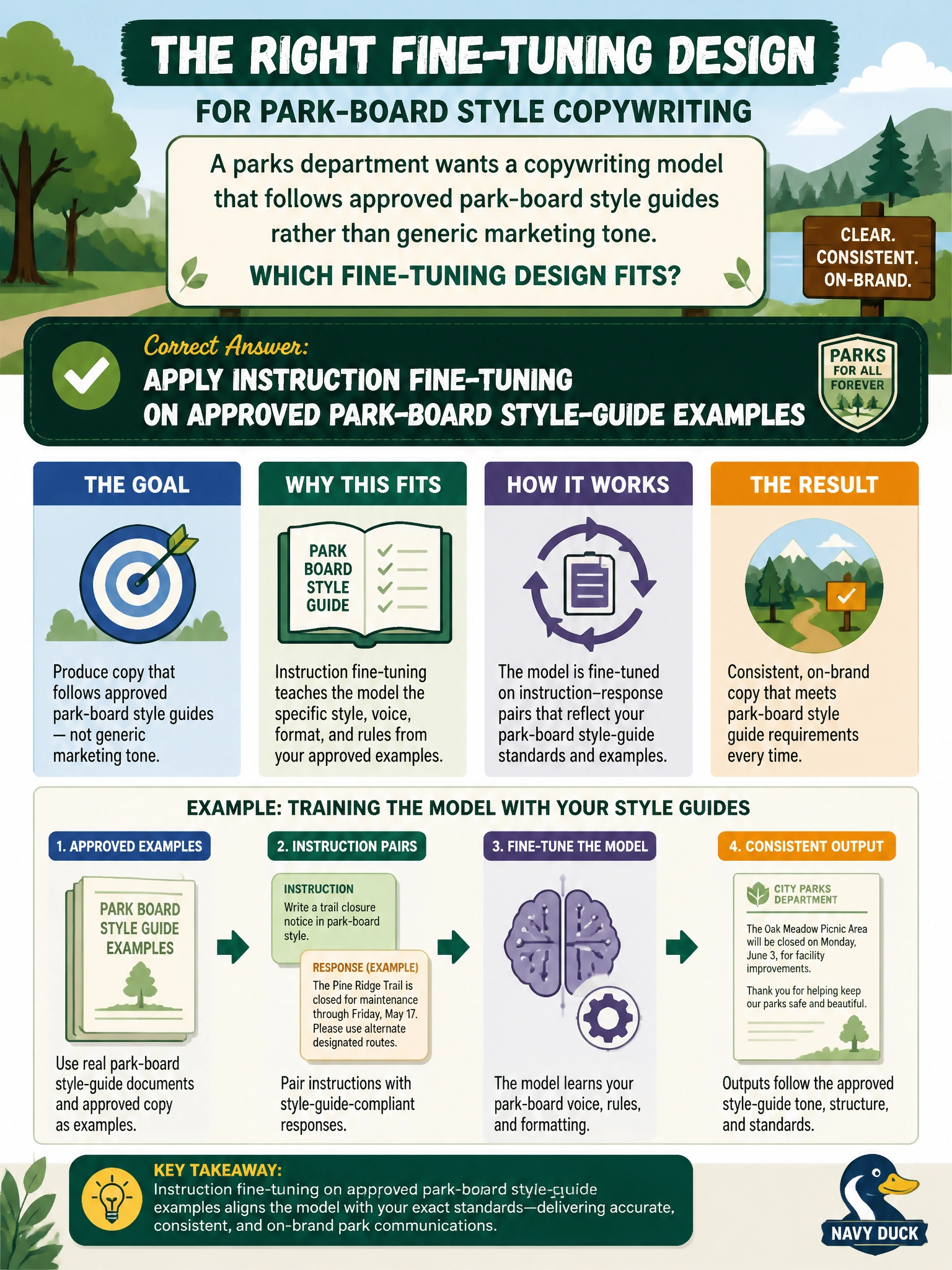
A parks department wants a copywriting model that follows approved park-board style guides rather than generic marketing tone. Which fine-tuning design fits?
Select an answer to reveal the explanation.
Short Explanation
You'll see the park board's own examples are what teach its voice, while national park-service examples will pull you toward a different authority's rules. You'll get city-ready copy from approved style-guide examples, while meeting transcripts will leave you with bureaucratic cadence that misses the style rules. You'll find evaluations won't teach drafting because they're for scoring, so they can't replace example-based tuning.
Full Explanation
Applying instruction fine-tuning on approved park-board style-guide examples fits a parks department that wants copywriting following official style rather than generic marketing tone. Instruction fine-tuning on governed examples teaches the model to follow municipal voice, formatting, and prohibited claims documented by the park board. That is a data-aligned customization, not a vague instruction alone.
Applying instruction fine-tuning on national park-service style-guide examples teaches the wrong authority's voice and rules, so it pulls outputs toward national wording and formatting instead of the local park-board's approved style. Applying instruction fine-tuning on approved park-board meeting transcripts trains on administrative discussion and meeting cadence, which often fails to enforce detailed style-guide rules and risks bureaucratic jargon that does not suit engaging park copy. Applying instruction fine-tuning on approved park-board style-guide evaluations trains the model to grade or score style compliance rather than to draft copy in that style, so it lacks the generative examples needed for voice, formatting, and claims.
Exam caveat: when stems emphasize approved style guides versus generic tone, prefer instruction fine-tuning on those approved materials over national park-service style-guide examples, approved park-board meeting transcripts, or approved park-board style-guide evaluations. Style customization is not the same as RAG retrieval of the style PDF unless the question asks only for grounding at inference.
Operational check: assemble park-board-approved style examples as instruction pairs, fine-tune, score outputs on a style rubric (voice, claims, inclusivity), compare against national park-service style-guide and meeting-transcript baselines, and block release if evaluation-style grading language or off-board voice reappears.
Prefer to study offline? Printable PDF study book + test engine ($7.50, unofficial). These questions stay free here.