
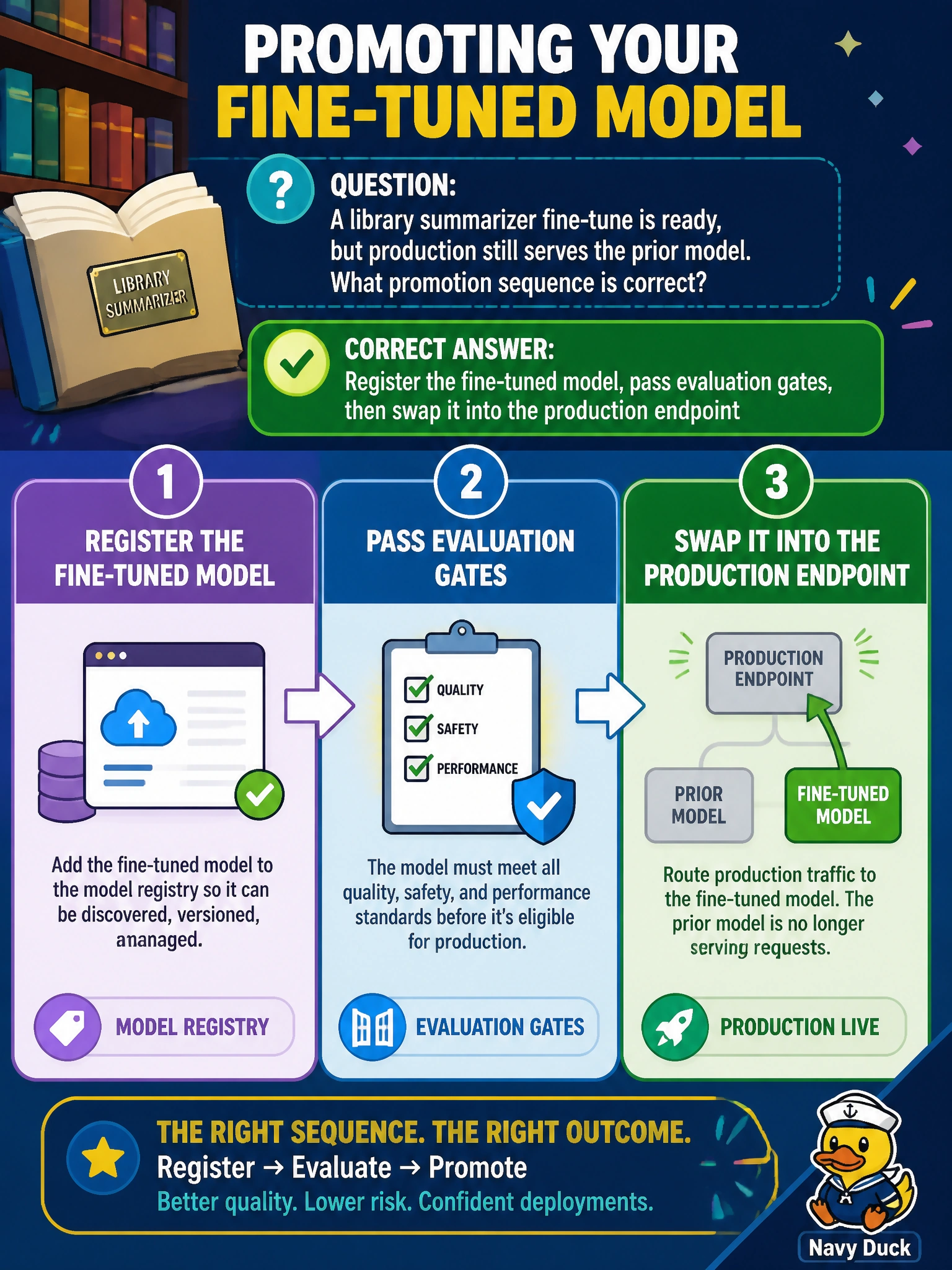
A library summarizer fine-tune is ready, but production still serves the prior model. What promotion sequence is correct?
Select an answer to reveal the explanation.
Short Explanation
Register it, prove it, then swap it—like checking a new catalog system before cutting over the OPAC. If you run the gates before you've registered it, you'll have scores with no versioned lineage to hold them. Versioned promotion keeps the trail clean.
Full Explanation
Registering the fine-tuned model, passing evaluation gates, then swapping it into the production endpoint is the correct promotion sequence when a library summarizer fine-tune is ready but production still serves the prior model. Registration creates lineage; evaluation gates prove fitness; controlled endpoint swap completes cutover without silent overwrite. That ordered lifecycle is how GenAIOps moves a library summarizer from ready artifact to resident-facing service.
Passing evaluation gates on the fine-tuned model before registering it and then swapping it into the production endpoint inverts lineage and accountability; gates must run against a registered version so scores attach to immutable lineage before any cutover. Registering the fine-tuned model, collecting patron usage metrics, then swapping it into the production endpoint skips required evaluation gates; patron usage signals cannot prove fitness before cutover, so an unvalidated summarizer would reach residents without a controlled quality clearance. Registering the fine-tuned model, passing evaluation gates, then deploying it as a new production endpoint creates a parallel serving path instead of completing cutover; a controlled swap into the existing production endpoint preserves routing, version history, and instant rollback.
Exam caveat: promotion sequence questions want register → evaluate → swap into the existing endpoint (often with canary), not evaluate-before-register, metrics-for-gates, or spinning up a separate production endpoint. Version history remains after cutover for rollback.
Operational check: register the summarizer checkpoint in the model catalog, record eval gate results, swap the production endpoint through a controlled deployment, verify hold-summary quality on a smoke set, and retain the prior endpoint version for instant rollback.
Prefer to study offline? Printable PDF study book + test engine ($7.50, unofficial). These questions stay free here.