
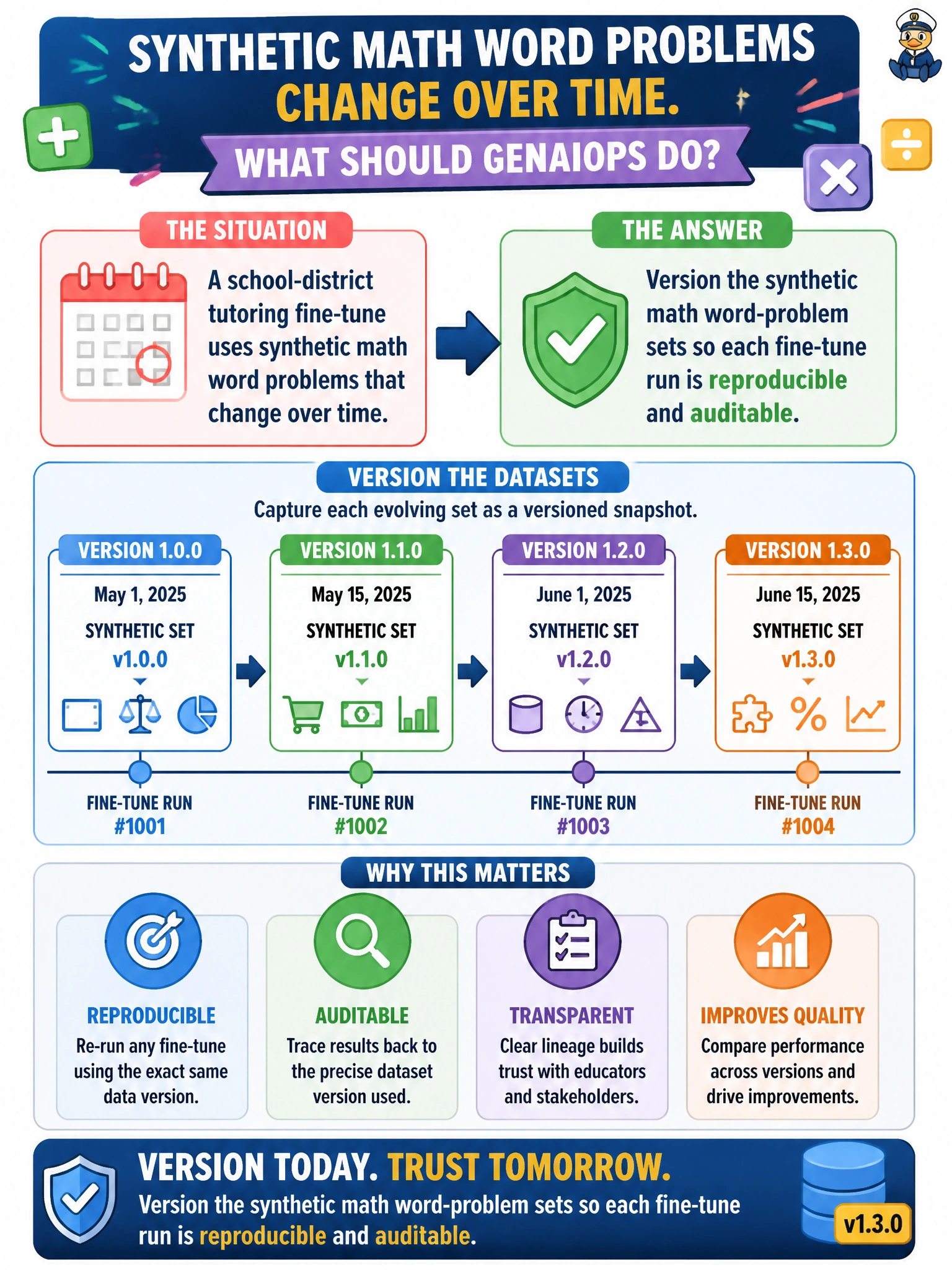
A school-district tutoring fine-tune uses synthetic math word problems that change over time. What should GenAIOps do with those datasets?
Select an answer to reveal the explanation.
Short Explanation
Synthetic datasets are ingredients—label the jars. Versioning word-problem sets lets the district reproduce and audit which mix trained which tutoring checkpoint. Caching the sets in temporary storage speeds things up, but you'll lose history when it's wiped, so you can't reproduce which mix trained which checkpoint.
Full Explanation
Versioning the synthetic math word-problem sets so each fine-tune run is reproducible and auditable is what GenAIOps should do when a school-district tutoring fine-tune uses synthetic problems that change over time. Versioned datasets tie each checkpoint to an exact training mix, support rollback when quality drops, and satisfy audit expectations for student-facing systems. Changing synthetic corpora without versions makes regressions unexplained. Caching the synthetic math word-problem sets in temporary training storage to speed fine-tune runs improves speed but uses ephemeral storage without version history, so it cannot make each training run reproducible or auditable. Logging the synthetic math word-problem token counts in the experiment tracker to compare run performance tracks size metrics for comparison, yet it does not version the synthetic word-problem sets or tie a checkpoint to an exact dataset version. Publishing the synthetic math word-problem sets to the staging model registry for validation testing puts datasets in a model registry for release validation rather than versioning them, and it does not ensure the underlying training mix is reproducible. Exam caveat: synthetic data is allowed and useful, but exam items that mention changing synthetic sets almost always want versioning and auditability. Publishing the synthetic sets to the staging model registry stores data in the wrong system for release validation, but it cannot substitute for versioned synthetic datasets. Operational check: store each synthetic word-problem snapshot with a version ID and checksum, record which version trained which tutoring checkpoint, evaluate each run on a fixed math rubric, and remember that temporary caching, token-count logs, and publishing to the staging model registry do not replace versioning the synthetic datasets themselves.
Prefer to study offline? Printable PDF study book + test engine ($7.50, unofficial). These questions stay free here.