
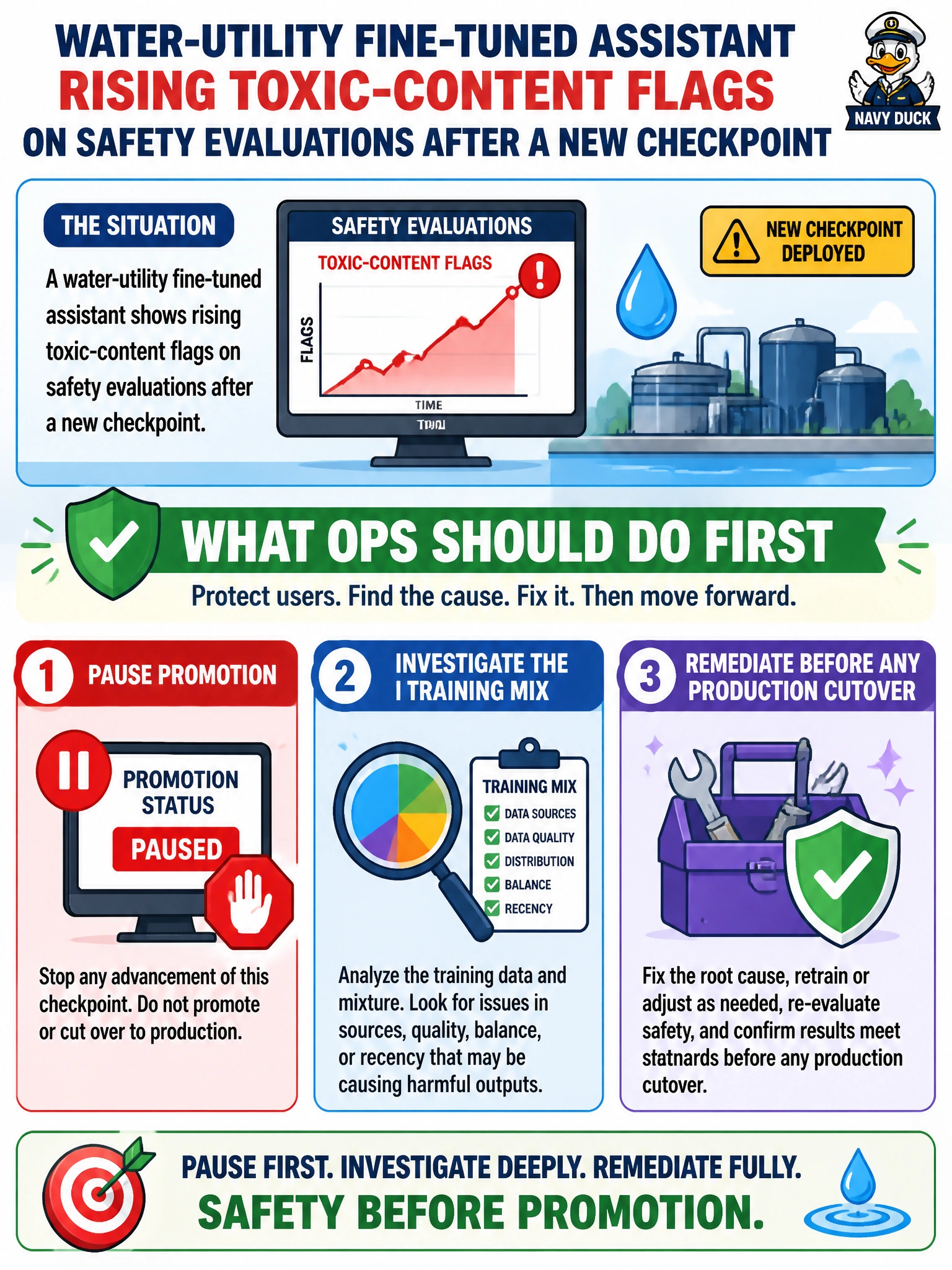
A water-utility fine-tuned assistant shows rising toxic-content flags on safety evaluations after a new checkpoint. What should ops do first?
Select an answer to reveal the explanation.
Short Explanation
Rising toxic flags are a stop sign, not a suggestion. Pause the promotion, dig into what landed in the training mix, and fix it before residents see that checkpoint. Digging through prompt versions won't explain it when the regression came from fine-tuning, so you'll miss the training mix that caused the flags.
Full Explanation
Pausing promotion, investigating the training mix, and remediating before any production cutover is required when a water-utility fine-tuned assistant shows rising toxic-content flags on safety evaluations. Safety regressions are release blockers: continuing to push the checkpoint risks resident-facing harm and policy violations. Investigation of data mix, filters, and recent training changes is the GenAIOps response before cutover.
Pausing promotion to investigate the serving traces misdirects the response to serving infrastructure and request logs, which cannot explain a safety regression introduced by a new fine-tuned checkpoint, and it leaves the training mix unexamined. Pausing promotion to investigate the prompt versions misattributes the toxic-content flags to system-prompt changes rather than to the new training data and filtering, so the offending mix that caused the regression remains unfixed. Pausing promotion to investigate the helpfulness ratings conflates user satisfaction with safety; a checkpoint can score well on helpfulness while still producing elevated toxic content on the prompts the safety suite is designed to catch, so helpfulness review does not remediate the training mix.
Exam caveat: rising safety flags after fine-tuning mean stop-and-remediate, not tune-and-ship. Distinguish safety regressions from mild quality noise; toxic-content signals specifically call for pause and training-mix review.
Operational check: halt promotion pipelines for the flagged checkpoint, diff training data against the last clean mix, remove or reweight offending sources, re-run the full safety suite plus water-utility FAQ quality tests, and only then reconsider canary with heightened monitoring.
Prefer to study offline? Printable PDF study book + test engine ($7.50, unofficial). These questions stay free here.