
A 311 knowledge base of long PDFs retrieves noisy chunks that miss the right procedure. Which chunking change often improves civic RAG?
Select an answer to reveal the explanation.
Short Explanation
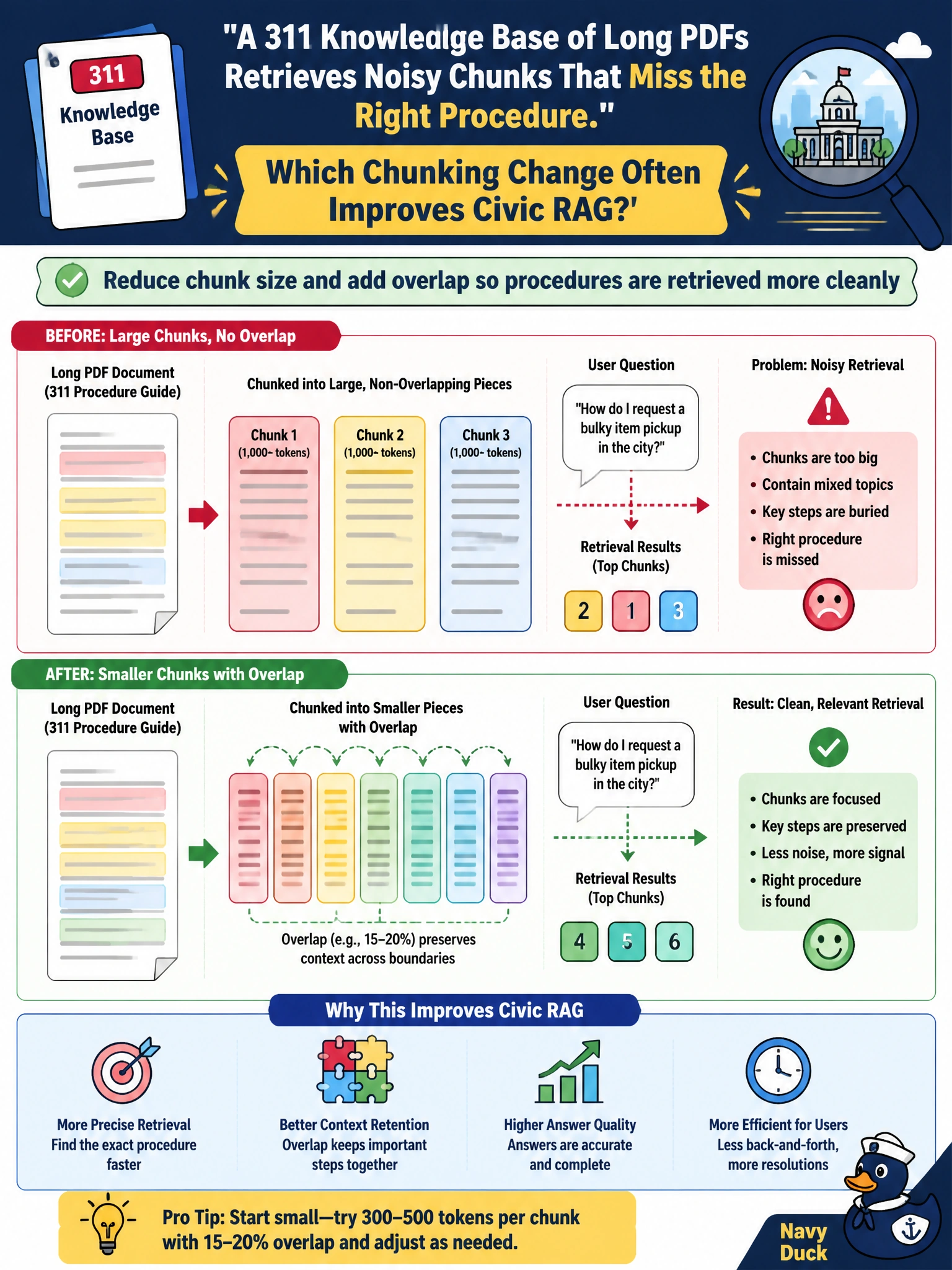
Making your chunks bigger with less overlap is like stuffing a whole binder into one bite — you'll mix procedures together and lose continuity. Smaller chunks with a little overlap usually retrieve the right 311 procedure cleaner.
Full Explanation
Reducing chunk size and adding overlap so procedures are retrieved more cleanly is correct because oversized chunks from long 311 PDFs mix multiple procedures into one embedding, diluting similarity and returning noisy context. Smaller chunks focused on a single procedure or section, with modest overlap to preserve cross-boundary sentences, typically improve retrieval precision for municipal how-to content. That chunking change is a standard civic RAG remediation when long PDFs miss the right procedure.
Increasing chunk size and reducing overlap so procedures are retrieved more cleanly moves in the wrong direction for this failure mode—bigger chunks mix even more procedures into one embedding while reduced overlap breaks cross-boundary sentences rather than fixing similarity dilution. Splitting long PDFs at page breaks so procedures are retrieved more cleanly keeps multi-procedure pages intact, so chunks still blend unrelated steps and retrieval remains noisy. Expanding overlap to half chunk size so procedures are retrieved more cleanly does not fix oversized chunks that mix multiple procedures, it just duplicates large amounts of text across chunks, inflating the index and adding redundancy without improving retrieval precision.
Exam caveat: long-document RAG quality hinges on chunk size and overlap. Noisy procedure retrieval → smaller chunks + overlap; not bigger chunks with reduced overlap, not page-break splits, not half-chunk overlap.
Operational check: re-ingest the 311 PDF corpus with reduced chunk size and configured overlap, rebuild the index, compare retrieval and answer metrics on a fixed procedure eval set, spot-check that multi-step procedures still stitch via overlap, and roll forward when precision improves without unacceptable recall loss.
Prefer to study offline? Printable PDF study book + test engine ($7.50, unofficial). These questions stay free here.