
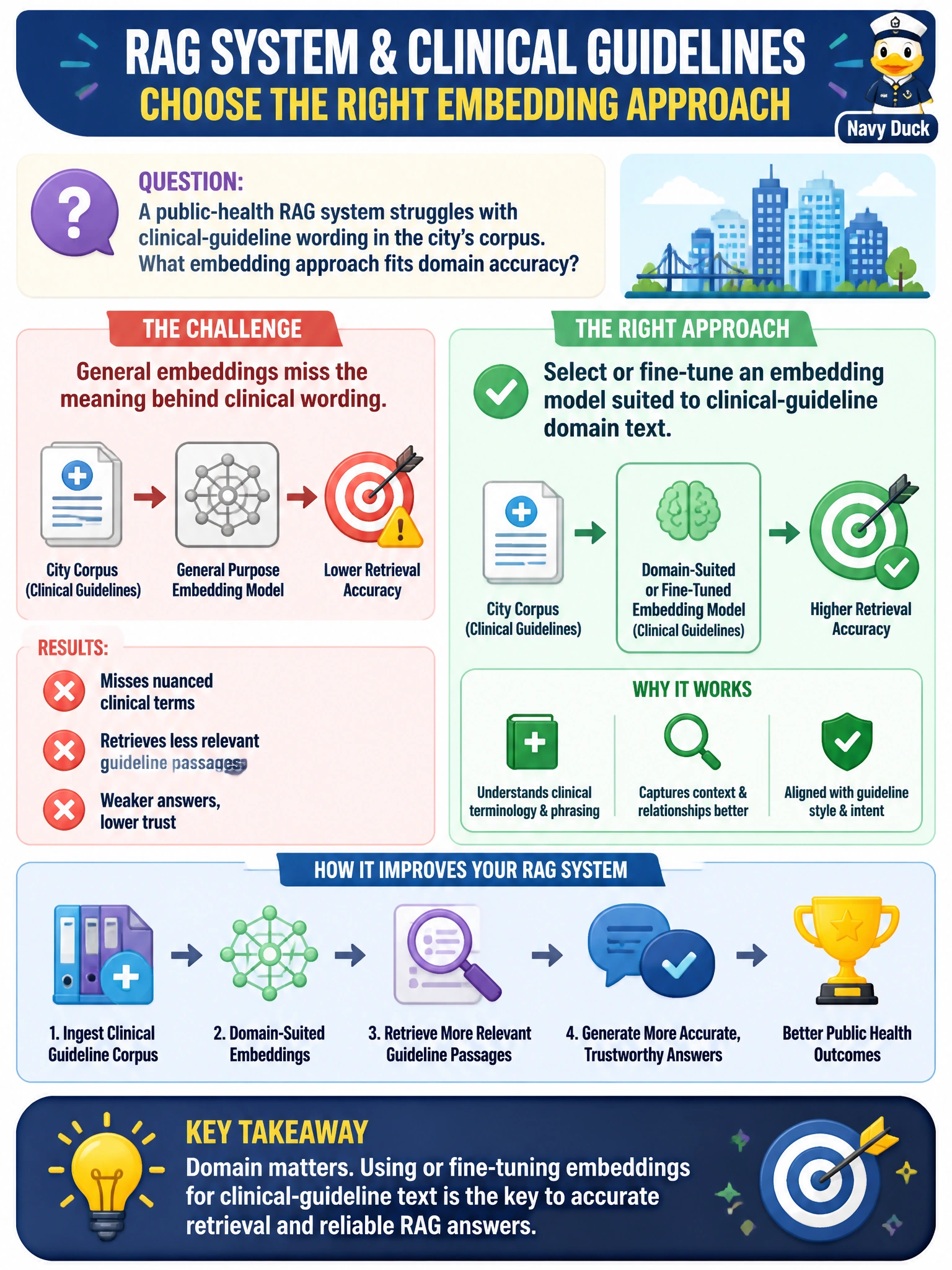
A public-health RAG system struggles with clinical-guideline wording in the city’s corpus. What embedding approach fits domain accuracy?
Select an answer to reveal the explanation.
Short Explanation
Clinical guideline jargon trips generic embeddings. Pick or fine-tune an embedding model that understands that domain language. You'll still miss the vocabulary gap with models built for web-search queries, support-chat transcripts, or code search since they don't understand clinical-guideline language.
Full Explanation
Selecting or fine-tuning an embedding model suited to clinical-guideline domain text is correct because embedding quality drives semantic retrieval of specialized vocabulary. A public-health RAG system that struggles with clinical-guideline wording in the city’s corpus needs vectors that understand that domain language—symptoms, prophylaxis, reporting terms—better than a generic embedding may. Choosing a domain-appropriate embedding model or fine-tuning on municipal clinical-guideline text improves retrieval accuracy for resident and clinician questions.
Selecting or fine-tuning an embedding model suited to general web-search query text keeps vectors optimized for short, broad web queries rather than clinical-guideline vocabulary, so it still misses the specialized symptoms, prophylaxis, and reporting terms needed for this corpus. Selecting or fine-tuning an embedding model suited to product-support chat transcripts optimizes for troubleshooting dialogue and conversational support language rather than clinical-guideline text, so retrieval still fails on the domain-specific medical wording. Selecting or fine-tuning an embedding model optimized for code-search retrieval tasks tunes vectors for programming syntax and code semantics, which does not transfer to clinical-guideline phrasing and leaves paraphrased resident and clinician questions unsupported.
Exam caveat: domain-specific RAG often needs domain-suited (or fine-tuned) embeddings. Clinical-guideline wording struggle → clinical-guideline embedding selection/adaptation, not web-search, product-support chat, or code-search embeddings.
Operational check: benchmark general versus domain or fine-tuned embeddings on a public-health guideline eval set (retrieval recall@k and downstream answer groundedness), pick the better embedding, re-index the city corpus, and monitor live groundedness after cutover.
Prefer to study offline? Printable PDF study book + test engine ($7.50, unofficial). These questions stay free here.