
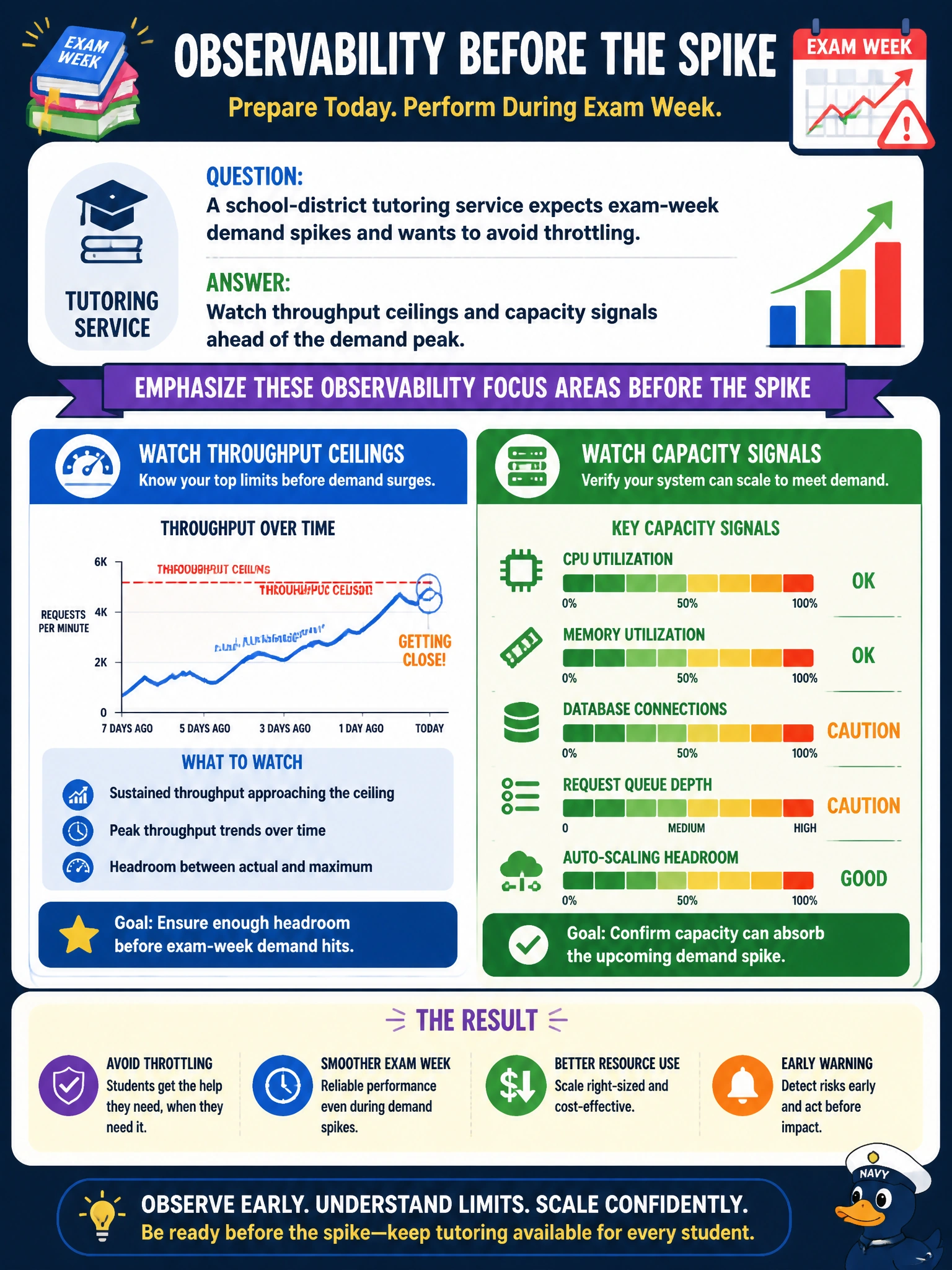
A school-district tutoring service expects exam-week demand spikes and wants to avoid throttling. What should observability emphasize beforehand?
Select an answer to reveal the explanation.
Short Explanation
Exam week will hammer the tutoring bot. Watch throughput ceilings now so you see capacity risk before students get throttled.
Full Explanation
Watching throughput ceilings and capacity signals ahead of the demand peak is correct because throughput monitoring supports capacity planning before known load events. A school-district tutoring service that expects exam-week spikes must observe current throughput, saturation, queue depth, throttling, and quota headroom now—while there is still time to scale endpoints, raise limits, or add caching—rather than discovering ceilings when students are already blocked. Observability emphasis beforehand converts forecasted civic demand into concrete capacity actions.
Tracking inference latency trends for steady sessions ahead of the demand peak misses the point because latency under normal classroom load does not reveal throughput ceilings or saturation under exam-week concurrency, so it cannot prevent throttling during the spike. Checking batch scoring rates for offline grading jobs ahead of the demand peak misses the point because offline batch throughput does not reveal live tutoring-endpoint ceilings or saturation under exam-week concurrency, so it cannot prevent throttling during the spike. Tracking client retry counts and backoff events in logs ahead of the demand peak misses the point because retries and backoffs are reactive signals after throttling has started, not proactive throughput ceilings that let you scale before exam-week concurrency hits.
Exam caveat: when the stem cites expected demand spikes and avoiding throttling, choose proactive throughput/capacity monitoring—not steady-session latency trends, batch scoring rates for offline grading jobs, or client retry counts and backoff events.
Operational check: baseline tutoring-endpoint throughput and error/throttle rates under synthetic load approximating exam week, compare to forecasted concurrent students, scale or reserve capacity (including any Foundry/Azure quotas), set alerts on approach-to-ceiling, and keep the dashboard staffed through the exam window.
Prefer to study offline? Printable PDF study book + test engine ($7.50, unofficial). These questions stay free here.