
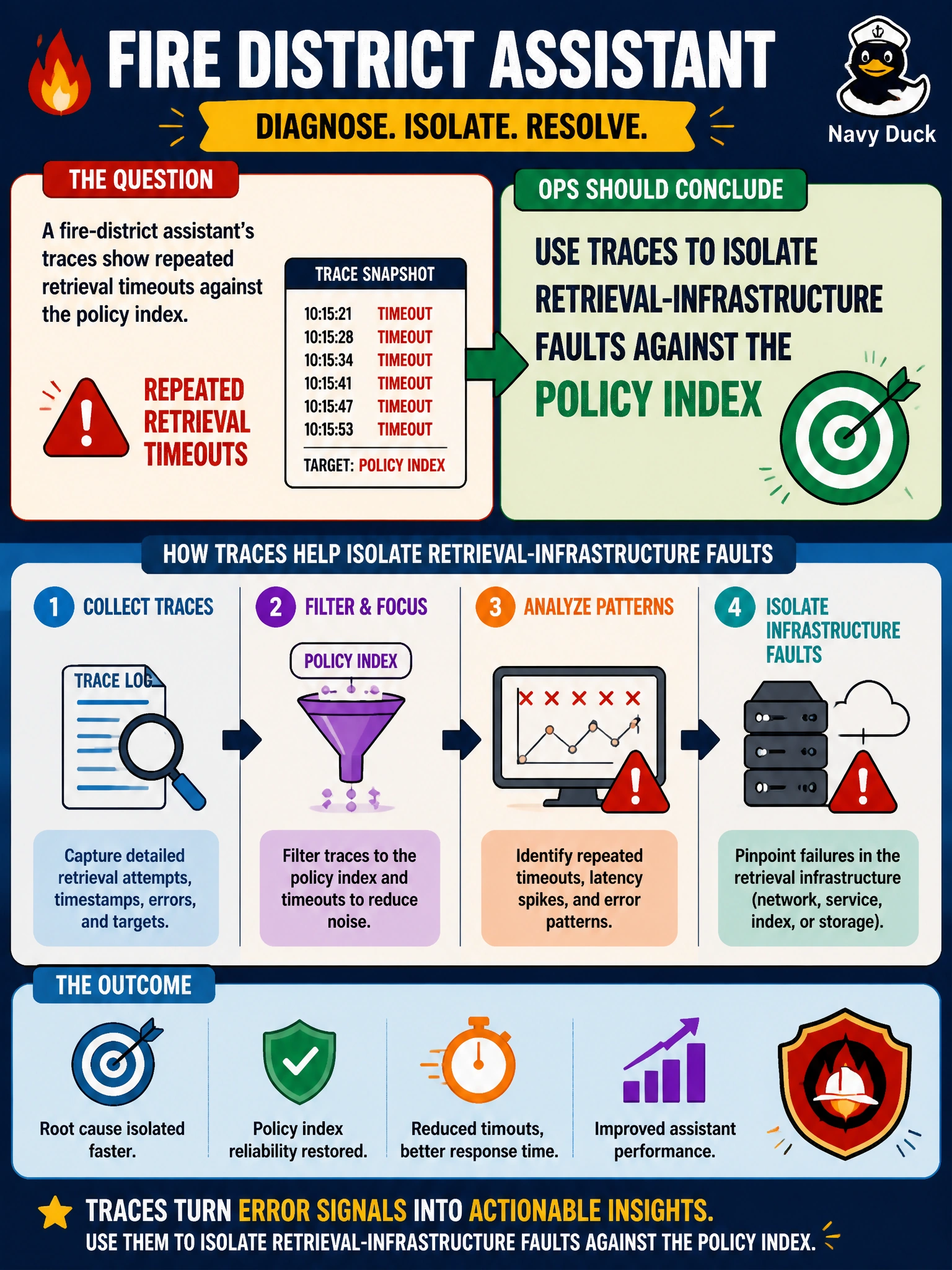
A fire-district assistant’s traces show repeated retrieval timeouts against the policy index. What should ops conclude?
Select an answer to reveal the explanation.
Short Explanation
You've got repeated retrieval timeouts, so you'll trace it to index or search trouble. Embedding drift in stored vectors would give you poor hits, but you'll see deadline failures here.
Full Explanation
Using traces to isolate retrieval-infrastructure faults against the policy index is correct because end-to-end GenAI traces show which pipeline stage fails. Repeated retrieval timeouts in a fire-district assistant’s traces localize the problem to search/index latency, connectivity, or capacity—not to insufficient context window for the policy documents. Ops should follow the trace into the retrieval dependency, remediate the policy index or search service, and confirm timeout disappearance before considering model-level changes.
Using traces to confirm insufficient context window for the policy documents misattributes an infrastructure timeout to a modeling issue; a context-window limit would show up as truncated or dropped content, not as a retrieval call that fails to return within its deadline. Using traces to attribute policy timeouts to model hallucination patterns confuses output quality with infrastructure failure—the same end-to-end trace that can surface a hallucination here surfaces exactly which span, the retrieval call, timed out. Using traces to tie policy-index timeouts to embedding drift in stored vectors is premature; the traces point to the policy-index retrieval path, not to stale embeddings, and re-embedding won’t fix a search service that is slow or unreachable.
Exam caveat: trace-driven isolation precedes broad remediations. Retrieval timeouts → fix retrieval/index infrastructure; do not tie them to embedding drift in stored vectors before confirming the retrieval path.
Operational check: open failing traces, confirm timeout spans on the policy-index retrieval calls, check search service health, latency, and quotas, remediate (scale, fix network, rebuild index), replay representative fire-policy queries, and verify traces show successful retrieval within SLO before closing the incident.
Prefer to study offline? Printable PDF study book + test engine ($7.50, unofficial). These questions stay free here.