
A parks event bot needs support tickets linked to GenAI traces for faster triage. What logging practice enables that?
Select an answer to reveal the explanation.
Short Explanation
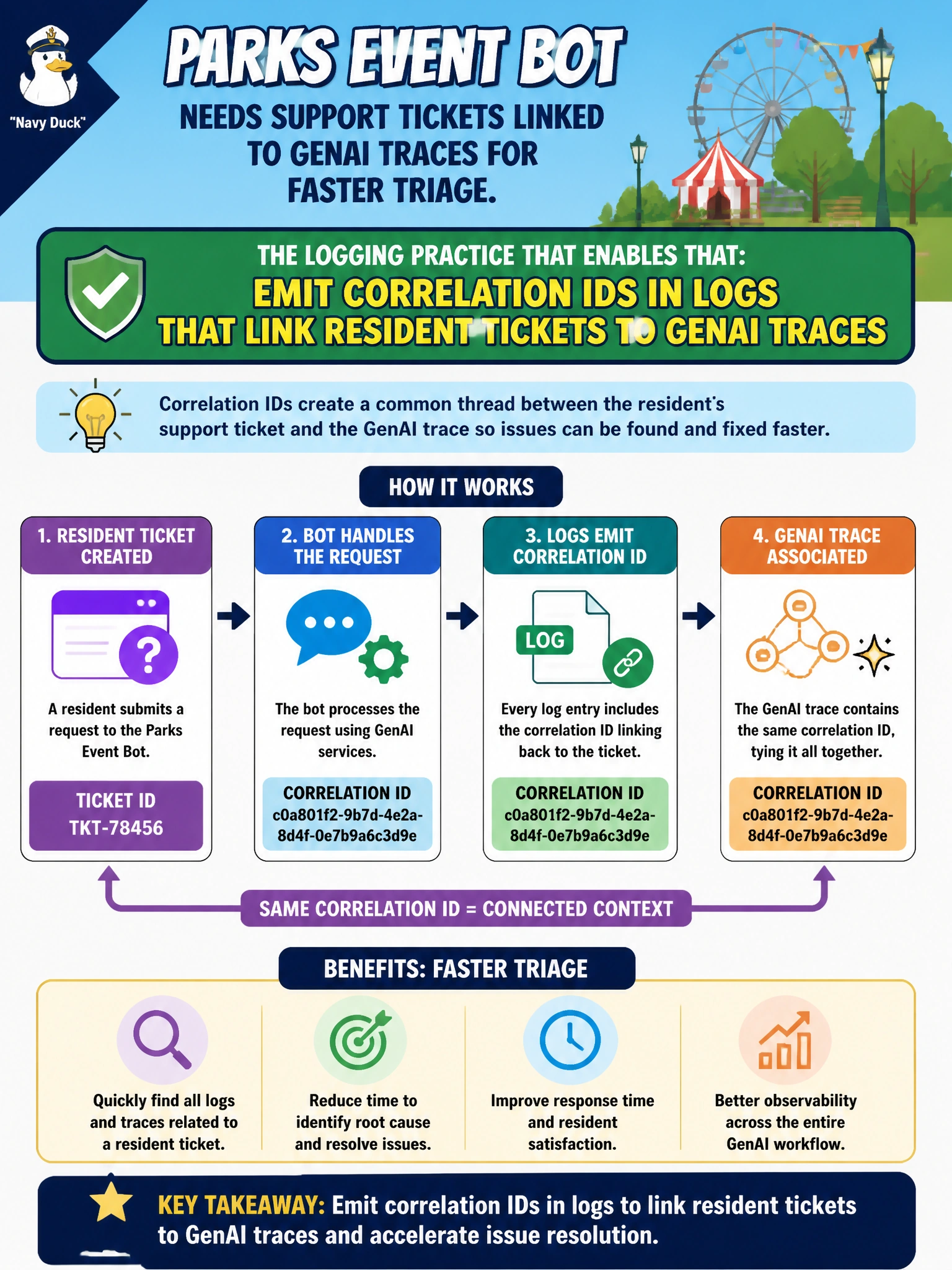
Support moves faster when a ticket ID hooks into the GenAI trace. Correlation IDs are the zipper between resident tickets and logs.
Full Explanation
Emitting correlation IDs in logs that link resident tickets to GenAI traces is correct because support triage depends on joining human-reported problems to the exact generative request path. A parks event bot that generates support tickets needs a shared identifier—request ID, conversation ID, or correlation ID—present in both the ticket and the GenAI traces/logs. That link lets municipal support open the failing span, see prompts, retrieval, tool calls, and errors, and resolve event-registration or schedule issues faster.
Logging the same duplicate request ID for resident tickets with GenAI traces reuses a single identifier across many requests and does not create a unique shared identifier between a specific ticket and its GenAI trace, so triage cannot open the exact failing span. Caching correlation IDs in the ticket UI linking resident tickets to GenAI traces keeps the identifier in the client view but does not emit it in logs alongside the GenAI traces, so support still cannot jump straight to the relevant run during triage. Emitting correlation IDs in metrics aggregating resident tickets over GenAI traces rolls activity into aggregate counts but does not preserve a per-request log link from a specific resident ticket to the GenAI trace that handled that ticket, leaving triage without a direct path to the original request.
Exam caveat: correlated logging/tracing = shared IDs across tickets, app logs, and GenAI traces. The stem asks for faster triage via ticket-to-trace linkage; correlation IDs are the mechanism.
Operational check: generate a correlation ID at request start, propagate it through the parks bot, Foundry/App Insights traces, and the support-ticket form or agent UI, train support to search traces by that ID, and verify mean time to triage drops on a sample of production tickets.
Prefer to study offline? Printable PDF study book + test engine ($7.50, unofficial). These questions stay free here.