
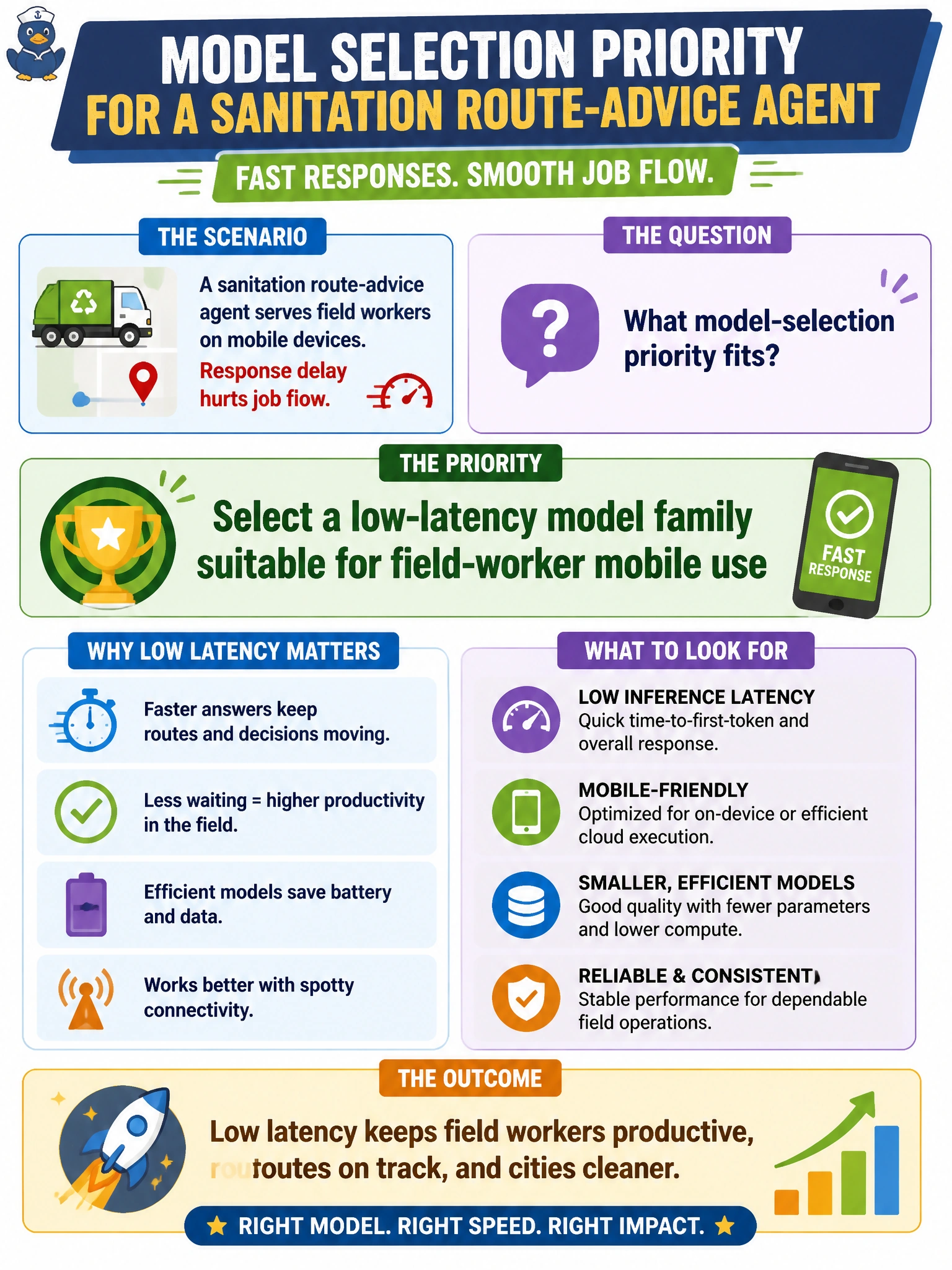
A sanitation route-advice agent serves field workers on mobile devices where response delay hurts job flow. What model-selection priority fits?
Select an answer to reveal the explanation.
Short Explanation
Field crews asking for route advice on a phone need answers now. You'll want a low-latency conversational model for route advice, since a vision sorter handles images, an embedding retriever only indexes documents, and a back-office drafter writes summaries rather than answering your live route questions.
Full Explanation
Selecting a low-latency model family suitable for field-worker mobile use is the correct model-selection priority for a sanitation route-advice agent where response delay hurts job flow. Field crews on mobile devices need near-interactive answers while navigating routes; model families optimized for lower latency (often smaller or efficiently served variants) preserve workflow better than a low-latency vision model optimized for on-device waste sorting that is tuned for image classification rather than conversational route advice. Municipal GenAIOps should treat latency as a first-class selection criterion alongside accuracy for mobile field agents.
Selecting a low-latency vision model optimized for on-device waste sorting fails because waste-sorting vision specialization targets image classification and does not deliver conversational route advice for field navigation. Selecting a low-latency embedding model tuned for route document retrieval fails because embedding models only support retrieval indexing and do not generate direct route-advice answers for field workers. Selecting a lightweight distilled model tuned for back-office summary drafting fails because back-office drafting tuning is optimized for office summaries, not for near-interactive mobile route guidance where delay hurts job flow.
Exam caveat: latency-sensitive mobile field route-advice scenarios prefer low-latency conversational model families; on-device waste sorting, route document retrieval, or back-office summary drafting scenarios use their own specialized models.
Operational check: measure p95 response time of candidate model families on representative route-advice prompts over the field network profile, pick a low-latency option that still meets quality thresholds, and monitor field abandonment or retry rates after release.
Prefer to study offline? Printable PDF study book + test engine ($7.50, unofficial). These questions stay free here.