
A county GenAIOps board requires a canary week when updating foundation models. What deployment pattern satisfies that policy?
Select an answer to reveal the explanation.
Short Explanation
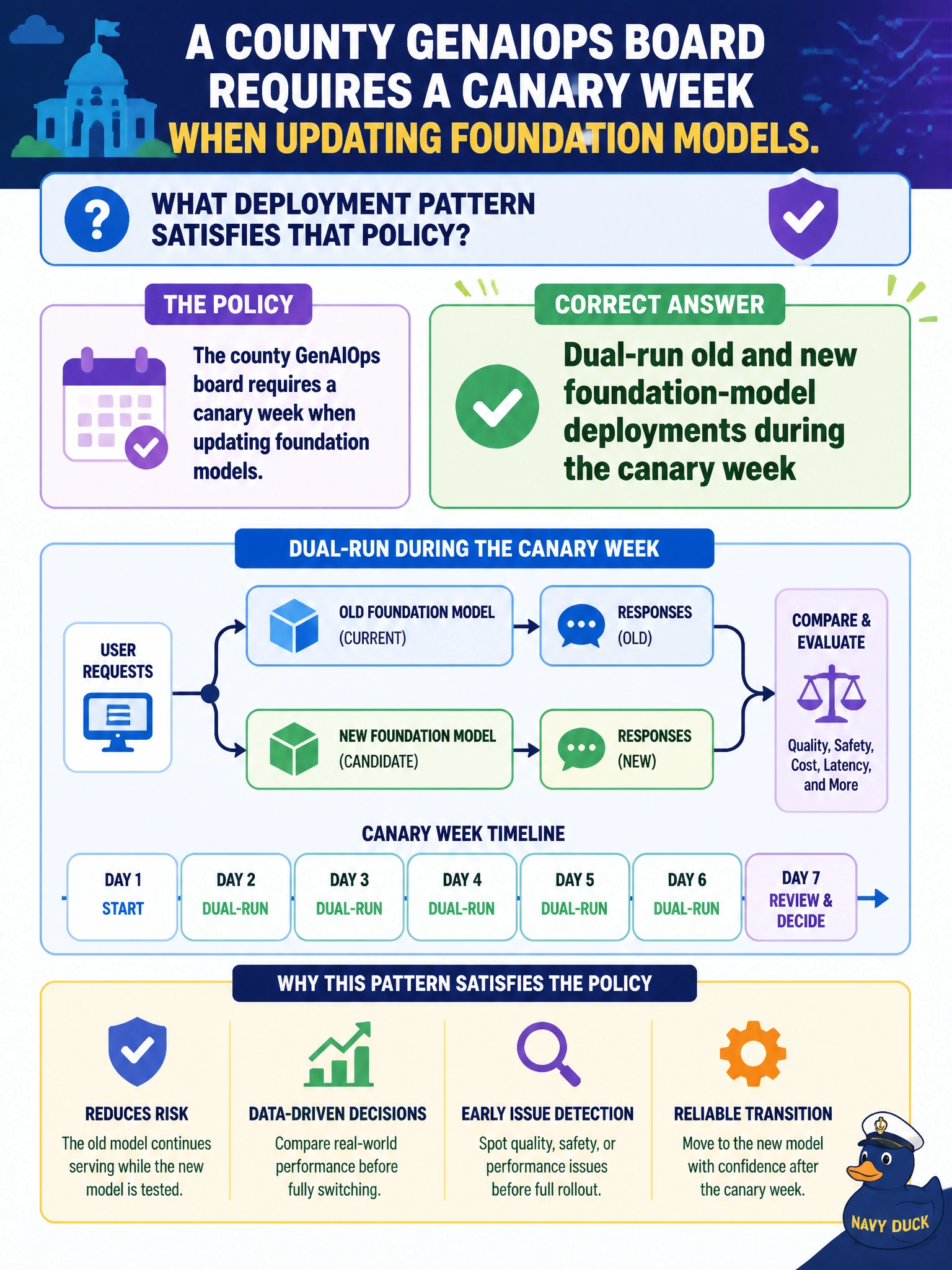
Canary week means both models stay on stage. Dual-run old and new so the county can compare before retiring the veteran.
Full Explanation
Dual-running old and new foundation-model deployments during the canary week satisfies a county GenAIOps board policy that requires a canary week when updating foundation models. Side-by-side deployments keep the prior FM available while a limited or parallel path exercises the new version, enabling comparison of quality, safety, latency, and incident rate before full cutover. That pattern gives the board evidence and a fast rollback path if the new model misbehaves in real civic traffic.
Promoting the new foundation-model deployment to production before the canary week fails because it completes the production cutover before the required canary observation, leaving no dual-run week for comparison and rollback. Testing the new foundation-model deployment in staging for the canary week fails because staging-only exercise is not a production canary in real civic traffic. Scoring mirrored traffic using the new foundation-model deployment during the canary week fails because shadow scoring alone does not dual-run old and new deployments for production serving, comparison, and rollback.
Exam caveat: canary/dual-run is more specific than staging-only testing or scoring mirrored traffic. When policy explicitly requires a canary week, choose dual-run of old and new FM deployments rather than promoting to production before the canary.
Operational check: deploy the new FM alongside the old, shift a controlled traffic fraction or shadow comparisons during the canary week, review board metrics, then complete cutover or roll back while both deployments still exist.
Prefer to study offline? Printable PDF study book + test engine ($7.50, unofficial). These questions stay free here.