
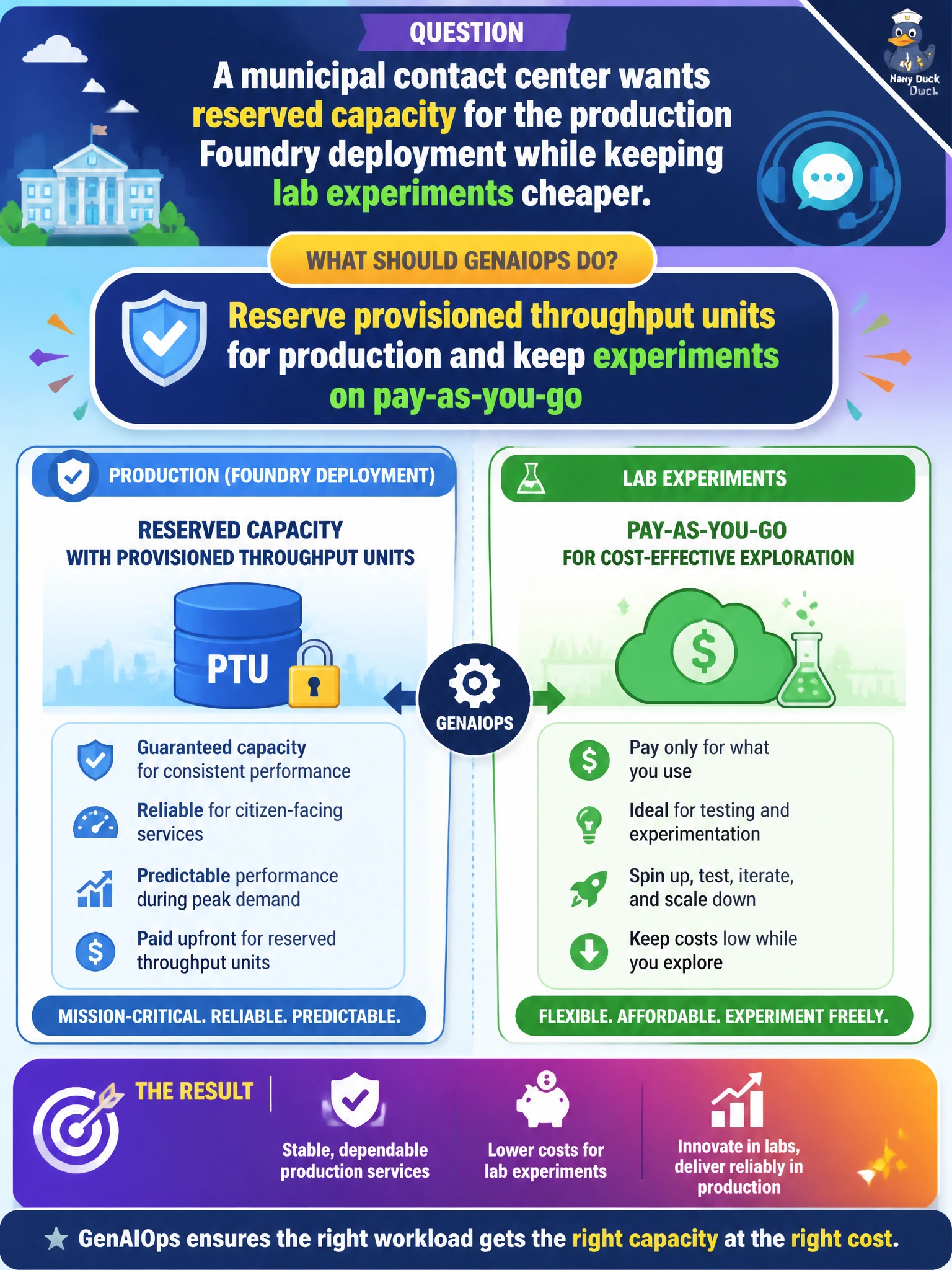
A municipal contact center wants reserved capacity for the production Foundry deployment while keeping lab experiments cheaper. What should GenAIOps do?
Select an answer to reveal the explanation.
Short Explanation
Don't host production and lab on shared PTUs sized for peak production, because you'll let sandbox traffic eat reserved capacity and you'll pay reserved rates for lab work that should stay cheap. Keep lab traffic on pay-as-you-go so the contact center’s live lines stay fast without burning budget on sandboxes.
Full Explanation
Reserving provisioned throughput units (PTUs) for the municipal contact center's production Foundry deployment while keeping lab experiments on pay-as-you-go isolates paid reserved capacity where resident-facing SLAs matter. PTUs buy predictable concurrency and latency for live 311 or call-center GenAI traffic; consumption billing lets sandboxes spike and idle without locking city budget into unused reserved seats. GenAIOps therefore maps production endpoints to PTU capacity plans and leaves notebooks, A/B harnesses, and proof-of-concept agents on standard pay-as-you-go so finance sees reserved spend only where uptime and time-to-answer metrics are contractual.
Hosting production and lab on shared provisioned throughput units sized for peak production fails because shared reserved capacity still lets lab experiments contend with resident-facing contact-center traffic, and it locks city budget into reserved seats for lab work that should stay cheaper on pay-as-you-go. Sizing production provisioned throughput units using lab average token rates for peak planning fails because lab averages do not represent resident-facing contact-center peak demand, so capacity sized that way can under-provision the production SLA the plan is meant to protect. Reserving provisioned throughput units for production and copying the reservation for lab workloads fails because it duplicates guaranteed capacity behind experiments that should remain on consumption billing, so it wastes municipal budget without adding protection for production when call volume spikes.
Exam caveat: PTUs are a capacity and cost-control tool, not a substitute for load testing, autoscaling strategy, or separating prod versus non-prod Foundry projects and identities. Reserved throughput still requires monitoring utilization so over-provisioning does not waste municipal budget and under-provisioning does not queue residents.
Operational check: Confirm production Foundry deployments show PTU (or equivalent provisioned throughput) assignments sized for peak contact-center concurrency; verify sandbox and lab projects remain on consumption billing with spend alerts; run a peak-hour load test that proves production latency stays within SLA while experimental traffic does not consume reserved units; and document the cost allocation so finance can see reserved versus pay-as-you-go GenAI spend by environment.
Prefer to study offline? Printable PDF study book + test engine ($7.50, unofficial). These questions stay free here.