
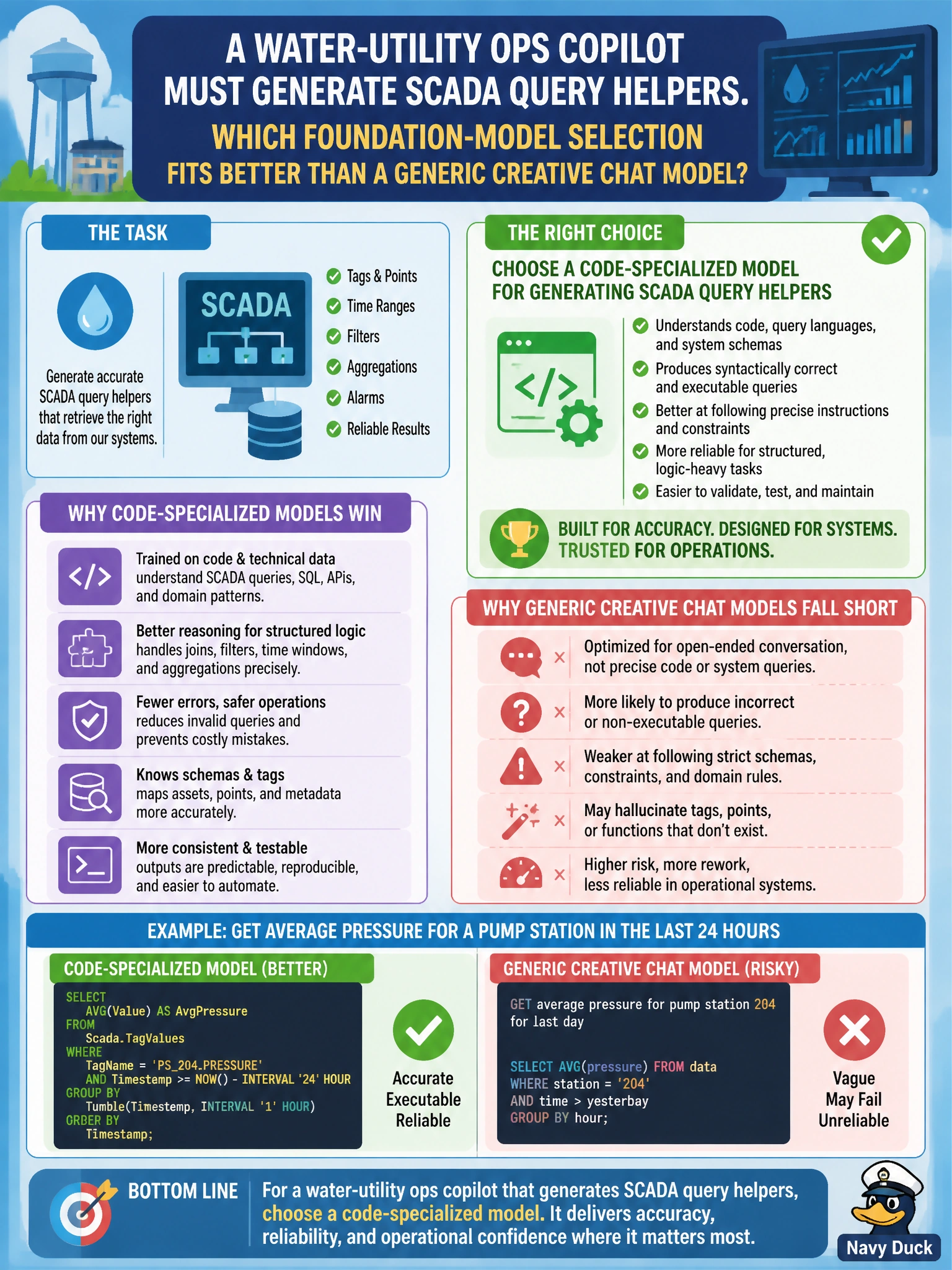
A water-utility ops copilot must generate SCADA query helpers. Which foundation-model selection fits better than a generic creative chat model?
Select an answer to reveal the explanation.
Short Explanation
SCADA helpers need fresh queries generated, not a code-summarization model that's built to describe existing code. Point your water-ops copilot at a code-specialized foundation model. It's built for syntax.
Full Explanation
Choosing a code-specialized foundation model for generating SCADA query helpers is the correct selection for a water-utility ops copilot, rather than a code-summarization model. Code-oriented models are trained and tuned for structured programming tasks—syntax, APIs, and query patterns—so they better draft SCADA helper snippets and reduce hallucinated control logic compared with code-summarization models, which optimize for explaining existing code in natural language rather than emitting executable queries. Municipal water GenAIOps should match model specialty to the technical artifact being generated while still wrapping outputs with human review and operational safeguards.
Choosing a code-summarization model for generating SCADA query helpers fails because code summarization is trained to explain existing code in natural language, not to produce structured query syntax, and can omit critical operators or conditions needed for safe SCADA queries. Choosing a code-embedding model for generating SCADA query helpers fails because code embeddings are designed for semantic similarity and retrieval, not for generating syntactically valid query code. Choosing a code-translation model for generating SCADA query helpers fails because code-translation models are tuned to convert code between programming languages, not to generate the precise structured syntax and query patterns required for SCADA helper generation.
Exam caveat: model specialty (code generation vs code summarization vs code embedding vs code translation) is a first-class selection axis on AI-300-style items. When the stem contrasts SCADA/query helpers with code-summarization, code-embedding, or code-translation variants, pick the code-specialized model.
Operational check: evaluate candidate code-specialized models on representative SCADA helper prompts offline, require operator review before any query runs against production systems, and keep the copilot identity least-privileged to data sources.
Prefer to study offline? Printable PDF study book + test engine ($7.50, unofficial). These questions stay free here.