
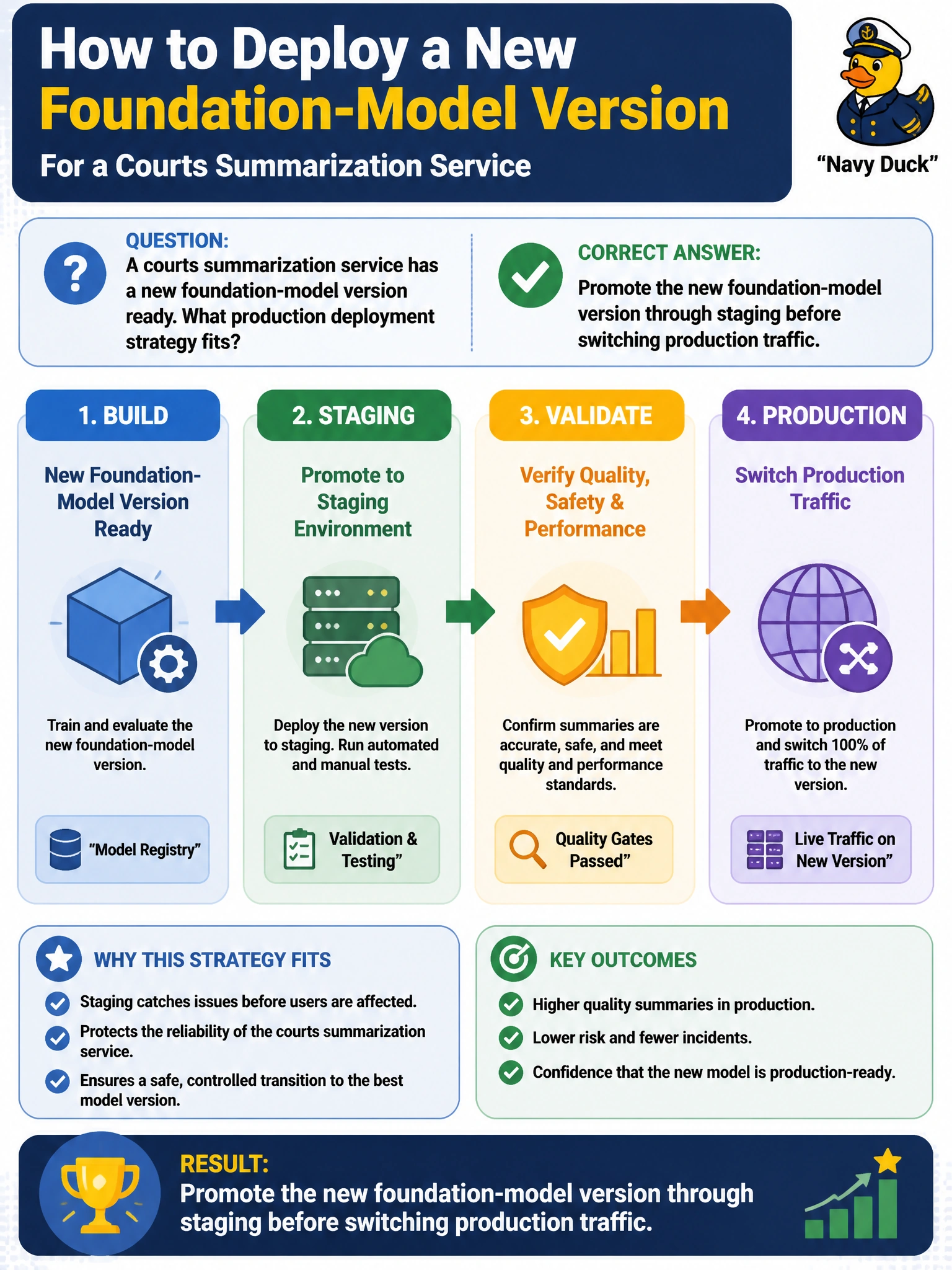
A courts summarization service has a new foundation-model version ready. What production deployment strategy fits?
Select an answer to reveal the explanation.
Short Explanation
New model versions earn their stripes in staging first. You'll shelve the improvement if you promote the prior version through staging since production never gets the new model.
Full Explanation
Promoting the new foundation-model version through staging before switching production traffic is the correct production deployment strategy for a courts summarization service. Staged promotion lets municipal GenAIOps validate summarization quality, safety filters, latency, and integration against court-like workloads in staging, then cut production traffic only after evidence passes. That protects docket-facing users from untested model behavior while still allowing the service to adopt improved FM versions deliberately. Promoting the prior foundation-model version through staging before switching production traffic fails because it re-validates the old model and never deploys the ready new version, so production sees no improvement. Promoting the new foundation-model version through staging before switching development traffic fails because development traffic does not serve docket-facing users, so the production service never receives the validated new version. Promoting the new foundation-model version through staging after switching production traffic fails because it reverses the safe order and exposes production users to unvalidated behavior before staging evidence passes. Exam caveat: staged promotion is the default safe production strategy; canary/dual-run is a related pattern when policy requires side-by-side comparison for a period. When the stem simply says a new FM version is ready and asks for production strategy, choose promote-through-staging first. Operational check: deploy the new FM version to staging, run courts summarization evals and integration checks, retain the prior production version until cutover succeeds, then switch production traffic and watch quality/latency dashboards.
Prefer to study offline? Printable PDF study book + test engine ($7.50, unofficial). These questions stay free here.