
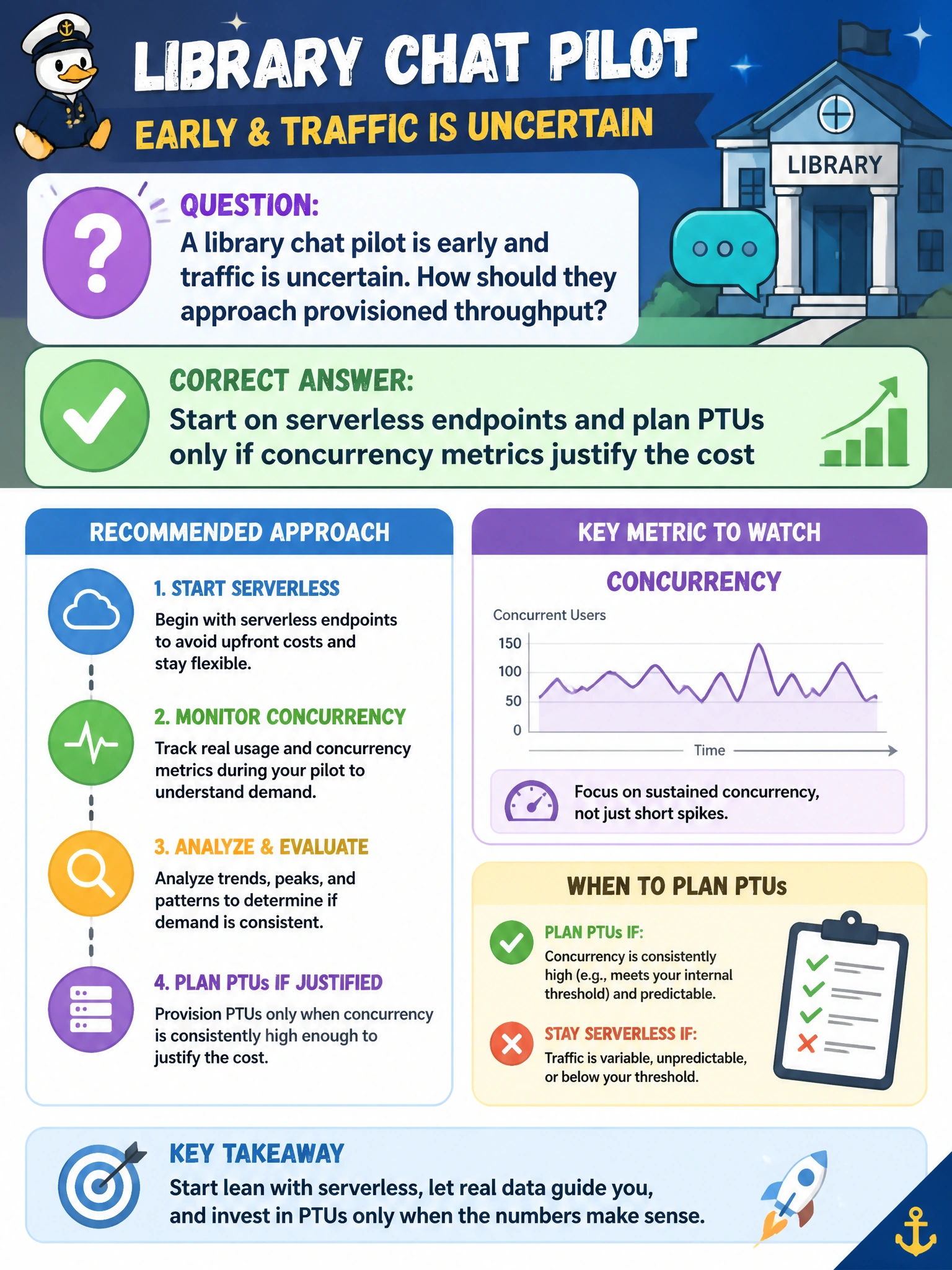
A library chat pilot is early and traffic is uncertain. How should they approach provisioned throughput?
Select an answer to reveal the explanation.
Short Explanation
Don't reserve a modest PTU deployment for an empty reading room. Start serverless, then add PTUs when concurrency numbers prove the library needs them.
Full Explanation
Starting on serverless endpoints and planning PTUs only if concurrency metrics justify the cost is the correct provisioned-throughput approach for an early library chat pilot with uncertain traffic. Serverless lets the library learn real concurrency and latency without reserving a modest PTU deployment upfront to ensure stable latency during the pilot. PTUs become appropriate after measured concurrency, SLA risk, or quota pressure shows reserved throughput is cheaper or more reliable than continued best-effort consumption—an evidence-based FinOps path for municipal GenAIOps.
Reserving a modest PTU deployment upfront to ensure stable latency during the pilot fails because it spends reserved capacity before demand is known. Configuring autoscaling on PTU quota to handle uncertain pilot traffic spikes automatically fails because PTUs are reserved capacity, not an automatic scaling layer, and it locks in fixed cost before the pilot proves demand. Estimating pilot PTUs from total token volume and average request latency trends fails because those are not concurrency metrics and do not show reserved throughput is justified over serverless.
Exam caveat: this is the complement to storm-surge PTU questions—uncertain early pilots start serverless; known high-volume SLA events reserve PTUs. Read whether the stem stresses uncertain pilot traffic versus forecast surge.
Operational check: launch the library pilot on serverless, collect concurrency/latency/cost metrics over a representative period, and only then raise a PTU request with those numbers attached.
Prefer to study offline? Printable PDF study book + test engine ($7.50, unofficial). These questions stay free here.